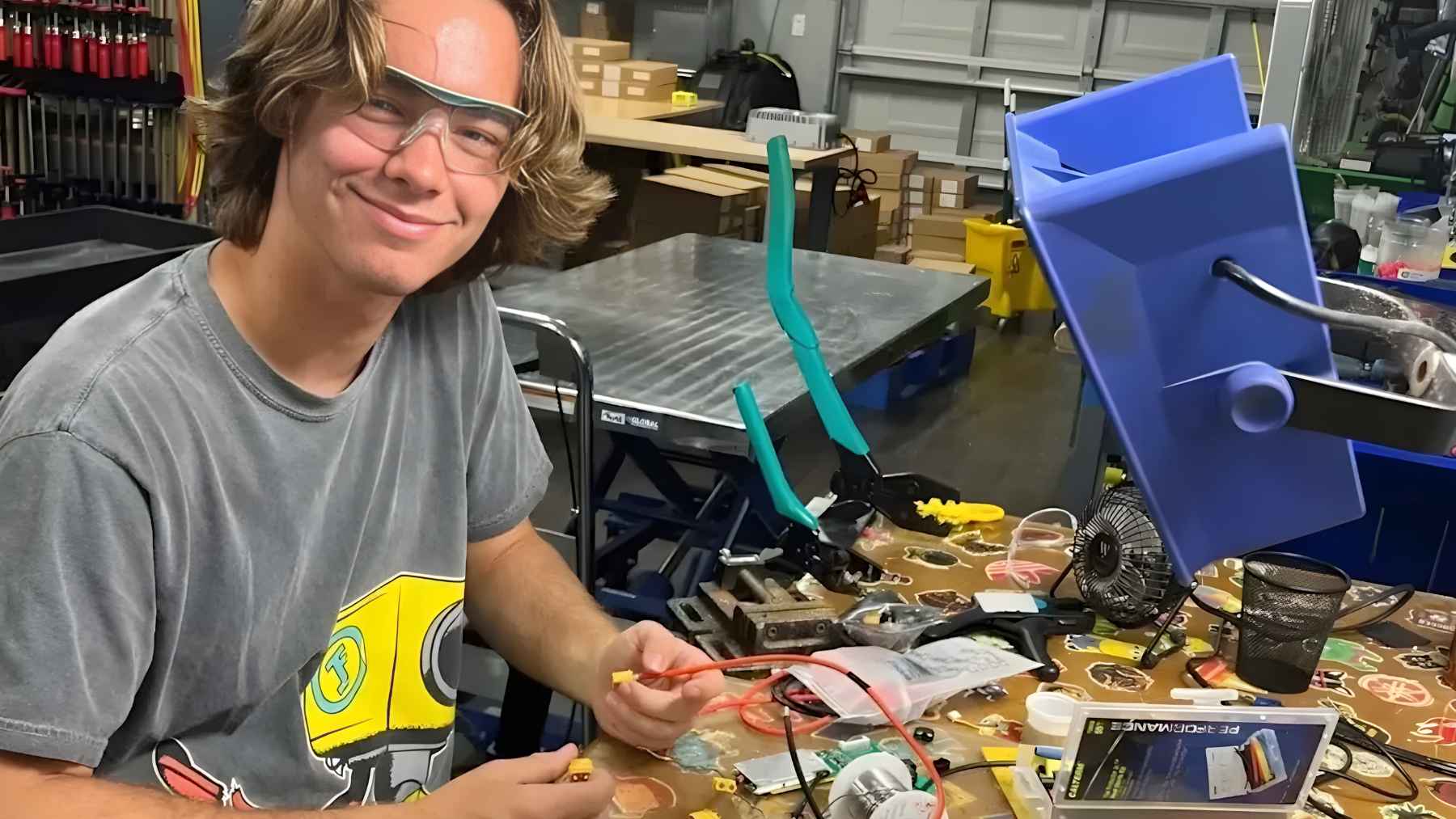
When a storm knocks out power, the first thing many people worry about is the fridge. In Palm Harbor, Florida, 19-year-old entrepreneur Noah Bild is betting that the next wave of backup power will look less like a gas can and more like a wheeled battery box called the OffGrid Pro, designed to run essentials without the noise and fumes of a traditional generator.
It is a compelling idea in hurricane country, where outages can shift from annoying to dangerous fast. So what do you need when the grid goes dark, a few critical devices or “business as usual” for the whole house?
The bigger story is what comes next, because portable batteries are entering a market that is growing quickly, tightening its safety expectations, and wrestling with a global supply chain that is anything but calm.
A garage startup with a hurricane deadline
Bild told FOX 13 that he started tinkering with batteries through hobbies like RC cars and one-wheeling, then spent about two years building his first commercial product in his home garage. He described the OffGrid Pro as “completely odorless, fumeless, silent,” and said last year’s hurricane season made the need feel personal in his own neighborhood.
He also said the unit can run a refrigerator for “2 to 3 days,” and that pairing it with solar panels can keep it going longer.
On the company’s website, BILD Power says the OffGrid Pro uses lithium iron phosphate (LiFePO4) batteries and lists 9,792 watt-hours of storage, split-phase 120- and 240-volt output, and solar charging support with input listed up to 3,700 watts.
The same listing shows a product weight of 128.5 kilograms, which is about 283 pounds, so “portable” here usually means rollable or a two-person lift.
The price point is also central to the pitch. FOX 13 reported that Bild aims to compete with the Tesla Powerwall at about half the cost, and BILD Power lists an offer price of $3,995 on its site as of publication.
Why batteries are beating generators
Gas generators are common, but they come with risks that spike during outages. The U.S. Centers for Disease Control and Prevention warns that carbon monoxide from fuel-burning equipment is a deadly hazard during power disruptions, and its public messaging notes that carbon monoxide kills more than 500 Americans each year.
That is where quiet, indoor-capable battery storage starts to feel less like a luxury and more like a practical safety upgrade. Bild’s claim is that a battery-based system can keep basics running without exhaust, without fuel runs, and without that constant engine roar that keeps the whole street awake.
Still, it helps to keep expectations grounded. Whole-home backup is a different problem, especially if you expect to run central air conditioning or electric cooking for days, and solar only helps if you have enough panels and usable sun.
NOAA research also suggests tropical cyclone rainfall rates will rise in a warming world, with modeling studies pointing to about a 14% increase in rainfall rates averaged within about 62 miles of a storm for a scenario with roughly 3.6 degrees Fahrenheit of global warming.
A fast-growing market with real constraints
The OffGrid Pro is arriving while batteries move from niche to mainstream across the U.S. energy system. The U.S. Energy Information Administration says utility-scale battery storage capacity exceeded 26 gigawatts in 2024, and developers planned another 24 gigawatts of utility-scale battery additions in 2026 after a record year in 2025.
Residential storage is rising quickly too, driven largely by resilience concerns and a widening range of products. Wood Mackenzie reported that the U.S. residential market hit a record in 2025 with 2.7 gigawatts installed, up 92% from 2024, which helps explain why startups and legacy brands are racing to get products in front of homeowners.
But batteries are not just an engineering story – they are a supply chain story. Reuters reported that U.S. battery storage installations grew to 58 gigawatt-hours in 2025, and that the industry still relies heavily on imported components, with shifting trade rules and restrictions on some foreign-linked supply chains adding uncertainty for manufacturers and buyers alike.
Certification and trust
If you have ever shopped for a generator, you know the anxiety that sits under the purchase. You are spending real money on something you hope you never need, and when you do need it, you cannot afford surprises.
That is why one of the most important lines in FOX 13’s report came from Bild’s mother, Traci Bild, who said the team has been talking with “certification groups” about what electrical standards they need to meet. In a market tied to home wiring and indoor use, trust is not a marketing add-on – it is the product.
UL’s testing and certification guidance for energy storage lays out what that trust usually looks like in practice, including UL 9540 for energy storage systems, plus key related standards such as UL 1973 for batteries and UL 1741 for inverters and interconnection equipment.
For buyers, those numbers are not trivia – they are a quick way to separate a serious product from one that only looks serious online.
What to watch next
Bild has talked about taking the OffGrid Pro beyond homes and into municipal use, and that direction makes sense given how emergency response actually works.
The U.S. Department of Energy has highlighted microgrids as a pathway to keep power flowing during disruptions that can last days or even weeks, and portable storage can act as a building block for local resilience when paired with solar and smart controls.
There is also a national security angle that rarely shows up in consumer product launches, but it is there.
U.S. law calls for the Department of Defense to ensure that, by the end of fiscal year 2030, critical mission energy loads at military installations meet a minimum availability level of 99.9%, which is one reason defense planners keep pushing microgrids and layered backup systems instead of relying on a single solution.
For households, the takeaway is simple but easy to skip when you are scrolling product pages. Ask what you need to power, ask how long you need it, and look for credible safety certification and a code-compliant way to connect it, because “backup power” is only comforting when it is also safe.
The latest federal battery storage outlook was published on the U.S. Energy Information Administration.