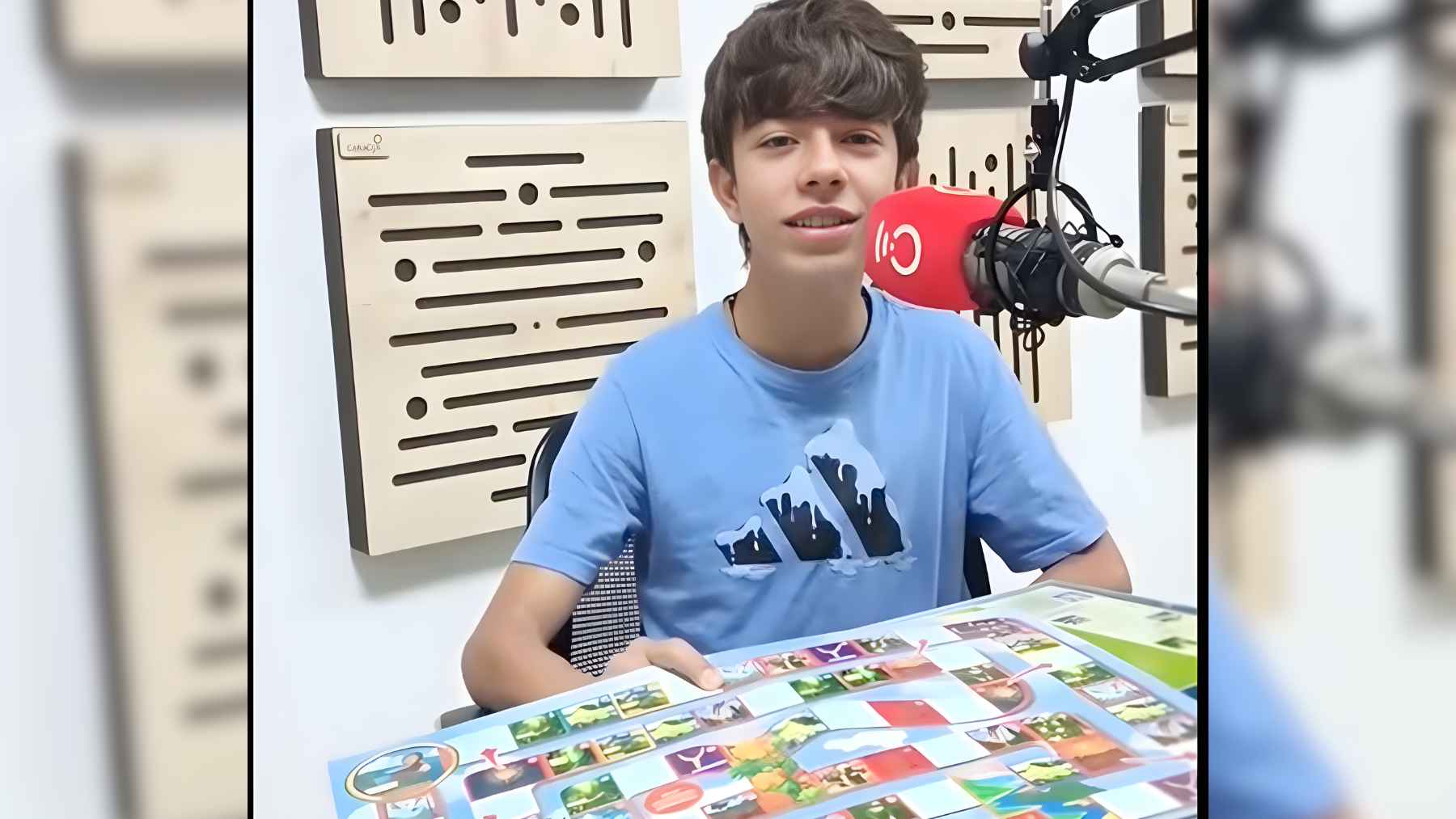
A 14-year-old in Colombia’s Quindío department has designed a board game that does not try to compete with mobile apps. Instead, it tries to pull kids away from screens and push them toward the birds they can already hear outside their windows.
In an interview with Caracol Radio, Andrés Felipe Navarro, known on social media as “Pipe corre y vuela,” said his game “Volando por los Andes” was built to help children, teens, and adults learn about local birds and the threats they face, then practice simple actions to protect them.
A game with purpose
Navarro told Caracol Radio his interest in birds took off after meeting a classmate, Alejandro Williams, who could identify species just by their songs. From there, he started birdwatching and says he has spotted “more than 500” and “almost 600” birds across Quindío and beyond.
That curiosity turned into product design. He spent about a year sketching, testing ideas, and rebuilding the rules so the game stayed fun while still teaching, something he says ordinary talks could not always deliver.
“Volando por los Andes” borrows familiar mechanics from classic board games like Monopoly and Snakes and Ladders, then swaps generic tokens for birds.
Players choose from six Andean species, including the Andean condor, torrent duck, yellow-eared parrot, multicolored tanager, and the “gallito de roca,” turning each move into a small prompt to talk about habitats and behavior.
Why offline matters
When friends suggested he should make a video game, Navarro went the other way. He argued that a board game is easier to use in rural schools, and that he wants kids to stop being “stuck to the cellphone” and rediscover the habit of gathering around a table.
This is not just nostalgia. A 2023 systematic review in Frontiers in Psychology mapped research on analog game-based learning and found a broad body of studies exploring how tabletop games can support learning in classroom settings.
It is easy to miss how “low-tech” can be a strategic advantage. A physical game does not need accounts, updates, or Wi-Fi, and it creates a built-in social experience that can turn learning into something closer to a family ritual than a homework assignment.
Birds as local capital
Colombia is not short on birds, and that is part of the business story. BirdLife DataZone lists 1,873 bird species for Colombia, including 95 endemic species, numbers that help explain why the country is a global magnet for birders and biodiversity research.
That biodiversity is increasingly visible in citizen science and tourism campaigns. In a 2024 press release, ProColombia highlighted Colombia’s performance in the Global Big Day, reporting 1,558 species recorded in a single day, a snapshot of how much bird knowledge already lives in local communities.
Quindío itself sits inside that broader advantage. A peer-reviewed checklist published in Check List documented at least 543 bird species in the department, which helps explain why the region can support both education projects and eco-tourism at the same time.
Threats on the board
Navarro’s game is not only about naming birds. He builds “bad squares” into the route where birds hit windows after mistaking reflections for forest, or where they are trapped and kept in cages because people like hearing them sing nearby.
In the radio interview, he used a blunt rule of thumb, saying 80% of birds that collide with windows die. Scientists debate the exact fatality rate by species and setting, but the direction of travel is clear – collisions are not a minor problem, especially when glass-heavy design spreads into more places.
One 2024 study in PLOS ONE looked at birds injured by building collisions and found that only about 40% survived even after receiving rehabilitation care. That kind of number lands differently once you picture the ordinary places it can happen, an office lobby, a glass balcony, or even a bright patio door at home.
From hobby to microbusiness
Navarro told Caracol Radio the game sells for 60,000 Colombian pesos, which works out to about $16.63 at Colombia’s representative market exchange rate of 3,608.1 pesos per $1 on April 14, 2026. He stressed that the point is not personal profit, but using the money to travel to rural schools and run workshops where kids can learn by playing.
Distribution, for now, is also simple. He asks interested buyers to message him through Instagram or TikTok under the “Pipe corre y vuela” name, a reminder that social media is not only a distraction for teens – it is also a storefront.
There is a bigger market context here, too. One industry estimate put the global playing cards and board games market at about $19.9 billion in 2024, with further growth projected over the rest of the decade, which helps explain why small, mission-driven projects can sometimes find surprising demand.
What happens next
The next test is impact, not attention. If “Volando por los Andes” keeps expanding into schools, educators will want to know what changes after the game hits the table, whether students retain bird knowledge, talk differently about cages and habitat, or persuade their families to plant trees.
There is also room to iterate without losing the offline advantage. New expansions could add regional birds, local threats, or teacher guides, and a bilingual rule sheet could help the game travel beyond Colombia while still keeping its roots in the Andes.
At the end of the day, Navarro’s bet is simple. If learning about nature feels like play, more people may choose to protect what is already in front of them, even on an ordinary afternoon when the phone is buzzing and the birds are singing.
“The press report was published on Caracol Radio.