Scorpio Tankers is placing a real wager on nuclear power at sea, backing U.S. startup AMPERA with a $10 million investment to help develop “micronuclear” energy systems for ports, offshore sites, and eventually commercial ships. The pitch is bold and simple. Keep vessels running far longer without diesel refueling while cutting carbon emissions at the same time.
This is not happening in a vacuum. Global shipping is under growing pressure to decarbonize, and fuel is the industry’s giant recurring headache, like a household electric bill that never stops climbing.
The big takeaway is that nuclear, long associated with submarines and aircraft carriers, is creeping back into mainstream maritime planning, but only if regulators, insurers, and port authorities can be convinced it belongs there.
A real-world push for nuclear at sea
In its announcement, Scorpio Tankers said the partnership aims to develop and commercialize nuclear power solutions for marine and shipping markets, starting with floating nuclear power barges and later moving toward nuclear-powered vessels.
Scorpio will act as the market lead for maritime applications, while AMPERA provides its reactor technology and works on commercial models like leasing and long-term service agreements.
This matters because Scorpio is not a small operator testing a science project. The company says it owns 89 product tankers with an average age of 10.1 years, which puts it squarely in the real world of refits, regulations, and cost control. If a tanker owner is exploring nuclear, others across the industry will at least pay attention.
Shipping’s climate math helps explain why. The International Maritime Organization has warned that ships currently burn about 350 million metric tons of fuel oil a year, which is roughly 386 million short tons. That is why the IMO’s net-zero push toward 2050 keeps tightening the screws on fuel choices and long-term fleet planning.
What a containerized microreactor is supposed to deliver
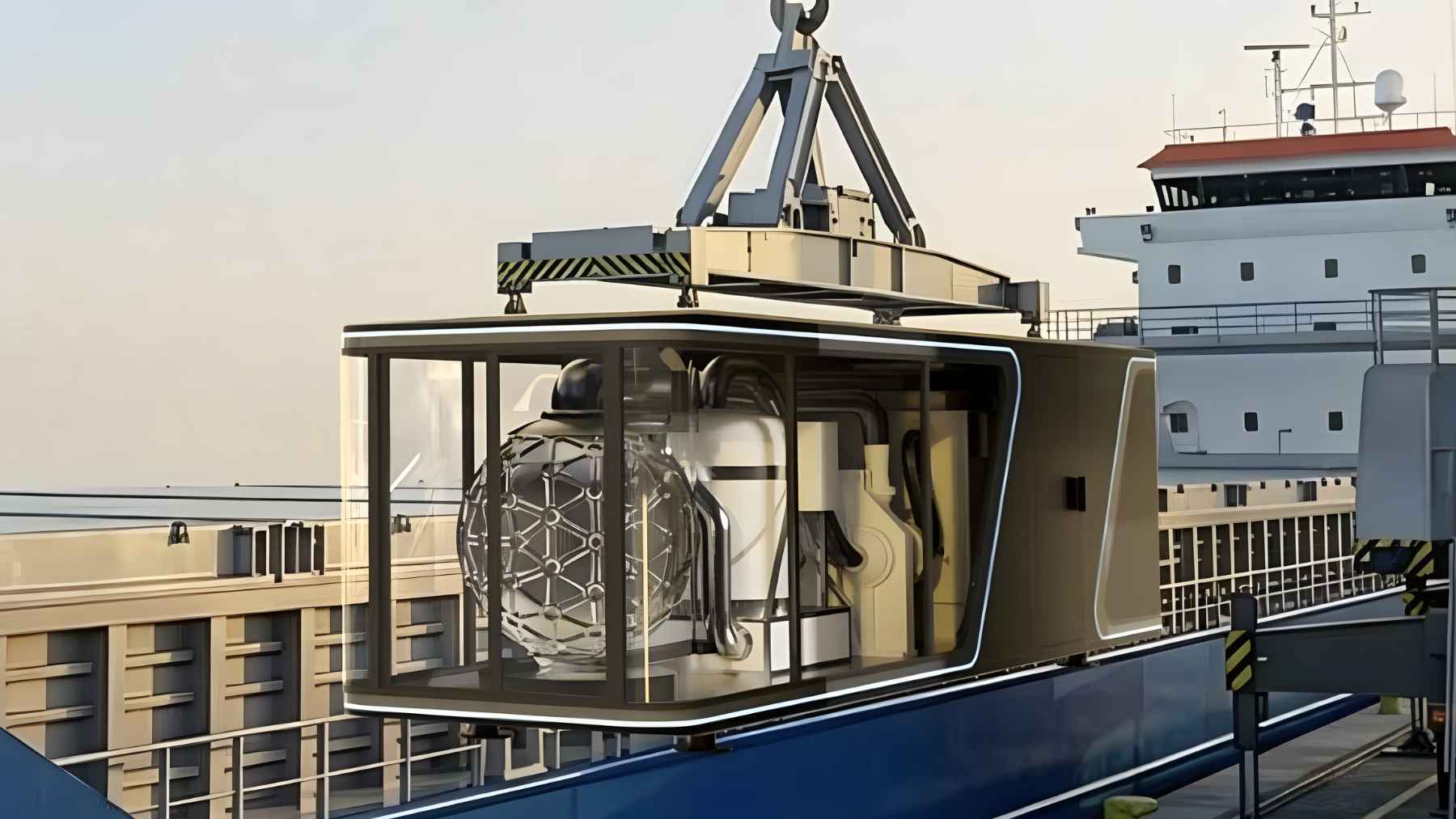
AMPERA describes its concept as a compact, containerized microreactor system using thorium in a subcritical, solid-state design that is “never refueled,” according to Scorpio’s press release. The company argues that sealing the core for decades could eliminate routine fuel handling, which is one of the biggest operational and security complications in nuclear.
The power levels being discussed are not tiny. Multiple reports describe AMPERA systems in the 15-to-30-megawatts electric range, enough to cover serious onboard loads depending on the vessel and operating profile.
POWER magazine’s reporting also lays out the core technical pitch, including TRISO fuel particles and a power conversion setup that uses supercritical carbon dioxide rather than relying on large volumes of cooling water.
Why does that detail matter to non-engineers? Because ship design is a constant fight for space, weight, and maintenance hours, and “no water for cooling” could simplify some layouts if it works as advertised. In everyday terms, it is the difference between adding a new system and having to rebuild half the engine room to keep it running.
Barges first, ships later
The near-term plan is telling. Scorpio and AMPERA say they want floating nuclear power barges first, then nuclear-powered commercial vessels over the longer term, along with offshore and port energy systems. Starting with barges effectively puts nuclear into a more controlled setting before it ever tries to cross oceans under commercial schedules.
A barge can also address a growing pain point for ports. As shipping tries to cut emissions in coastal cities, ports are being pushed to supply cleaner shore power so ships can reduce local exhaust while docked. If you have ever sat in traffic behind a diesel truck and felt that gritty air, you understand why port communities are demanding changes that are visible and immediate.
Then there is the business model angle, which may end up being as important as the reactor itself. Scorpio’s statement points to “power-as-a-service,” leasing, and long-term service agreements, suggesting a world where shipowners buy energy and uptime rather than becoming nuclear operators.
That sounds convenient, but it also raises practical questions about who holds responsibility for safety, maintenance, and end-of-life handling.
Regulation is finally catching up
This partnership lands right as U.S. nuclear regulation is changing in a way that advanced reactor developers have been asking for. The Nuclear Regulatory Commission says it has issued Part 53, a new, technology-inclusive licensing pathway designed to make advanced reactor reviews faster and more predictable while maintaining safety.
The NRC frames it as the first new reactor licensing process in decades, built to avoid forcing novel designs into older light-water rules.
Part 53 is not just a talking point. The NRC said the rule will take effect 30 days after it appears in the Federal Register, and the final rule publication process is already underway. That timing matters because companies planning demos and prototypes tend to align their technical milestones with the earliest plausible licensing steps.
AMPERA has publicly signaled it wants to use this pathway. World Nuclear News and POWER magazine report that AMPERA submitted a formal pre-application letter to the NRC on February 23, 2026, seeking to begin the pre-application process and requesting an initial meeting by the end of May.
That is still early-stage, of course, but it is the kind of move that turns a concept into a regulatory file with dates and deliverables.
The hard parts that still decide everything
Even with a new licensing framework, maritime nuclear is not only a reactor question. It is also a port access question, an emergency planning question, and an insurance question, and those can be harder to standardize across countries than any piece of hardware.
DNV, one of the major maritime classification voices, has argued that nuclear propulsion could be viable for decarbonization, but it also stresses that success hinges on credible regulatory pathways and business models that can scale through standardization and modularization.
Public acceptance can make or break timelines, too. Nuclear-powered ships are not unprecedented, yet they have largely been concentrated in military fleets and specialized roles, and the World Nuclear Association notes that most nuclear-powered vessels are submarines, with surface examples like icebreakers and aircraft carriers.
Asking a commercial port city to host a floating reactor is a different social and political test, even if engineers say the design is “ultra-safe.”
So what should readers watch next? The clearest signals will be concrete milestones, including NRC engagement under Part 53, demonstration work on bargelike deployments, and whether shipping regulators and classification bodies begin treating microreactors as a real design pathway rather than a futuristic footnote. Big idea, hard execution.
The press release was published on Scorpio Tankers.