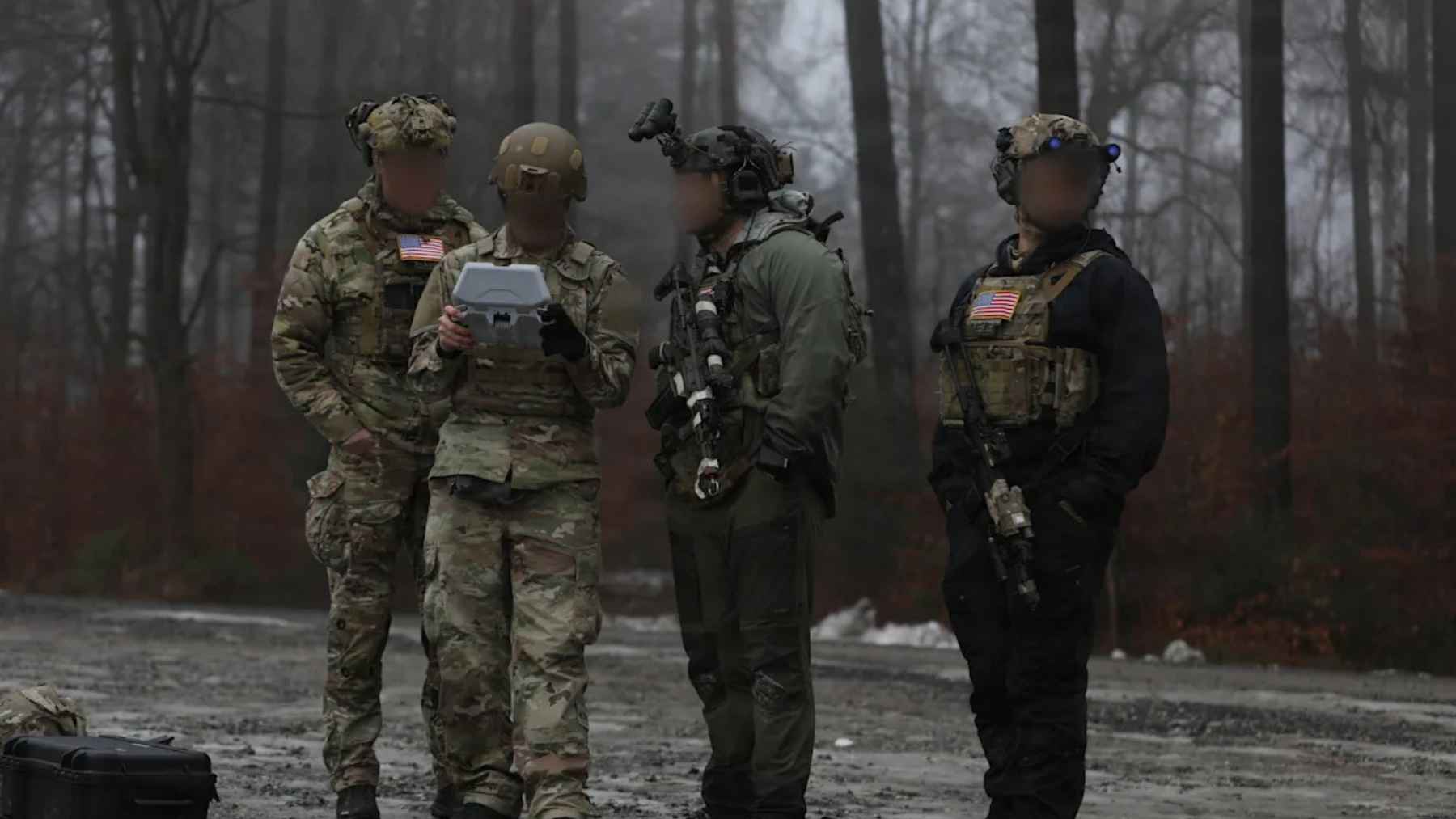
A dramatic U.S. personnel recovery mission in southern Iran is now at the center of an even more dramatic claim. Reports say the CIA used a secret tool called “Ghost Murmur” to locate a downed U.S. airman by detecting the magnetic signal of his heartbeat from about 40 miles away.
Scientists who study magnetic fields are not buying the story as described. Their view is blunt but important. The rescue appears real, but the public “quantum heartbeat detector” narrative looks wildly out of step with what decades of biomagnetism research says is physically feasible, even with AI-assisted signal processing.
The claim that set off alarms
The public storyline took shape after President Donald Trump and CIA Director John Ratcliffe hinted at a breakthrough technology tied to the rescue.
Then a report said the CIA deployed “Ghost Murmur” to find an airman hiding in rugged terrain. In that telling, the system uses “long-range quantum magnetometry” and AI to isolate a heartbeat signal from background noise.
Some of the most quoted lines read like spy-movie marketing copy. One source compared it to “hearing a voice in a stadium, except the stadium is a thousand square miles of desert,” and another promised, “In the right conditions, if your heart is beating, we will find you.”
What gets lost in the splashy language is what was already available to rescuers. Scientific American notes the rescue mission involved multiple aircraft and a survival beacon carried by the airman, which is a far more standard explanation for how someone gets found under pressure.
Why the heartbeat math collapses
Here’s the core problem, in plain terms. The heart does produce a magnetic field, and ultrasensitive instruments can measure it, but the signal is incredibly weak and drops fast with distance.
Vanderbilt University professor John Wikswo told Scientific American that even at roughly 4 inches from the chest, the heart’s magnetic field is barely detectable, and moving to about 3.3 feet away makes the signal about a thousand times weaker.
Now scale that out to battlefield distances. At around 0.62 miles away, Wikswo says the signal becomes dramatically weaker, which is before you even get to tens of miles. In other words, the gap between “possible in a specialized setup” and “possible from an aircraft across a wide region” is not a small engineering tweak.
Then there’s the noise problem – the kind you can’t wish away with a buzzword. Chad Orzel of Union College warned that any such sensor would be competing with Earth’s magnetic field and with magnetic signals from everyday life and wildlife, the “sheep and dogs and jackrabbits” of the world, not to mention power lines, vehicles, and electronics.
Even strong pattern matching would not conjure a signal that is not there.
What quantum sensors can really do
It’s worth separating the hype from the real science, because quantum magnetometers are not imaginary. They are being explored for medical uses such as magnetocardiography, which measures magnetic fields linked to the heart’s electrical activity, and researchers are building sensors around nitrogen-vacancy centers in diamond.
A recent preprint, “Human Cardiac Measurements with Diamond Magnetometers,” demonstrates non-contact detection of human cardiac magnetic signals using NV-diamond quantum sensors in several configurations. But it also spells out the catch.
The signals were averaged over hundreds to thousands of heartbeats, and the authors say that moving toward practical use outside shielded environments requires strong noise suppression.
Earlier work points in the same direction. A 2024 preprint on non-invasive magnetocardiography in a living rat reports capturing a cardiac signal using a room-temperature diamond quantum sensor, but the work is still built around careful experimental control and very small scales.
That’s impressive progress, yet it is a different universe from real-time detection of a single person from roughly 40 miles away.
Skunk Works, secrecy, and the business angle
Another reason this story spread so quickly is the brand name attached to it. Reports linked “Ghost Murmur” to Lockheed Martin’s Skunk Works, a unit famous for advanced aerospace development and for projects that stayed secret for years. That reputation can make almost anything sound plausible for a moment, especially during a fast-moving conflict.
But even Skunk Works credibility has limits if the physics is wrong. Bradley Roth, a physicist at Oakland University, told Scientific American that a helicopter-borne system doing what’s described would be “a revolutionary advance from the state of the art,” not a marginal improvement.
When experts start talking like that, they are not nitpicking – they are signaling that the claim would require an enormous leap beyond publicly demonstrated capabilities.
There is also a simpler explanation that fits how intelligence agencies operate. Orzel suggested the story could be someone “yanking a reporter’s chain,” or deliberate disinformation meant to hide what really worked, whether that was a beacon, signals intelligence, airborne surveillance, human sources, or some classified mix of all of the above.
If your goal is to keep adversaries guessing, a too-cool-to-be-true gadget can be a useful smokescreen.
The questions Washington still has to answer
So what should readers keep in mind right now? First, the strongest reporting and the strongest skepticism agree on one point. The rescue happened, but the “heartbeat from 40 miles away” mechanism has not been substantiated in any public technical way, and multiple physicists say the public version clashes with basic limits of magnetic sensing.
Second, the real stakes go beyond one mission. If long-range biometric detection ever became practical, it would reshape search and rescue, surveillance, and military targeting in ways that would raise obvious privacy and civil liberties questions, the kind that land on regular people the moment they leave their homes.
That is why extraordinary claims deserve extraordinary evidence, not just anonymous quotes and a catchy codename.
Finally, watch what comes next, not what sounds coolest today. If officials want the public to believe a breakthrough is real, they may eventually point to non-sensitive demonstrations, technical papers, or at least verifiable capability boundaries.
Until then, the most grounded takeaway is that quantum sensing is advancing, but the battlefield myth version is likely getting ahead of the science.
The study was published on arXiv.