If you have ever lived near a construction site, you know the routine. Jackhammers at dawn, dust on the windowsill, and that gritty feeling in the air that makes you wonder what you are breathing. Now some Chinese cities are testing an unusual fix: sealing entire building sites inside giant inflatable domes.
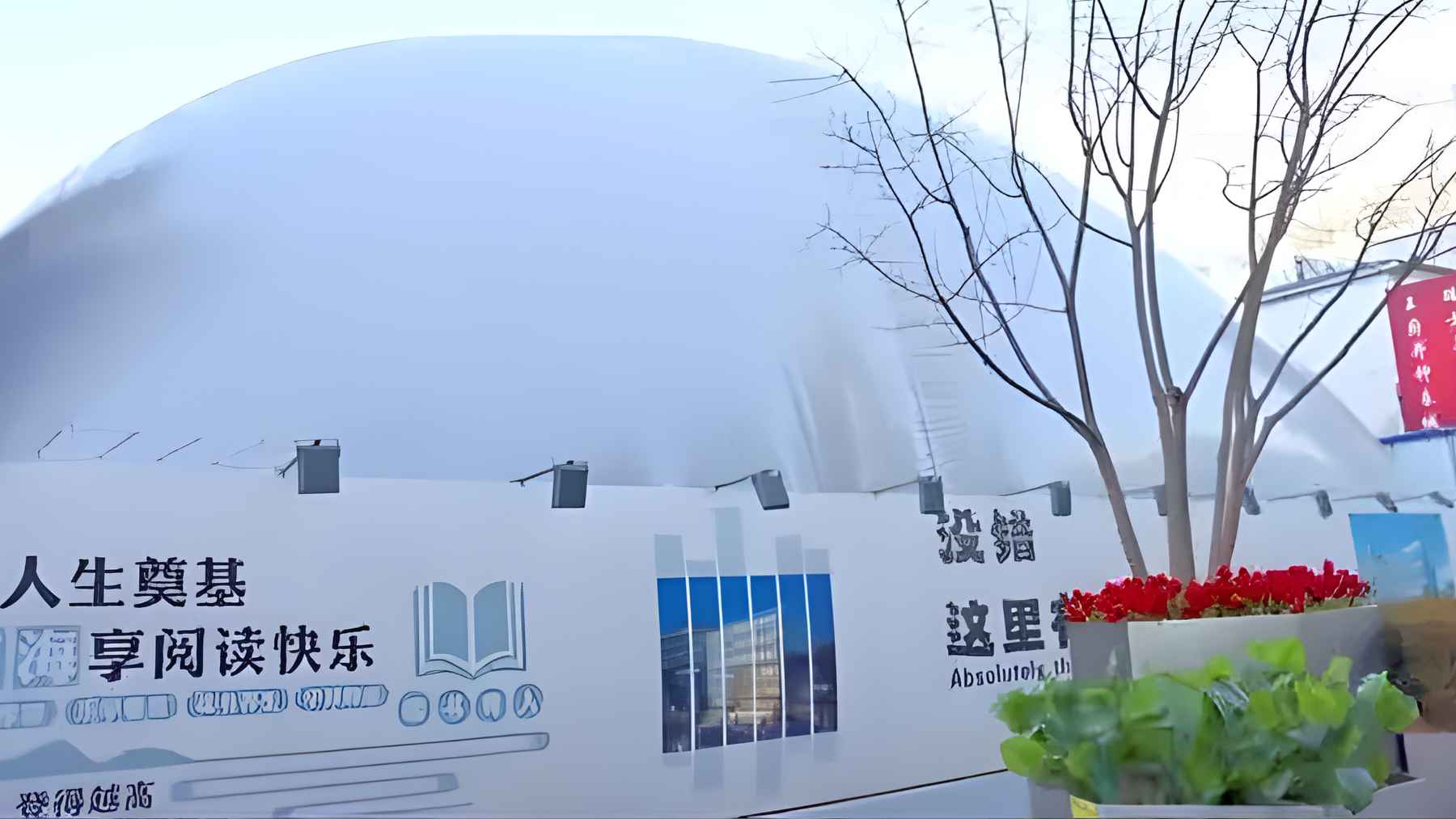
The best-known example is in Beijing’s Wangfujing shopping district, where a renovation of the Foreign Languages Bookstore is being done under a pressurized “air membrane” that works like a temporary indoor shell. District officials say the setup keeps noise below 50 decibels and blocks more than 95% of dust generated by cutting, drilling, and earthmoving.
A similar approach popped up in Jinan, capital of China’s Shandong province, where a roughly 164-foot-high inflatable dome covers about 19,966 square feet of a downtown redevelopment site called “Honglou 1905.” Technical notes cited by local outlets say the membrane uses PVDF, blocks around 90% of ultraviolet rays, and meets a B1 fire-resistance rating.
These domes are not a gimmick. They represent a shift in how cities think about construction disruption, treating dust and noise like controllable emissions rather than unavoidable side effects.
A bubble over one of Beijing’s busiest blocks
In Beijing, the appeal is obvious. Wangfujing is a high-traffic retail corridor, and construction next door can push shoppers away fast.
The inflatable dome works like an enormous temporary enclosure. If the seal is tight and ventilation is controlled, dust stays inside, meaning fewer gritty films on storefronts and less debris on sidewalks.
Noise is also part of the equation. Officials in Dongcheng district say the site’s sound level stays under 50 decibels, roughly the volume of a quiet conversation. That matters in dense areas where complaints can pile up and business owners demand action.
From Jinan to other dense cities, the same problem repeats
Jinan’s dome shows this can scale. A 164-foot structure covering nearly 20,000 square feet is not a small tent – it is a mini indoor environment built around a building site.
Reports say these systems can reduce surrounding noise by about 80%, which some outlets describe as a drop of around 40 decibels. Exact numbers depend on distance and where measurements are taken, but the point is to stop the sound before it spreads across blocks.
For residents, this is the everyday benefit. Fewer mornings woken by drills, less dust settling on balconies, and a better chance that a nearby project does not turn a neighborhood into a gritty wind tunnel.
Weather and logistics are the hidden cost drivers
The other promise is speed. Officials say working under a covered structure reduces weather disruption by up to 90% because crews do not stop for rain or strong winds.
That can shorten total schedules by about 20%, which is a serious number when developers are paying interest, renting equipment, and managing deadlines. It is also a reminder that “green” construction tech often sells best when it saves time and money.
But weatherproofing is not free. These domes need constant air pressure, monitoring sensors, and ventilation systems, which means power use and maintenance. In practical terms, that is another operating cost that will show up in the project budget.
Climate and safety questions are next
Cleaner sidewalks do not automatically mean cleaner air. If dust is trapped inside the dome, it still has to be filtered, removed, and disposed of, or it is simply concentrated in one place.
The key question is what happens to the particulate matter once it is captured. If filtration is weak, workers inside could breathe more of it, even if the neighborhood outside is spared.
Safety is another layer. A pressurized membrane has to handle wind loads, maintain fire resistance, and avoid sudden deflation. That is why the materials, backup power, and emergency procedures matter as much as the headline dust numbers.
What to watch if this goes global
In the near term, this looks like a China-first solution for ultra-dense commercial districts. But the idea travels well, especially as cities worldwide face stricter air rules and louder public pressure to keep neighborhoods livable.
The bigger bet is that construction firms will treat enclosure domes like modular equipment. If the cost is predictable, developers may decide it is worth it to reduce complaints, avoid weather delays, and keep projects moving.
At the end of the day, these inflatable “bubbles” are a simple idea with a big message. Cities still want to build, but fewer people are willing to tolerate months of dust and noise outside their front door.
The official statement was published by Beijing Urban Construction Group.