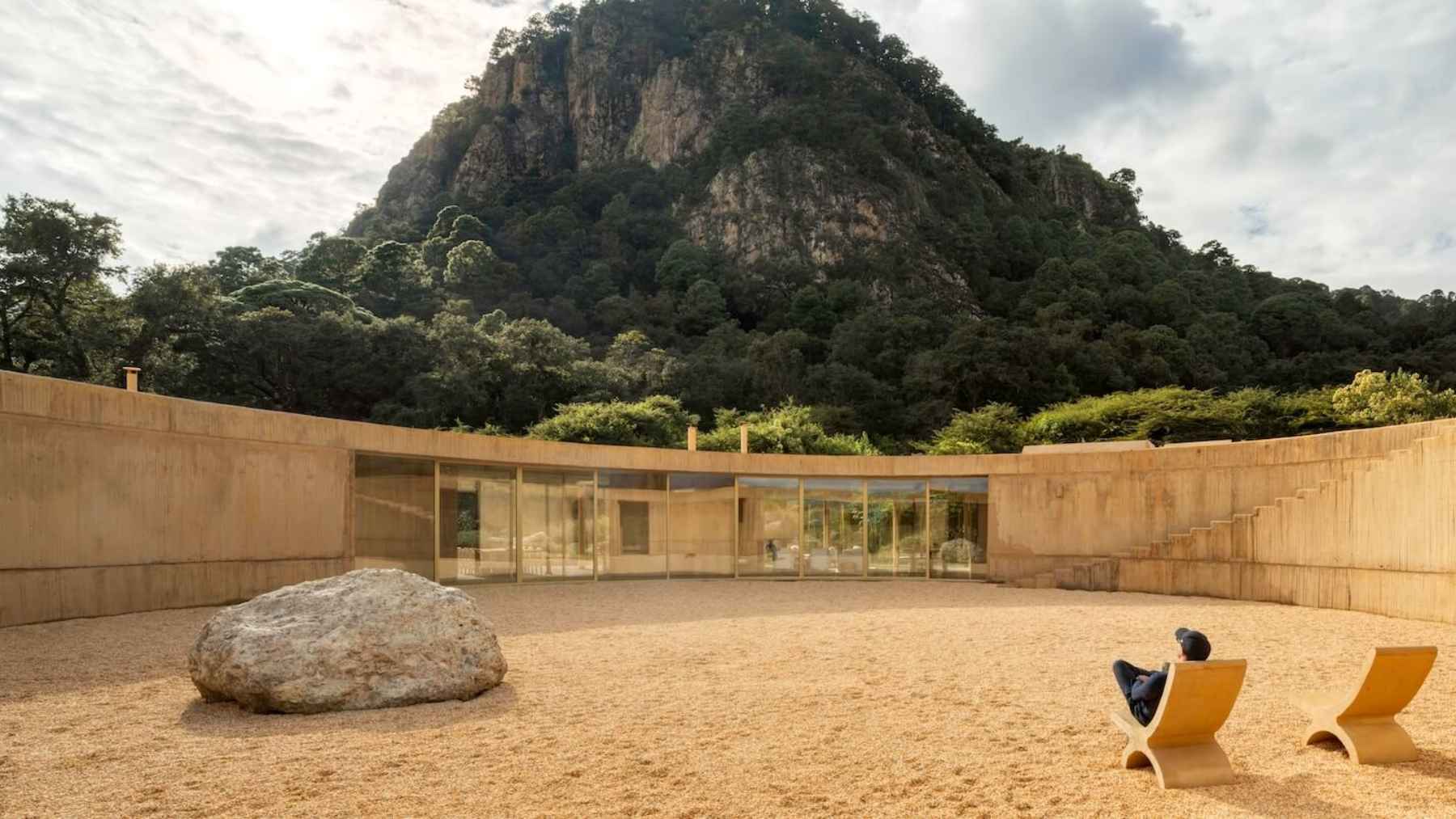
What if a house could behave a little more like a utility company, making its own electricity and banking water for later? In Mexico’s State of Mexico, architect Fernanda Canales has built a striking example called “Casa 720°,” designed for two families and engineered to work with the climate instead of fighting it.
The headline features are simple to grasp and hard to ignore. The residence captures rainwater, generates electricity with solar panels, and uses that solar system to heat water that feeds warm, hydronic radiant floors, all while leaning on natural cross-ventilation to keep interior spaces comfortable.
A self-sufficient home built for two families
Casa 720° is not a single monolithic structure. Project descriptions break it into three volumes: a main circular house, a separate studio or guest room, and a rectangular wing with its own patio that holds extra bedrooms, storage, and services.
The sustainability package is equally direct. The house collects rainwater, produces electricity through solar panels, and uses the solar setup to heat water used throughout the home, including heated floors that circulate warm water beneath bedroom surfaces.
Even the finish choices are part of the strategy. The project is described as using local earth mixed with concrete and regional wood, plus durable materials meant to stand up to weather without constant repainting or re-coating, keeping long-term upkeep low.
Why off-grid features are moving from niche to necessity
This kind of design is showing up at a moment when buildings are under real scrutiny. By UN-backed estimates, the buildings and construction sector consumes about 32 percent of global energy and contributes roughly 34 percent of global CO2 emissions, which is why efficiency and on-site generation keep rising on the agenda.
Then there is the everyday pressure people actually feel. In January 2026, U.S. residential electricity averaged 17.45 cents per kilowatt-hour, according to the U.S. Energy Information Administration, and prices were up year over year, which helps explain why the monthly electric bill has become a recurring stress point.
Solar economics also help explain the shift. IRENA notes that solar PV module prices have fallen by around 90 percent since the end of 2009, which has made “generate some of your own power” a more realistic sentence than it used to be, even if local permitting and site constraints still matter a lot.
The geometry that makes the tech work
The name “Casa 720°” is not marketing fluff. The architect’s studio describes it as a “geometric and optical device” that doubles the usual 360-degree field of view, organized around a central patio that links indoor and outdoor life through screens, large folding windows, and framed vistas.
Published project notes add a clear day-night logic. The house is described as extroverted during the day, opening to long views that include a mountain and a volcano, and then turning inward at night around its circular courtyard, which changes how the same rooms feel over a 24-hour cycle.
That geometry is not just about aesthetics, either. Flexible openings and cross-ventilation are repeatedly emphasized in project descriptions, and the layout includes a primary level plus a roof terrace that functions as an extra living surface rather than dead space.
Building with the landscape, not against it
Multiple write-ups stress that the building is meant to feel anchored to its site. The structure is described as integrating into the terrain by sinking into the ground and drawing its material language from local earth mixed with concrete, helping it blend visually with the surrounding landscape.
The decision to break the project into separate volumes is also practical. By separating the main circle from a guest studio and an additional wing, the design responds to steep topography and aims to preserve existing vegetation instead of leveling the whole plot into submission.
And the climate constraints are not subtle. Project descriptions say the site can swing by about 54 degrees Fahrenheit in a single day and see rain dominate roughly half the year, which makes the “refuge but open” balancing act more than a poetic line.
What builders and investors should take away
Not every home can go this far on self-sufficiency, and not every region allows rainwater capture or off-grid systems without restrictions. Still, the broader lesson is modular: cross-ventilation, shading and flexible openings, and solar hot water are the kinds of moves that can scale from custom builds into mainstream design playbooks.
The “two families” premise also lands in a market reality that is getting harder to dismiss.
In the United States, Pew Research Center found that the share of the population living in multigenerational homes rose from 7 percent in 1971 to 18 percent in 2021, and the National Association of Realtors reported that 17 percent of home purchases in 2024 were multigenerational, a record in its tracking.
Finally, there is a materials story hiding in plain sight. The UN report flags how dependent construction remains on high-impact materials like cement and steel, which is why projects that reduce finishes, prioritize durability, and use local materials are increasingly viewed as more than just design choices.
The official project statement was published on Fernanda Canales Arquitectura.