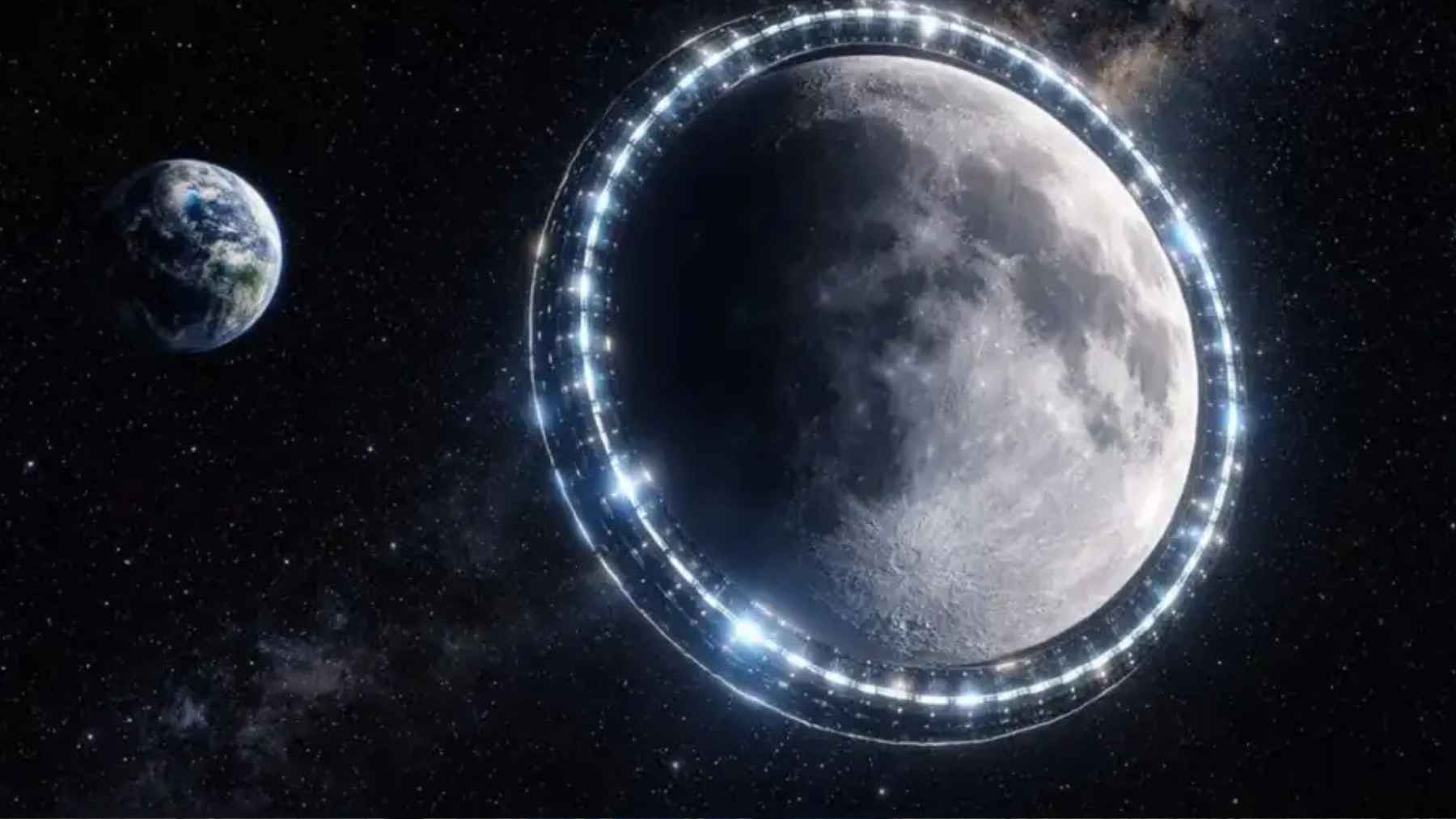
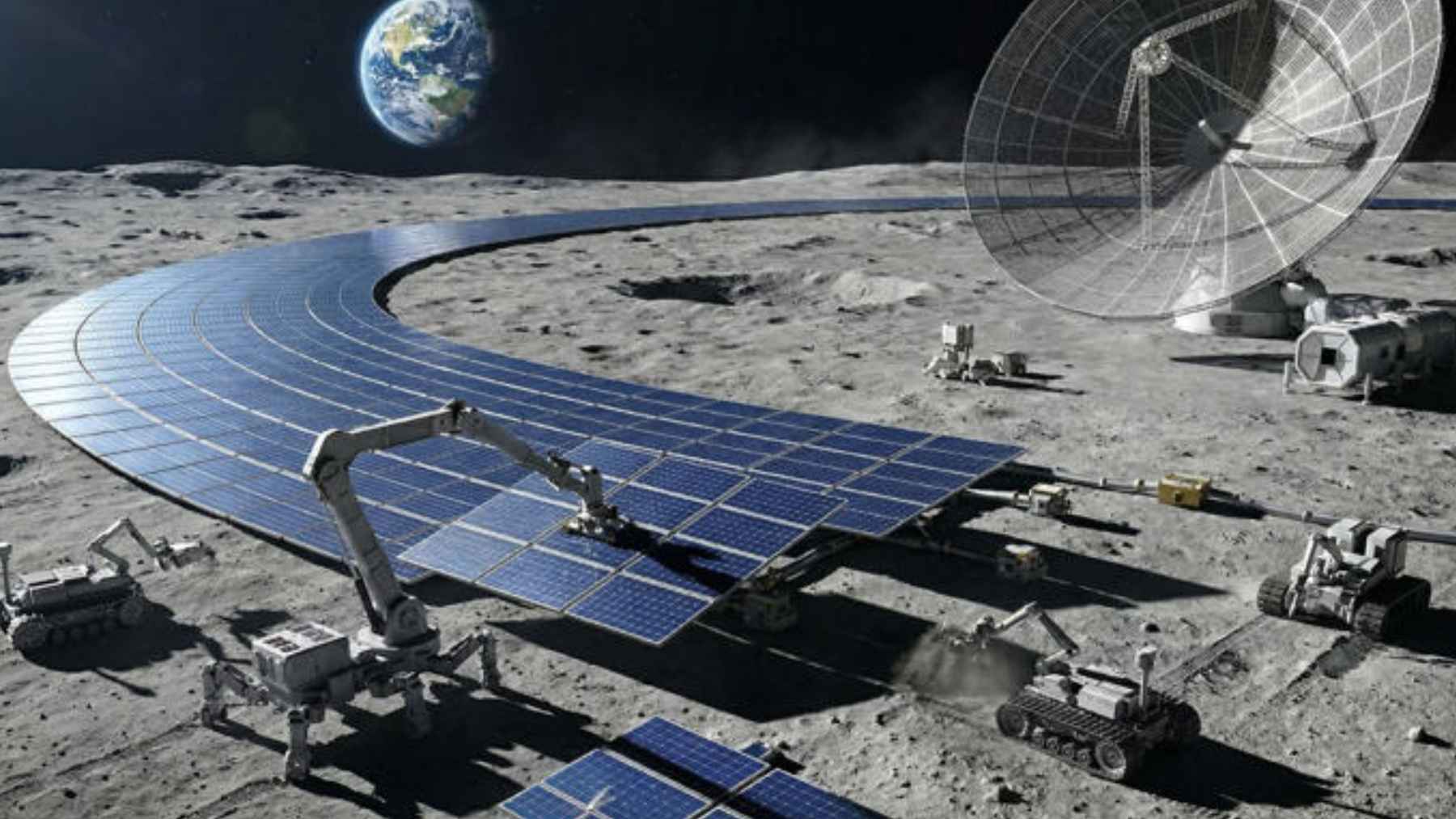
Japan is flirting again with an idea that sounds like it belongs in a science-fiction movie. A Japanese construction firm, Shimizu Corporation, has published concept materials for a “Luna Ring,” a belt of solar panels wrapped around the Moon’s equator that could generate power continuously and beam it back to Earth.
The big takeaway is simple and a little sobering. The Moon may be a perfect place to collect sunlight, but getting usable electricity safely and cheaply into the grid, the same grid that keeps your lights on and your electric bill climbing, is still the real bottleneck.
Luna Ring in a nutshell
Shimizu’s concept envisions solar cells stretching all the way around the lunar equator, which is roughly 6,800 miles long. In its own description, the belt could be as narrow as a couple of miles in some areas and as wide as about 249 miles at the largest sections.
The headline promise is “continuous, 24-hour power generation” because the Moon has no weather and no clouds to dim sunlight the way they do on Earth. Shimizu frames it as a step toward a future where clean energy is abundant enough to support a new “sustainable society.”
A key detail is that this is presented as a “Dream” concept, not a funded public works project with contracts and a build schedule. In earlier reporting, Shimizu’s adviser Tetsuji Yoshida said construction could start by 2035 if funding materialized, but he also acknowledged cost and timelines were still uncertain.
Why the Moon looks like a solar cheat code
On Earth, solar power has a familiar problem. Night falls, clouds roll in, and output drops, sometimes right when demand spikes and everyone turns on their air conditioner. That intermittency is why storage and grid upgrades matter so much.
On the Moon, the pitch is that sunlight is more reliable because there is effectively no atmosphere to block it. Yoshida told ABC News that even in ideal conditions, Earth-based solar panels can generate only “one-twentieth” of the energy produced in outer space.
Not everyone uses the same multiplier, and that is worth noticing. Caltech, which has tested key pieces of space solar hardware, has said space solar power could “potentially” yield eight times more power than solar panels “at any location on Earth’s surface,” depending on assumptions and design.
Getting that energy back to Earth
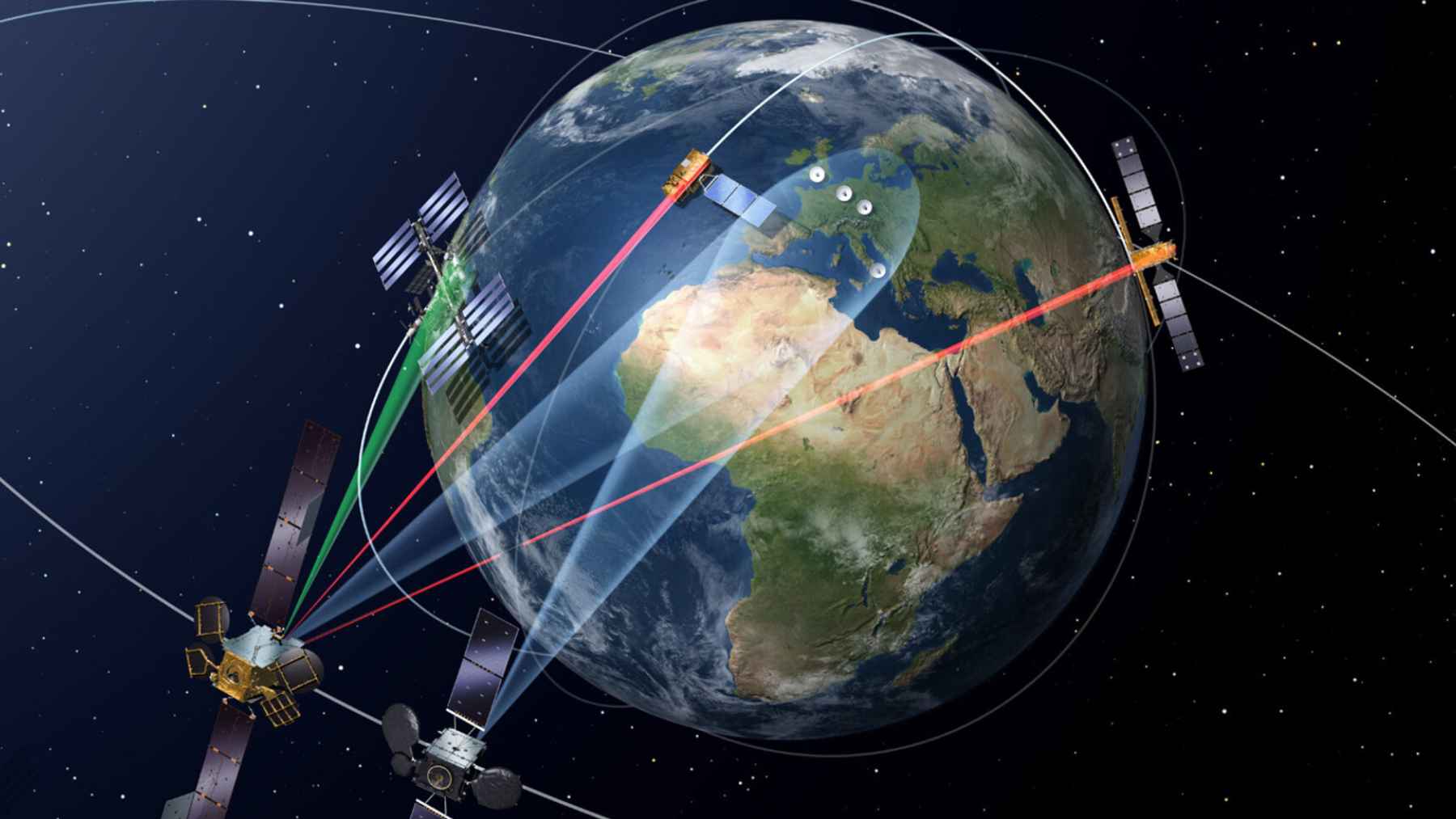
Shimizu’s pathway is straightforward on paper. Solar cells convert sunlight to electricity, cables move that electricity to the Moon’s Earth-facing side, and then transmission sites convert it into microwaves and laser energy aimed at receiving stations on the ground.
Those ground stations include “rectennas,” short for rectifying antennas, which convert microwave energy back into electric power. Shimizu also says the receiving side could convert the incoming energy into hydrogen for fuel and energy storage, which is one way to turn a steady energy stream into something shippable.
It is easy to picture it like a giant space charger for the planet. But in practical terms, you are talking about precision pointing, conversion losses at multiple steps, and the need to integrate output into national grids that already struggle with transmission constraints.
Power beaming is still a science project
The good news is that pieces of this have moved from theory into experiments. NASA’s 2024 space-based solar power report notes that beaming electricity from space to ground was first demonstrated in June 2023, but at a very small experimental scale.
Caltech’s Space Solar Power Demonstrator adds detail to what “small scale” really means. In 2023, Caltech reported that its MAPLE experiment could wirelessly transmit power in space and that a signal was detected on a campus rooftop receiver on May 22, showing basic end-to-end detectability.
Japan has also tested the guidance and control side that real power beaming would depend on. JAXA described a ground demonstration of microwave wireless power transmission using a 5.8 GHz system, with about 1.8 kW transmitted over roughly 180 feet, and even noted the test had to be postponed earlier because of rain.
The “no clouds” advantage does not help much if the receiver hardware still lives on Earth.
Robots, regolith, and lunar industry
Even if power beaming works, there is still the construction problem. Yoshida told ABC News the project would “largely rely on robots” for building, with astronauts supporting them on site, which is a realistic admission of how hard and expensive human labor is beyond Earth.
Shimizu’s concept leans heavily on using local resources to avoid hauling everything from Earth. Its materials describe “moon sand” as an oxide compound and claim that with imported hydrogen, operations could produce water and oxygen, and potentially make concrete, ceramics, glass fiber, and even solar cells from lunar materials.
That is the part where readers should pause and ask a simple question. Do we have the industrial base on the Moon to do that at meaningful scale yet, or is it still a research ambition? Shimizu’s own framing is aspirational, and the gap between a prototype plant and a 6,800-mile production line is enormous.
The bill for all this is the big unknown
The Luna Ring’s biggest obstacle has never been a lack of sunlight. It has always been cost, and even supporters say the numbers are not pinned down.
In 2011, Yoshida said he did not have a concrete cost estimate for the Luna Ring, while an energy economist interviewed by ABC News argued the approach “costs too much” and urged focusing on nearer-term alternatives like geothermal.
NASA’s more recent assessment shows why sticker shock keeps returning in these discussions.
Its 2024 report points out that NASA feasibility studies in the 1970s and 1990s found space-based solar power “prohibitively expensive,” including a $1 trillion estimate in then-year dollars for a demonstration in the 1970s and a $250 billion estimate in then-year dollars for the first commercial kilowatt in the 1990s.
Those are not prices you “value engineer” away with a better spreadsheet. To a large extent, the economics depend on major cost declines in launch, autonomous assembly, high-efficiency conversion, and safe power-beam operations, all at once.
Why this matters for business and security
There is a reason this idea keeps resurfacing. Space-based solar power research activity is rising, and NASA notes that publications on the topic nearly doubled from 2018 to 2022, with work concentrated in places like China, the U.S., the European Union, Japan, and Russia.
It is also not purely a civilian story. NASA’s report highlights that U.S. federal research includes efforts tied to power beaming, including DARPA’s POWER program for terrestrial applications and Air Force Research Laboratory work on an in-space power beaming experiment.
That overlap does not make Luna Ring a weapon, but it does explain why governments watch these technologies closely.
So what should readers keep in mind the next time the “solar ring around the Moon” headline pops up? Watch for concrete milestones such as larger space-to-ground demonstrations, credible safety and regulatory frameworks for beams, and a believable cost curve.
Until then, the Luna Ring remains what Shimizu presents it as, a bold vision that usefully spotlights where clean energy meets the realities of space engineering.
The original report was published on NASA.gov.