Japan is preparing for a future where some of the military’s most dangerous jobs are done without a pilot in the cockpit. In official planning documents, Tokyo says the functions handled by antitank and combat helicopters, along with observation helicopters, will be transferred to unmanned aerial vehicles (UAVs).
That shift is already showing up in budgets and flight tests. Japan’s Defense Ministry is funding a large unmanned “SHIELD” concept and buying long-range UAVs for maritime detection, while also testing drones from Israel and Turkey to see what fits its needs.
As of March 31, 2025, Japan’s Ground Self-Defense Force listed 36 AH-1S and 12 AH-64D in its inventory, the kinds of aircraft that traditionally do close support and armed scouting. Now, Japan is effectively asking a new question. If the battlefield is getting cheaper, faster, and more connected, why keep putting people in the most exposed seat?
A doctrine shift, not a gadget swap
Japan’s Defense Buildup Program, released in December 2022, says the “functions” of antitank and combat helicopters and observation helicopters will be transferred to UAVs. That language matters because it signals a planned handoff of missions, not just the addition of a few drones on the side.
In the same program, Japan also lays out a force structure that explicitly includes a “multipurpose unmanned aerial vehicle unit.” That reads like an organizational commitment to drone operations, not a short-term experiment.
For readers, the big takeaway is that Japan is building the rules and units first, then filling them with hardware. That usually makes a shift harder to reverse.
Follow the money in FY2026
In a Ministry of Defense budget document dated March 2, 2026, Japan says it will allocate ¥100.1 billion for SHIELD, short for “Synchronized, Hybrid, Integrated and Enhanced Littoral Defense,” with the goal of establishing it by FY2027. Using the exchange rate cited by Xinhua for Japan’s FY2026 request period, that is about $681 million.
The same document includes ¥11.1 billion, about $75 million at that same rate, to acquire five “wide range” UAVs designed to detect surface combatants early from long distance and feed targeting decisions. It also budgets for hundreds of close-range UAV sets, which is the kind of quantity you buy when you expect drones to be routine, not rare.
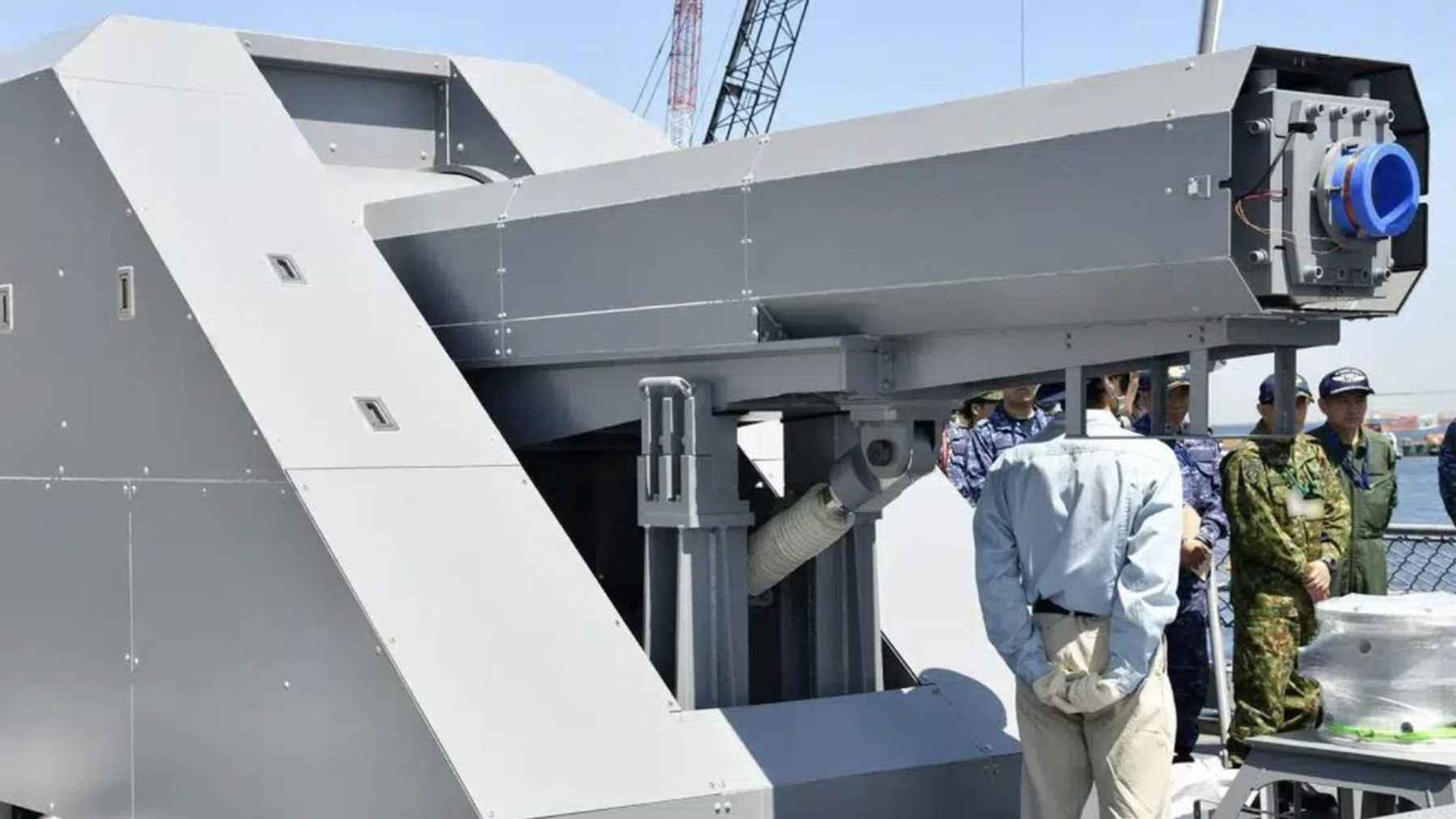
One more detail hints at how broad this unmanned push is. Japan also budgets ¥76.5 billion, roughly $520 million at the cited rate, for MQ-9B “Sea Guardian” long-endurance UAVs, tying together land and maritime surveillance in a way helicopters simply cannot match for time on station.
Turkey vs Israel, and the real requirement
Japan is not buying blind. In August 2025, a Defense Ministry spokesperson told Janes that testing and evaluation of Israel Aerospace Industries’ Heron Mk II concluded in FY2024, while Turkey’s Bayraktar TB2 was scheduled to complete demonstration trials within FY2025.
The same spokesperson emphasized that Japan had not yet decided whether it will procure either system and said selection will be based on performance, cost, and “logistical sustainability.”
That last phrase is easy to skip past, but it is where real procurement headaches live, including spare parts, training pipelines, secure communications, and what happens when a crisis disrupts supply chains.
On paper, the two candidates sit in different classes. The Heron Mk II brochure lists endurance up to 45 hours and payload up to 490 kilograms, about 1,080 pounds, with mission radius over 621 miles beyond line of sight and max speed around 173 mph (150 knots).
Baykar’s official TB2 specifications list payload capacity of 150 kilograms, about 331 pounds, endurance of 20-plus hours, a 27-hour flight record, and a max speed of 104 to 127 mph (90 to 110 knots), with communications listed as line of sight and beyond line of sight.
In practical terms, that means the Heron profile favors longer patrols with heavier sensor packages, while the TB2 profile leans toward lighter payloads and faster scaling. Japan’s decision will likely be less about which drone looks better in a brochure and more about which ecosystem it can sustain in the field.
Manpower and the empty cockpit problem
Japan’s demographic trend is not a side story – it is a strategic constraint. Population projections from the National Institute of Population and Social Security Research show Japan’s population falling below 100 million, to about 99.24 million, by 2053 in the medium projection.
Japan’s own defense documents describe the strain in blunt terms. A Ministry of Defense presentation published in February 2026 says applicant numbers for certain enlisted categories fell by about 40% from FY2014 to FY2024, and the staffing rate for privates dropped to 60.7 percent as of the end of FY2024, while mid-career resignations reached 5,620 in FY2024.
Drones are not a magical fix, but they do change the labor math. A single UAV can loiter for a full day while operators rotate in shifts, which is a different staffing model than training large numbers of pilots for high-risk, low-altitude missions.
Japan’s defense ministry explicitly connects population decline to the need to “promote the introduction of unmanned assets and automation upgrades,” which is about necessity as much as innovation.
Ukraine’s drone era is shaping planning documents
If you want to know why militaries are rewriting doctrine, look at what has happened at sea and on land in Ukraine. In October 2024, Reuters reported comments from a Russian-installed official saying the Black Sea Fleet had to change where it based ships because “large ships became just big targets” for unmanned enemy boats.
Reuters also reported in July 2024 that Ukraine’s navy said Russia’s last naval patrol ship had left Crimea, likely to rebase elsewhere, after sustained Ukrainian attacks on the peninsula. Even allowing for the fog of war, the strategic pattern is clear enough to influence planners far from Europe.
Japan’s FY2026 budget document shows that influence in surprisingly direct language. It calls for a “modular UAV” described as “FPV type” for short-range intelligence collection and also funds demonstrations to control multiple unmanned platforms simultaneously, which is the kind of networking and mass usage that has defined recent drone tactics.
What to watch next
The next milestone is a procurement decision that turns testing into fielded capability. Japan told Janes the TB2 trials were scheduled to wrap within FY2025, and with FY2026 budget lines now in place, the question is how quickly Tokyo moves from evaluation to operational units.
A second watch point is whether Japan can replace not just reconnaissance hours, but the firepower and responsiveness helicopters have provided for decades. Drone-heavy forces can be relentless, but they also depend on secure data links, resistance to jamming, and a logistics backbone that does not snap when politics gets complicated.
The official statement was published by the Japan Ministry of Defense.