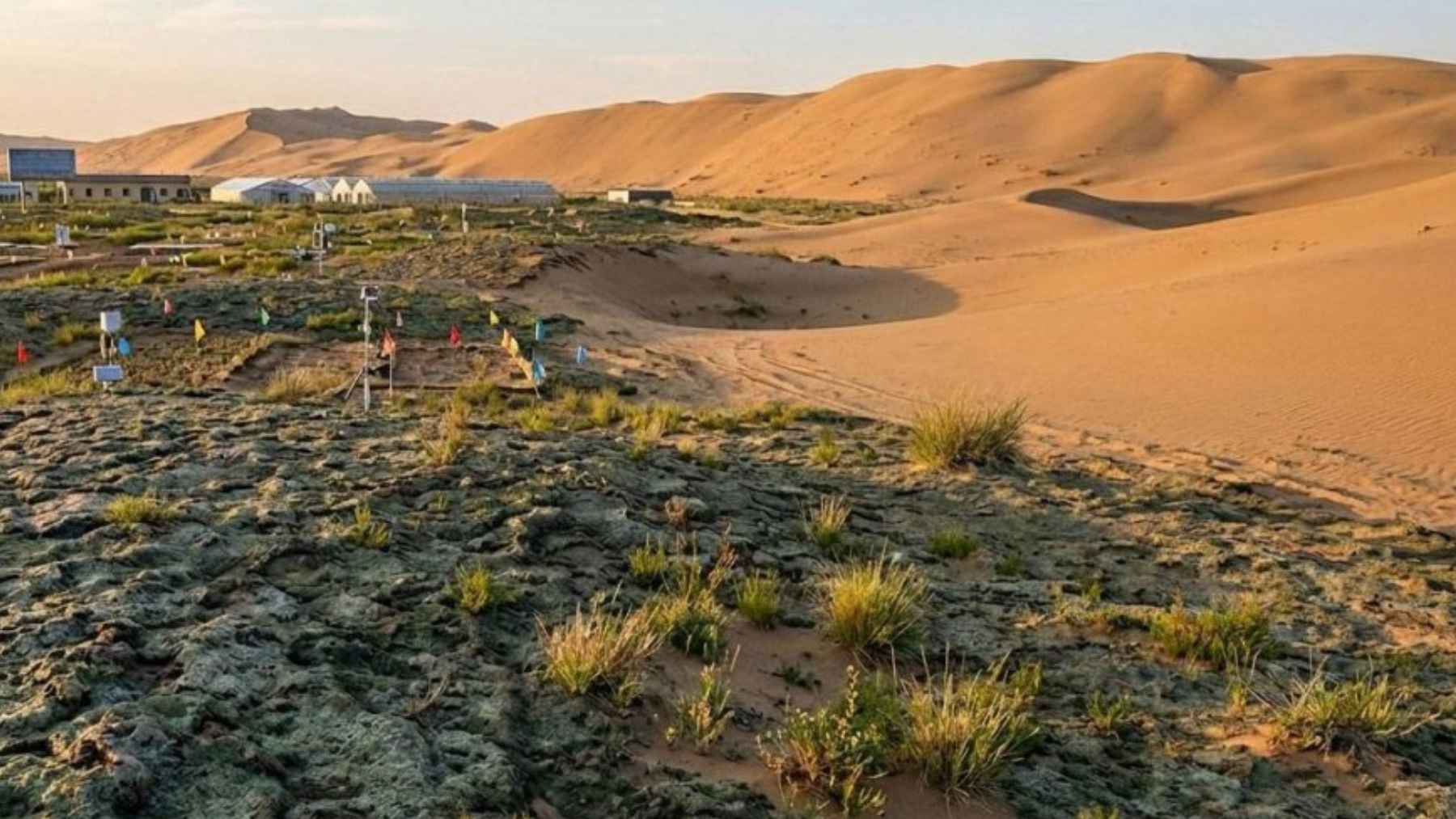
Scientists in northwestern China say they have turned a fragile lab culture into something you can scatter on a dune. The Chinese Academy of Sciences (CAS) describes a solid “soil seed” made from cyanobacteria that can form artificial biological soil crusts after rain, stabilizing shifting sand and preparing the ground for plants.
Desertification is not a niche issue. The United Nations says at least 100 million hectares of land (about 247 million acres) become degraded every year, affecting the well-being of roughly 3.2 billion people, and it estimates fighting land degradation and drought could require $1 billion per day between 2025 and 2030.
From petri dish to desert surface
The promise, according to CAS, is speed plus simplicity. “If you spread these seeds on the desert surface, soil crusts will form when they are exposed to precipitation,” said Zhao Yang, deputy head of the Shapotou Desert Research and Experiment Station.
Getting there took some hard lessons. Zhao said cyanobacteria thrived in petri dishes but “disappeared completely within less than a week” outdoors because mobile sand ripped apart the biofilm.
Pressurized spraying helped by injecting microbes into gaps between sand grains, and CAS reports survival above 60 percent while cutting crust formation from about 15 years naturally to roughly one to two years.
Then the team ran into a scaling problem that will sound familiar in any industry. Some target areas were unreachable by vehicle and the spraying equipment needed electricity, so researchers turned the crusts into transportable solid “seeds” by mixing cyanobacteria solution with organic matter and fine particles until it becomes paste-like.
Zhao compared it to “mixing cement,” where the ratio and mixing method decide the final strength.
The science behind a “living skin”
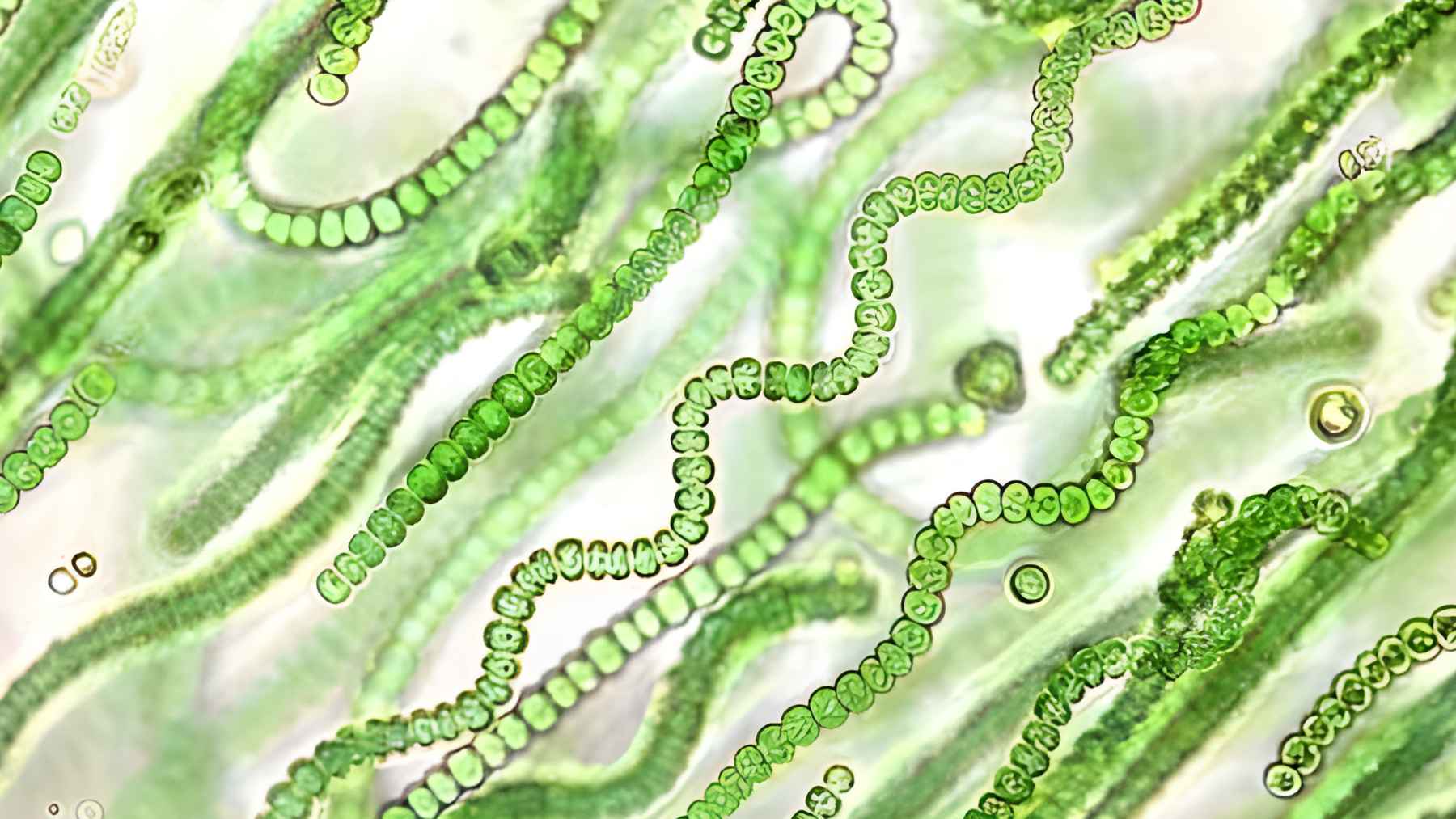
Biological soil crusts are thin communities that live at the soil surface, often built from cyanobacteria, algae, lichens, mosses, fungi, and other microbes. A USDA reference describes filaments weaving through the top few millimeters of soil and “gluing loose particles together” into a matrix that stabilizes and protects the surface from erosion.
Cyanobacteria are a good first wave because they tolerate drying out and return when moisture shows up. Over time, biocrusts can reduce wind and water erosion, fix atmospheric nitrogen, and add organic matter, acting a bit like living mulch on bare ground.
Anyone who has watched a dusty gust sweep across an empty lot knows how fast bare ground can travel. A crust cannot end drought, but it can buy time for shrubs and grasses to root before heat and wind erase the first planting attempt.
Speed is the selling point, but milestones matter
Some headlines frame this approach as turning sand into soil in about ten months. A recent Earth.com summary, citing CAS work, said trial plots stabilized sand within roughly 10 to 16 months, while also noting that a mature crust able to resist disturbance can still take two to three years in the best cases.
This is where readers should slow down and separate “stops the sand from moving” from “builds a resilient ecosystem.” Even when the biology works, the clock is still set by rain, because the seeds need precipitation to activate and then must survive long dry stretches.
Long term research supports the general direction. A multi decade field study published in Soil Biology and Biochemistry describes how cyanobacterial inoculation can accelerate biocrust succession “from decades to years” by boosting microbial functions linked to carbon and nitrogen fixation.
Scaling means logistics, rules, and tradeoffs
If this scales, it will look less like a volunteer tree planting day and more like a bioinput supply chain. The switch to solid “seeds” is a nod to transport, storage, and deployment in places where there is no road access and no plug-in power.
CAS says the solid inoculum is now part of the renewed Three North Shelterbelt Program, with an expected 80,000 to 100,000 mu of desert to be rehabilitated over five years. That is roughly 13,176 to 16,470 acres (about 21 to 26 square miles), a scale that demands monitoring, durable contracts, and clear success metrics.
The UN’s SDG reporting notes that each $1 invested in land restoration can yield $7 to $30 in benefits, but that financing is still far below what is needed.
The science also comes with fine print. A PLOS ONE study found cyanobacteria dominated crusts can reduce seed germination for both native plants and an exotic grass compared with bare soil, which means restoration teams may need to time crust building and planting carefully.
And because biocrusts can be damaged by traffic and grazing, any program built around them has to plan for long term protection or it risks crumbling fast.
Why it matters for infrastructure and security
Land degradation shows up in food systems and in budgets, not just in nature documentaries. The UN links it to poverty, food insecurity, and migration, and it estimates the world would need to restore around 1.5 billion hectares of land (about 3.7 billion acres) to reach land degradation neutrality by 2030.
There is also a quieter, very practical angle for defense and critical infrastructure. Dust and sand can chew up roads, rail lines, and equipment, and it is a maintenance bill that keeps coming back in hot, windy seasons.
A microbial crust that holds the surface together could become another tool for protecting logistics corridors and high value sites in arid regions, alongside fences, vegetation, and better land management.
At the end of the day, the “soil seed” idea treats land restoration like engineering, using microbes as the first layer of infrastructure. Can it travel well beyond China’s test sites, into new deserts with different soils and politics?
The official statement was published on Chinese Academy of Sciences.