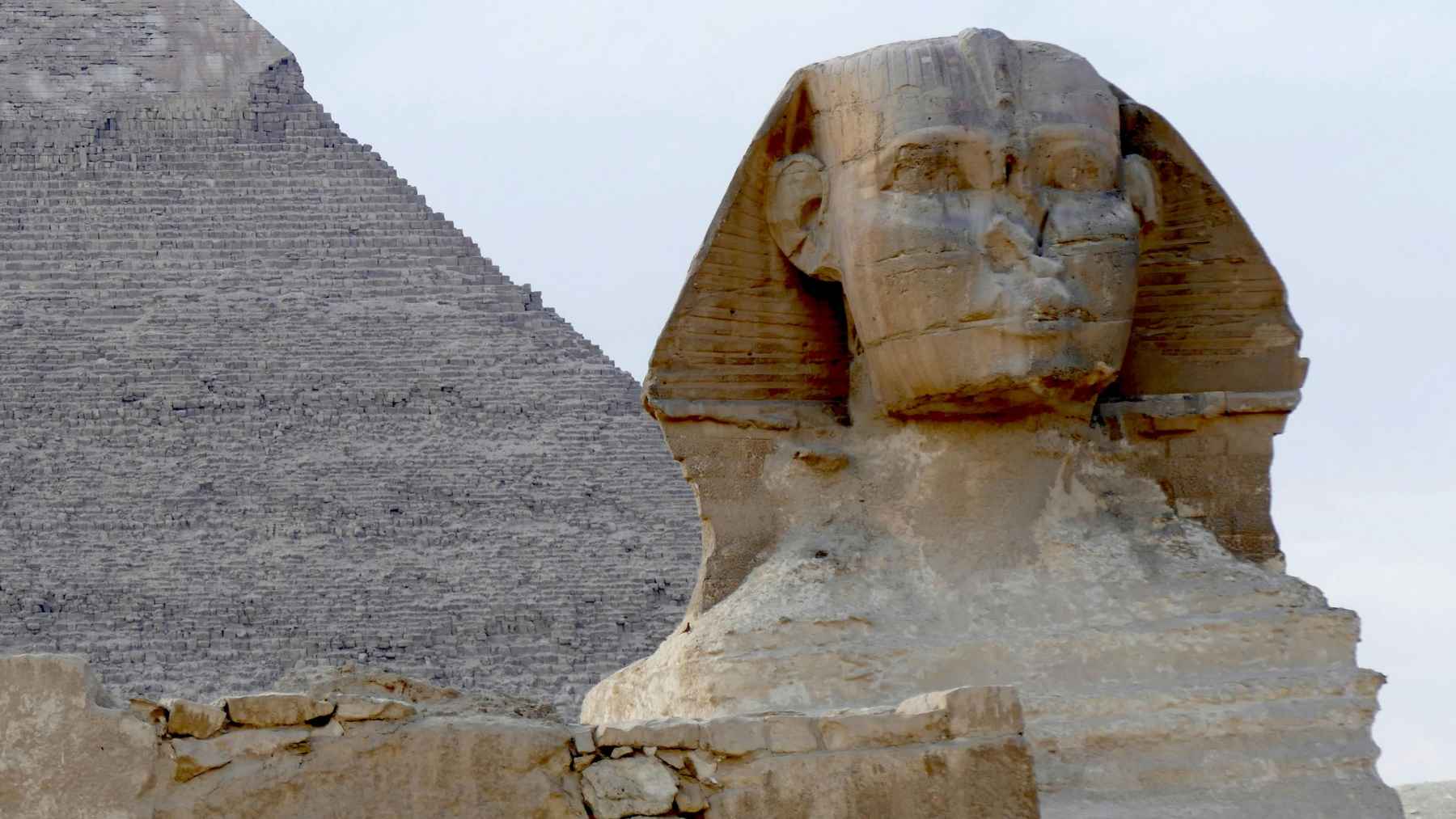
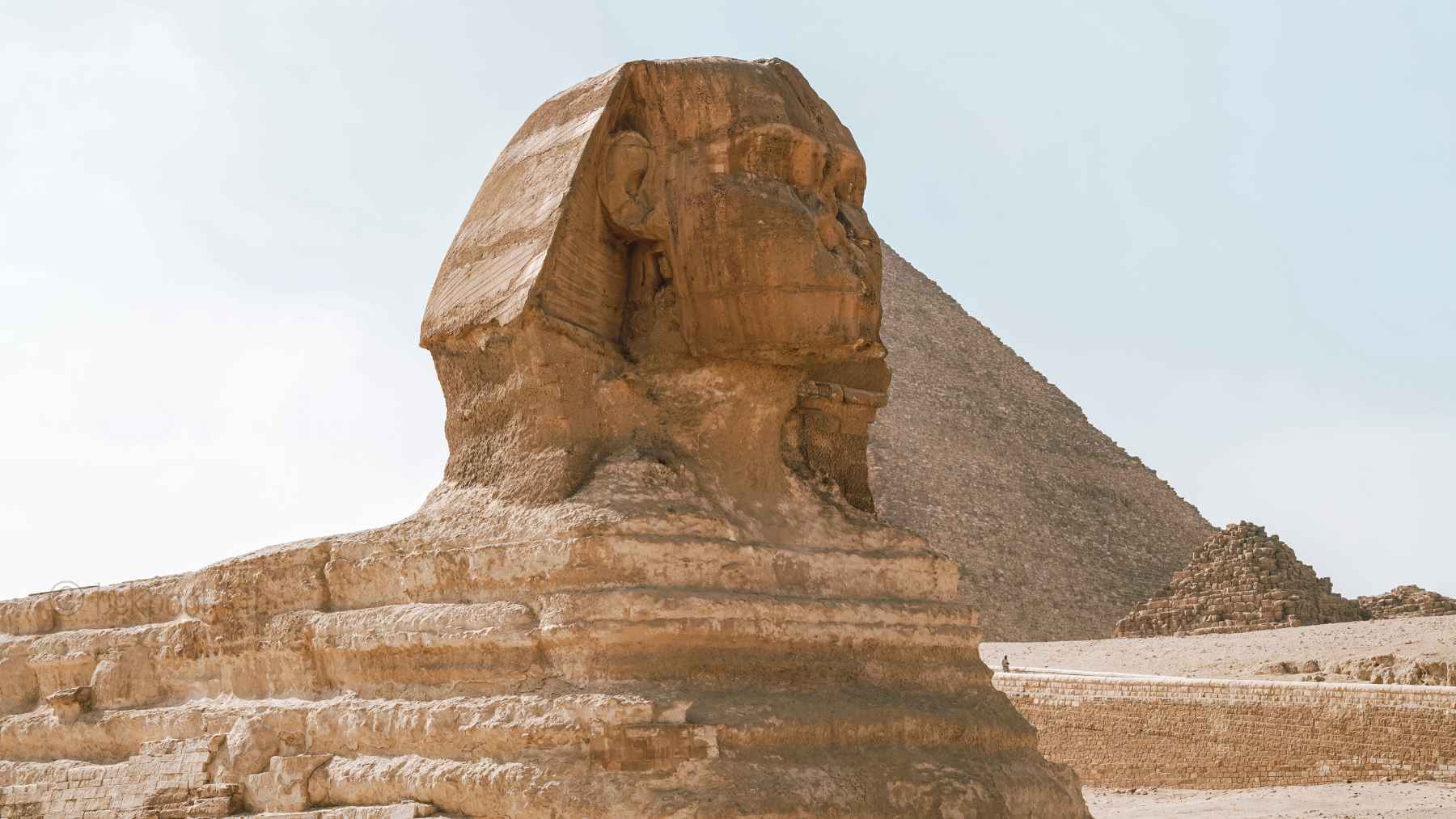
A new claim is rippling through social media and podcast clips that a second Great Sphinx may be buried under the sands of Egypt’s Giza Plateau.
Italian researcher Filippo Biondi says satellite radar scans point to a mirrored location across from the known Sphinx, with underground features he interprets as shafts and passages, and he has described his confidence as “about 80%.”
It is an attention-grabbing idea, but it is not the same thing as confirmed archaeology. Right now, there has been no publicly announced excavation, no peer-reviewed paper validating a second Sphinx, and Egypt’s authorities have not confirmed any discovery, which is why many archaeologists and geophysics experts are urging people to slow down before hitting “share.”
What is actually being claimed
Biondi laid out his case in a March 26 podcast appearance, saying the scans suggest a buried structure that could match the scale of the existing monument. Reports describe a sand mound at the proposed site rising to about 108 feet, and Biondi says the shapes in his data appear to mirror patterns seen near the known Sphinx.
A key part of the pitch is geometry. He argues that alignments between the pyramids and the current Sphinx can be “mirrored” to point to a second location on the plateau, where the mound sits.
Supporters also point to the “Dream Stele,” an ancient stone slab placed between the Sphinx’s paws around 1400 BC, which appears to show two sphinx figures in its carved imagery. That detail has fueled “twin Sphinx” speculation for years, even though many Egyptologists interpret the imagery as symbolic and note the text does not describe a second statue.
Why the tech sounds plausible
The story has traction partly because radar and satellites feel like modern magic. Synthetic Aperture Radar (SAR) is real, widely used, and extremely capable in its own lane, from mapping terrain through clouds to tracking surface changes over time, which is a reason it is heavily used in national security, disaster response, and infrastructure monitoring.
Biondi has also published work proposing that SAR data can be processed in unconventional ways. In a 2022 preprint, Biondi and Corrado Malanga describe a method based on analyzing “micro movements” in the Great Pyramid area generated by background seismic waves, using a series of SAR images from Italy’s COSMO SkyMed satellite system.
That is a big reason this debate is more complicated than “podcast nonsense” versus “hidden truth.” The same remote sensing toolbox that can find subtle changes in the ground can also produce patterns that look meaningful, especially when a researcher is hunting for symmetry and the public is hungry for a mystery.
Where critics push back hardest
The simplest objection is procedural and it matters. Archaeology is not a comments section – it is permits, controlled fieldwork, and documentation, and multiple fact checks have emphasized that no excavation has been announced and no peer-reviewed study has validated the second Sphinx claim.
There is also a long-running credibility problem in the background. Hawass, a prominent Egyptologist and former minister of antiquities, has publicly rejected earlier viral claims tied to similar “megastructure” narratives around Giza, saying they lacked scientific evidence and that no permits had been issued for work inside the Pyramid of Khafre.
In one statement, he wrote that the rumors were “fabrications” and added that the base of Khafre’s pyramid was carved from bedrock to about 8 meters, which is about 26 feet.
Then there is the physics question. Experts quoted in media coverage note that ground penetrating radar has limits and typically resolves features only a few meters below the surface, which raises doubts about sweeping claims of deep underground “cities” or vast networks without strong corroboration.
The real story is trust, not treasure
Here is what makes this more than an archaeology argument. Satellite sensing is a serious business, and the public is learning about it in real time through viral content, not through technical briefings, which can blur the difference between “we saw an anomaly” and “we found a monument.”
That gap matters for companies and institutions that depend on confidence in remote sensing, including commercial satellite providers, analytics firms, and government agencies that use radar imagery for everything from shipping monitoring to battlefield mapping.
If the average viewer walks away thinking radar “sees” statues under sand the same way an X-ray sees bones, expectations get warped fast.
It also creates incentives that are hard to ignore. A single dramatic claim can flood a feed, drive podcast downloads, and pull attention away from slower, more careful work, even when the careful work is the only kind that holds up years later.
What a credible test would look like
If there is something under that mound, the path forward is not another clip – it is a transparent method and independent verification. That usually means sharing data processing details, error estimates, and alternative explanations, then pairing the remote sensing with authorized on-site geophysical surveys and, only if warranted, a controlled excavation.
Egypt tightly regulates archaeological work in restricted zones, and that is not just a talking point. A recent Scientific Reports paper on noninvasive geophysical imaging in Egypt explicitly thanks the Supreme Council of Antiquities for granting permission to conduct surveys in restricted archaeological areas, which gives a sense of how formal the process is.
There are also established examples of careful, instrument-driven scanning at Giza. One 2025 arXiv paper describes the ScIDEP collaboration building muon telescopes to investigate the internal structure of the Pyramid of Khafre using cosmic-ray muons, scanning from multiple viewpoints inside and outside the pyramid to identify potential new structures.
That kind of work shows what “tech meets archaeology” looks like when it is built to be tested, not just talked about.
At the end of the day, the Giza Plateau does not need a second Sphinx to be astonishing. But if a claim is going to rewrite the history books, it has to survive the boring steps, the kind that do not trend.
The official episode page was published on Apple Podcasts.