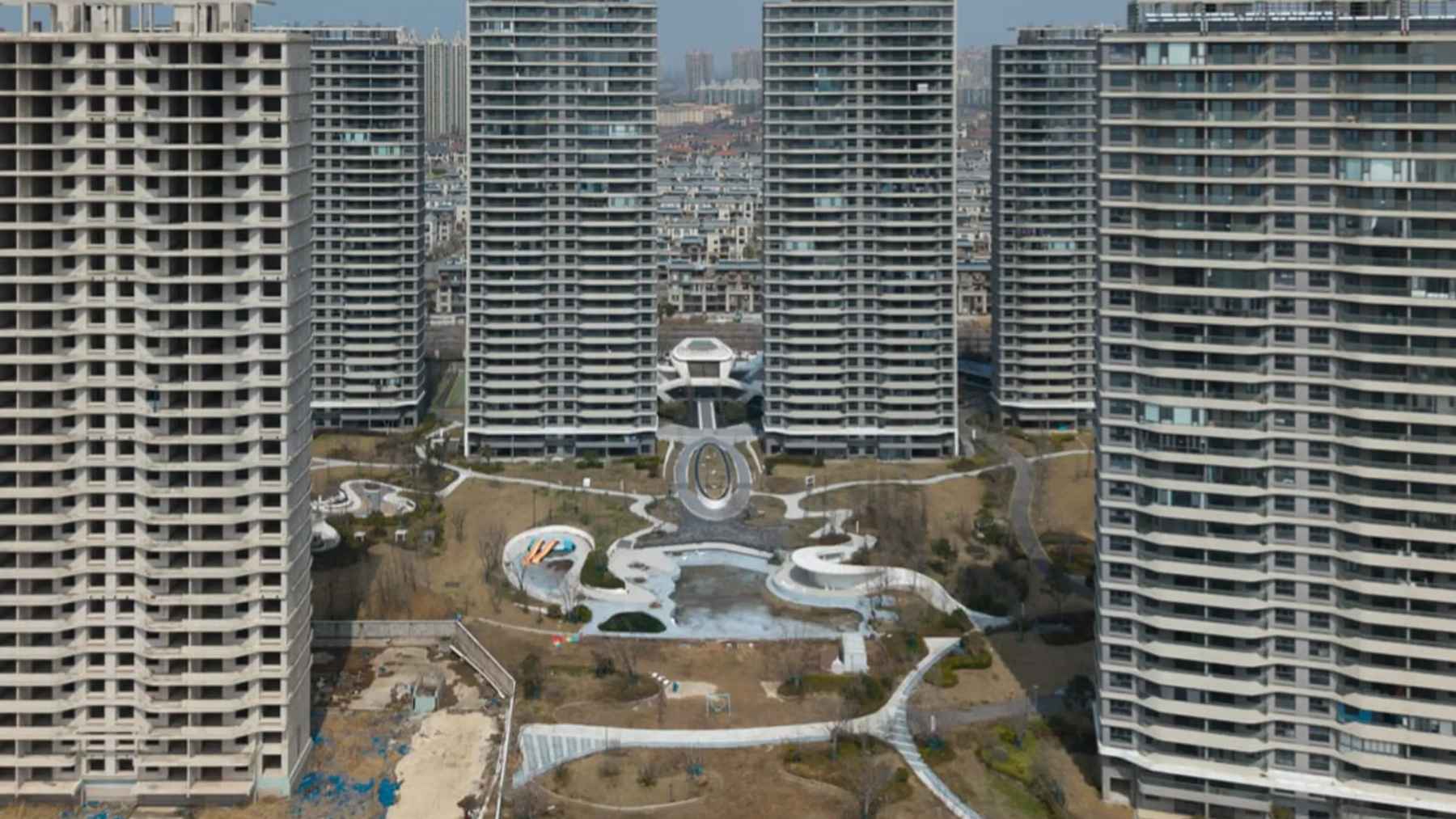
What do you do with 47,000 apartments when the buyers never show up? In Qidong, a coastal city about 90 minutes from Shanghai, a massive Evergrande development marketed as “life in Venice” is now drawing young renters who want a break, not a promotion.
A three-room unit of roughly 1,076 square feet can rent for 100 Swiss francs a month, about $125 at early-April exchange rates, which is far below typical big-city rents.
The strange part is that this calm little bargain exists because China’s property downturn is still grinding on, reshaping household behavior, local budgets, and even financial stability risks.
Evergrande’s “Venice” goes from dream to discount
SRF describes rows of towers on flat land between the Yellow Sea and the Yangtze River, with European-style architecture and canals meant to signal luxury. The project was built on a scale that feels more like a new district than a neighborhood, with villas in the south and 30-story towers in the north.
The complex is “gigantic,” SRF reports, with about 47,000 apartments designed for 120,000 people, yet many blocks sit empty or abandoned. Some villa prices have fallen by more than half, and in China, steeply devalued apartments like these are sometimes nicknamed “cabbage houses” because they have become so cheap.
“Lying flat” turns into a rental plan
One resident, Ma Chao, is a 27-year-old engineer who works for an auto company in Shanghai. “I come here from time to time to relax,” he told SRF, saying he mostly walks, cooks, and plays computer games, then summed it up with “compared to Shanghai it’s boring.”
That boredom is exactly the appeal. A local agent, Lin Xiaoqin, said young people are arriving because costs are low and the surroundings are pleasant, and “they feel very relaxed here and noticeably less under pressure,” while a retiree, Lui Cuiping, said people can “lie flat” here without being judged for not hustling.
SRF also reported daily shuttle buses from Shanghai, priced at two Swiss francs, about $2.50, with free rides for retirees.
The housing slump still shows up in the data
The Qidong story is unusual, but the wider market backdrop is not. Reuters reported that 53 of China’s 70 tracked cities recorded monthly declines in new home prices in February 2026, a sign that demand is still weak even when some indicators stabilize for a month or two.
Economists keep focusing on property because it has been so central to growth. IMF analysis and academic work by Kenneth Rogoff and Yuanchen Yang have estimated that real estate and related activity accounted for roughly one-fifth to one-quarter of China’s GDP in recent years once spillovers are included, so a long slump does not stay contained inside real estate firms.
Evergrande is in liquidation, but the risks did not disappear
The corporate story behind “Venice” helps explain why so much housing is sitting idle. A Hong Kong court ordered the liquidation of China Evergrande Group in January 2024 after it failed to put forward a restructuring plan, and Reuters has described the developer as having more than $300 billion in liabilities.
Liquidation is not a clean ending, and the stress can migrate. On April 13, 2026, Reuters reported that a Beijing court ordered the bankruptcy liquidation of Zhongzhi Enterprise Group and 316 affiliates, highlighting how property-linked strains can spread into the shadow banking system that once helped fund the boom.
Consumers and tech feel the downturn in quieter ways
Falling home prices do not just hit developers, they hit confidence. A 2025 working paper from the Bank for International Settlements underscores how housing and debt dynamics can amplify macro risks in China, and other research has noted that housing can make up an unusually large share of urban household wealth.
When people feel poorer on paper, they tend to cut back on big purchases first, from renovations to new appliances, and that drags on the broader economy. But day-to-day digital life often continues, which is why a “low desire life” can still mean paying for mobile data, delivery apps, and games while putting off a mortgage decision for another year.
Land sales fall while defense priorities hold
Local governments are also squeezed because land sales have long been a major revenue source. Reuters reported land-sale revenue was still falling in 2025, and Rhodium Group estimated land sales revenue fell nearly 15% that year to about 4.15 trillion yuan, roughly $580 billion using the Federal Reserve’s annual average exchange rate for 2025, which is less than half of peak levels in 2021.
At the national level, Beijing is signaling that some spending priorities remain intact. China set its 2026 defense budget at about $277 billion, a 7% increase, according to the Chinese Ministry of National Defense and reporting from Defense News, and IISS noted defense remains a priority even as fiscal challenges widen.
The report was published on SRF.