A Chinese research team says it has pulled off a 1-gigabit-per-second laser downlink from a satellite in geostationary orbit, using a transmitter rated at just 2 watts. That is roughly the power draw of a small LED bulb, yet the signal reportedly traveled about 22,370 miles (36,000 km) to a ground receiver in southwest China.
It sounds like a “Starlink killer” at first glance, but that framing misses the point. The most interesting part is how the engineers dealt with the messiest stretch of the journey, the last miles through Earth’s atmosphere, where turbulence turns a tight laser beam into a smeared patch of light.
A gigabit from far higher orbit
In the tests, the downlink was received at the Lijiang site in China’s Yunnan province, using a large optical telescope rather than a consumer antenna. The experiment was a point-to-point link, not a mass-market broadband service, and it depended on specialized ground infrastructure.
Still, the headline number matters, even if the internet loves a rivalry story. Delivering 1 Gbps from geostationary altitude is difficult because the signal has to cross far more distance than low-Earth-orbit systems, and the receiver has less margin when the air starts to wobble the wavefront.
The paper describing the work reports stable transmission of a 1 Gbit/s signal during the high-orbit satellite-to-ground experiment. That kind of language is careful on purpose, and it is a reminder that a lab-style milestone is not the same thing as a consumer product you can buy next week.
The atmosphere was the real enemy
Laser links look clean on diagrams, but the atmosphere is not a clean medium. Turbulence causes the air’s refractive index to fluctuate, which distorts the phase of the beam and makes its intensity flicker, exactly the sort of problem that turns a fast link into dropped packets and retransmissions.
Engineers have tried to beat that in two main ways. Adaptive optics uses deformable mirrors to “unwarp” the incoming light in real time, while mode diversity reception tries to capture multiple distorted versions of the signal and recombine the best of what survives.
What’s new here is the combination, described in reports as “AO-MDR synergy.” If the beam arrives as a blur anyway, why pretend you can make it perfect with one trick?
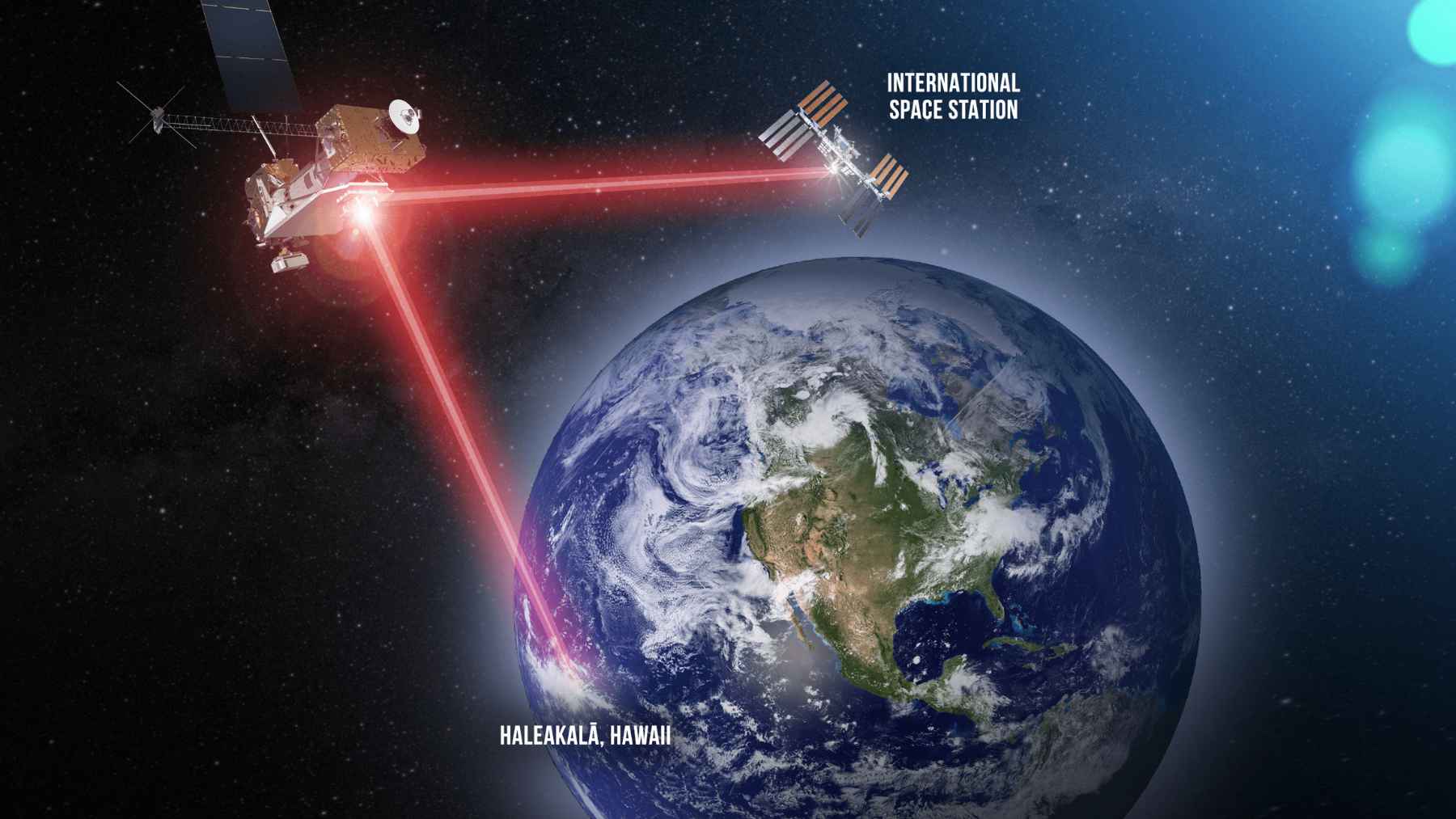
A space-based laser communication system connects a satellite with the International Space Station and a ground station in Hawaii.
The ground station did the heavy lifting
According to reports on the test setup, the receiver was built around a 5.9-foot (1.8-meter) telescope. That is a research-grade instrument, and it hints at where this approach fits best, in a small number of high-capacity gateways that feed data into terrestrial fiber networks.
Inside that ground chain, the adaptive optics stage used hundreds of tiny actuators to correct the incoming wavefront, paired with mode diversity processing that split the light into multiple channels and then combined the strongest ones. Reports described 357 micro-mirrors and eight channels, with the system selecting the best subset for decoding.
The payoff was not just speed, but reliability. In the published paper, the probability of achieving a bit error rate below 1×10⁻³ improved from 72.0 to 91.1% under the combined approach, and the authors also report a 3.94 dB gain in received power at a high-reliability threshold.
Why “faster than Starlink” is the wrong yardstick
Starlink’s satellites operate in low Earth orbit, and the “typical” operating altitudes often discussed publicly sit in the few-hundred-mile range. The Federal Communications Commission’s 2022 authorization for SpaceX’s “high performance” Ku-band terminals, for example, references a low-Earth-orbit Starlink system at 341 miles (550 km).
In early 2026, SpaceX said it planned to lower a large share of satellites from about 342 miles (550 km) to about 298 miles (480 km) as part of an effort to improve “space safety.”
But the job Starlink is doing is different. It uses radio links between satellites and end-user terminals, which is how it can support broad coverage without building a giant optical telescope in every backyard.
This Chinese test was closer to a backbone demonstration from a fixed orbital position. A geostationary satellite stays parked over the same region, which is great for a stable relay, but it also means you have to build and protect the ground stations that can see it, and you have to live with clouds and weather.
What it could mean for defense and industry
So what does a low-power gigabit downlink actually buy you? It could let Earth observation and surveillance satellites dump big data sets faster, which matters when you are trying to get insight while it is still fresh, not hours later.
Laser links are also attractive because they do not fight for crowded radio spectrum, and because a narrow beam can be harder to intercept than a broad RF footprint. For defense users, that could translate into faster movement of intelligence data and more resilient communications when radio channels are jammed or contested.
But there is a flip side that is easy to overlook until you have had a video call die in a summer storm. Optical links can be blocked by thick clouds and degraded by atmospheric conditions, which is why real-world systems often rely on multiple ground stations and smart routing rather than a single “perfect” site.
The bigger race is toward optical networks in space
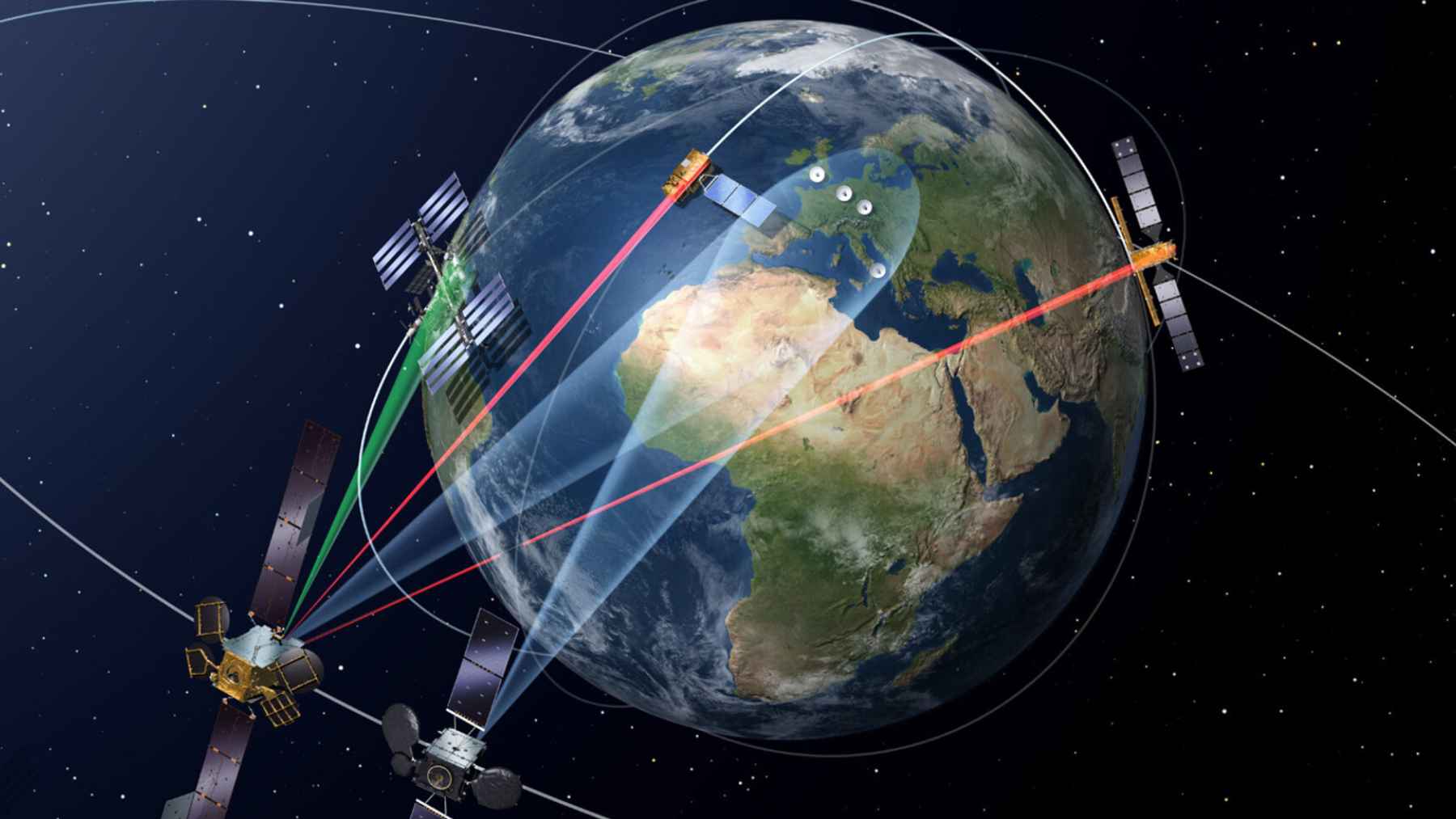
This Chinese result lands in the middle of a broader global push toward optical communications. NASA has been testing laser links with projects like the Laser Communications Relay Demonstration and Deep Space Optical Communications, while the European Space Agency has leaned on the European Data Relay System as a “SpaceDataHighway” for Earth observation data.
At the end of the day, the big question is not who is “faster” on a single headline test. It is whether these systems can be made routine, automated, and available enough that operators can count on them the way we count on fiber on the ground.
For now, the takeaway is simple – the bottleneck is shifting from space hardware to the air and the ground network built under it.
The study was published in Acta Optica Sinica.