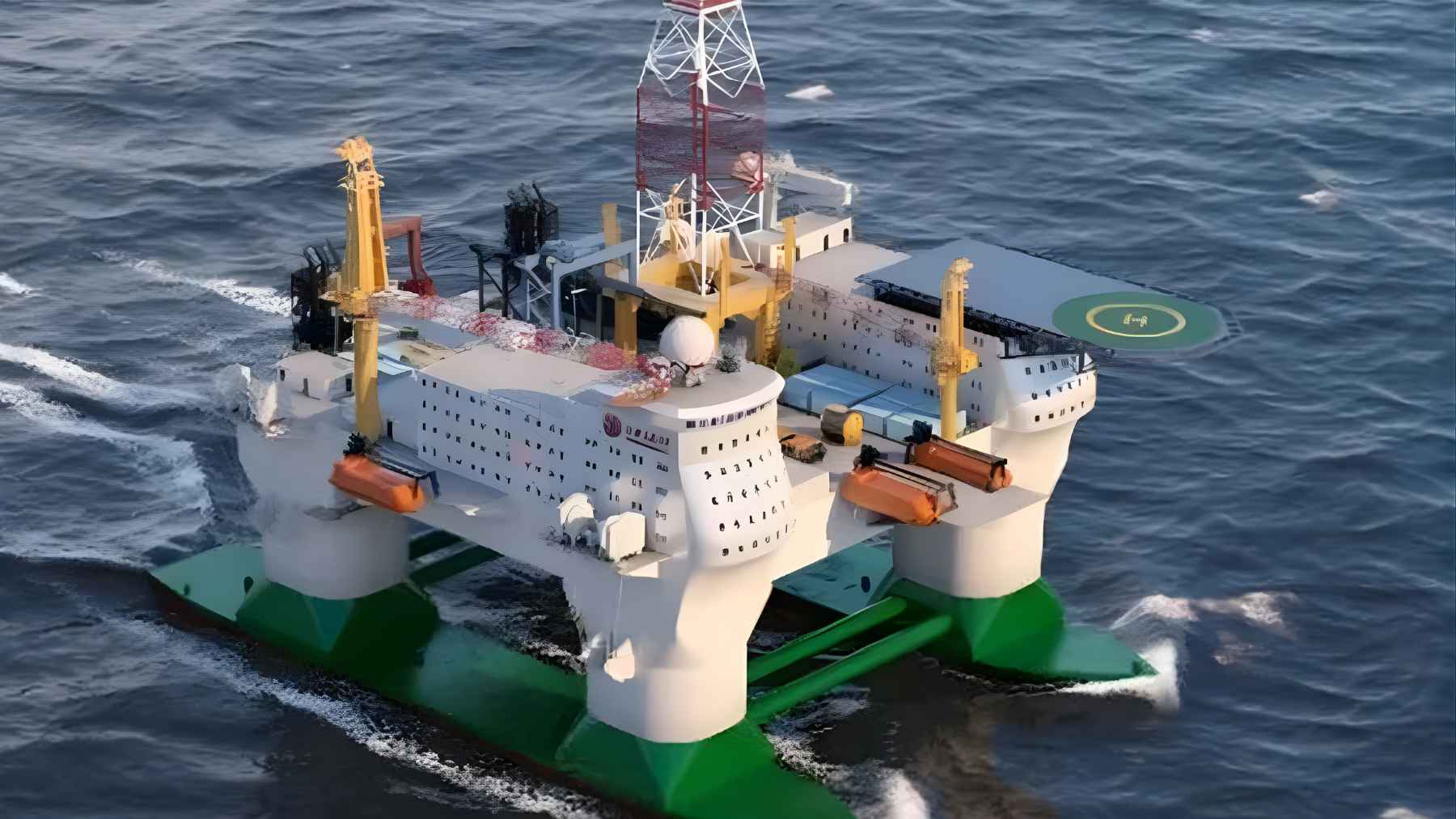
China is moving ahead with a deep-sea platform that sounds like something out of a spy novel and an engineering textbook at the same time. It is being described as a floating “island” with a nuclear-blast-resistant bunker at its core, designed to support long stays in rough weather and far from shore.
Construction of the deep-sea mobile living facility was formally launched in late March 2026, according to Chinese state media. The project is being led by researchers at Shanghai Jiao Tong University (SJTU), and it is expected to be completed by 2030.
What China says it is building
China’s official description frames the platform as a deep-sea scientific and mobile living facility that can operate in “all weather” conditions. In practical terms, that means a self-contained floating base that can keep people housed, powered, and connected while working in remote waters.
State media reports describe a semi-submersible, twin-hull design with a displacement of about 78,000 metric tons (roughly 86,000 U.S. tons). It is described as being about 453 feet long and 223 feet wide, with a deck area of more than 353,000 square feet.
Why the South China Sea is the obvious test
Much of the attention is on where it might operate. The South China Sea remains one of the world’s most contested waterways, with overlapping claims, heavy commercial shipping, and a dense mix of naval and coast guard activity.
China has built and expanded artificial islands and outposts across the region over the past decade, turning reefs into runways and port facilities. Researchers at the Center for Strategic and International Studies’ Asia Maritime Transparency Initiative (AMTI) have documented that buildup in detail.
For Beijing, a mobile platform changes the geometry. If it can move into position, stay there for months, and support long-range research or surveillance, it reduces the need for a fixed base while still extending presence into disputed waters.
The bunker angle is the real headline
The phrase “nuclear-blast-resistant” is what grabbed global attention, and it is not accidental language. Even if the platform is built for research, designers are highlighting the ability of core compartments to keep functioning after an extreme shock event.
A research team led by Professor Yang Deqing at Shanghai Jiao Tong University said the superstructure includes “critical compartments” for emergency power, communications, and navigation control, which is why blast protection for those spaces is “absolutely vital.”
The team’s paper says the platform will use “sandwich” metamaterial panels that convert catastrophic shocks into softer compressions, an approach intended to keep structural loads from reaching failure levels.
That work was published in Chinese Journal of Ship Research on November 4.
Speed, endurance, and the power projection question
The platform is also meant to move. Reports say it could reach 30 knots, or about 34.5 miles per hour, which is extraordinarily fast for an 86,000-ton structure.
It is designed to house up to 238 occupants for up to 120 days without resupply, a level of endurance that looks less like a ship and more like a floating research station with a built-in logistics buffer.
This is where the strategic reading begins. A self-sustaining platform in contested waters could support sensors, teams, and equipment in a way that extends a country’s reach without relying on friendly ports or constant naval escort.
What analysts should watch next
The most immediate question is simple. Where will China deploy it first, and what missions will it actually run? That early operational pattern will tell us more than the marketing language.
The second question is how other countries respond. Expect more scrutiny of deep-sea research projects, more investment in underwater awareness, and more debate over whether “civilian” infrastructure is quietly turning into strategic capacity.
Finally, there is the broader lesson for defense technology. The world is watching a race not only for ships and submarines, but for mobile infrastructure that can sit in the gray zone between science and security. A similar logic underpins older “sea basing” concepts that have been discussed in U.S. defense planning.
The official report was published on Xinhua.