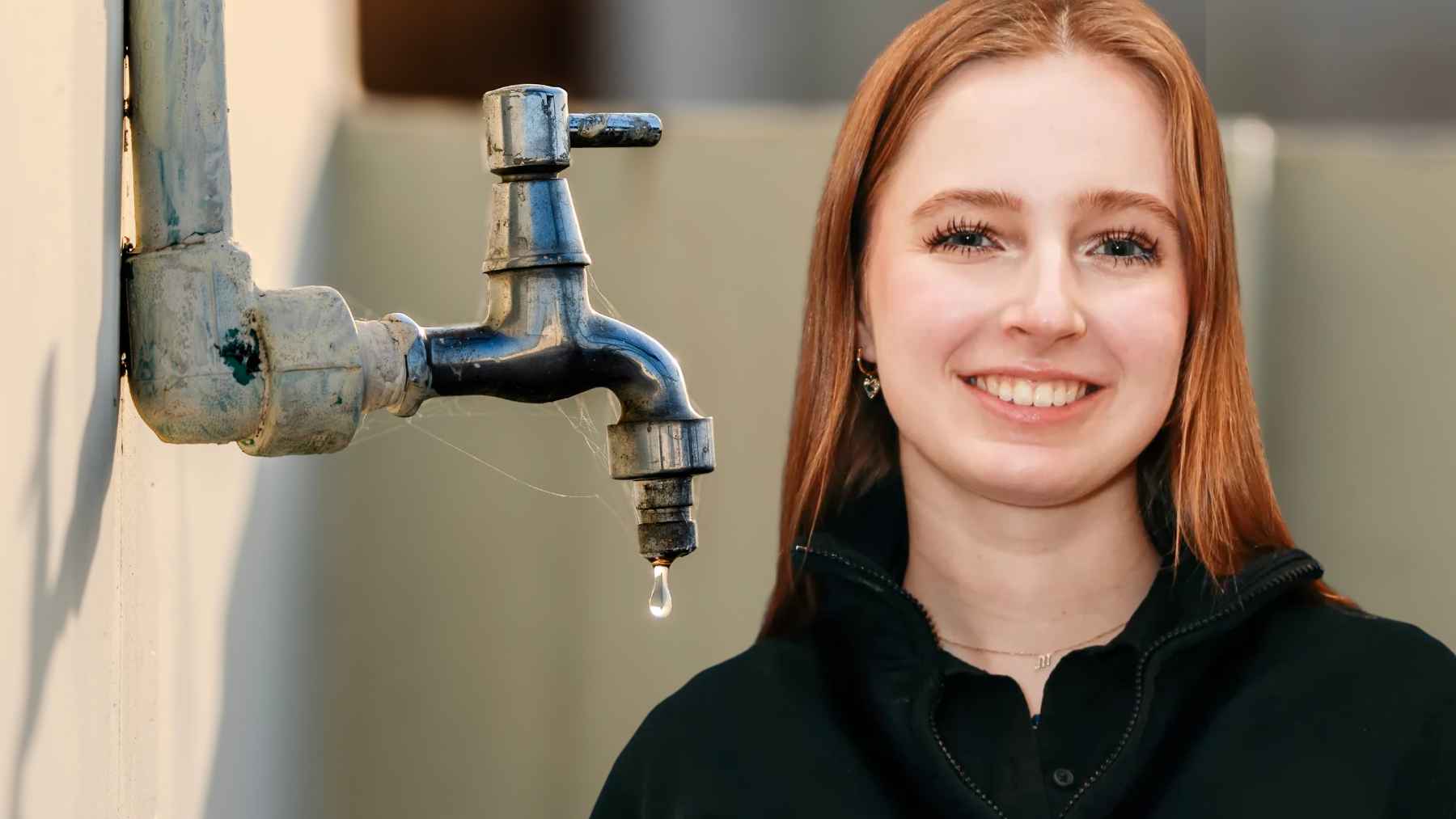
An 18-year-old Virginia student, Mia Heller, has built a prototype water filter that uses magnetic liquid to pull microplastics out of everyday tap water.
In tests she ran herself, her system removed 95.52% of microplastics while recycling 87.15% of the magnetic fluid used to trap them, according to Smithsonian Magazine.
The early results are eye-catching, but the bigger story is what comes next. If this ever leaves the garage and lands under a kitchen sink, it will have to prove it can scale, stay safe, and avoid creating a new mess while trying to solve an old one.
A magnet in the kitchen
Heller’s idea is simple to explain and tricky to execute. A reusable magnetic oil called ferrofluid binds to microplastics in flowing water, then a magnet helps separate the clumped particles so the water comes out cleaner.
Her current setup is roughly the size of a bag of flour and filters about 1 quart at a time. That puts it in the same household conversation as other drinking water technologies people read about, from new desalination concepts to under-sink systems meant to handle whatever is riding along in the pipes.
The practical appeal is maintenance. Instead of swapping membranes over and over, her design aims to keep the magnetic fluid in a closed loop, which could reduce waste and the constant “did we change the filter yet” routine.
Microplastics are everywhere
The U.S. Environmental Protection Agency defines microplastics as plastic particles ranging in size from 5 millimeters down to 1 nanometer. The agency also draws a line between primary microplastics made small on purpose and secondary microplastics that form when bigger plastics break down.
That size range matters because it helps explain why these particles show up in so many places. They move through water systems the way dust moves through a house, and they do not politely stop at the front door.
Researchers are also finding them in human tissue, including the brain, although what that means for health is still being debated.
A recent Nature Medicine paper, also summarized by University of New Mexico Health Sciences, reported higher microplastic and nanoplastic concentrations in brain samples from 2024 compared with 2016, with the authors stressing that the data are associative and not proof of cause and effect. So what should a reader do with that while pouring a glass at the sink?
Testing the prototype
To check her own device, Heller built a turbidity sensor to estimate suspended solids and help quantify how much microplastic was being removed.
Based on those measurements, her prototype hit 95.52% removal and recovered 87.15% of the ferrofluid used in the process, as described in the same Smithsonian Magazine report.
Those numbers matter because many water systems are not designed with microplastics as the main target. Traditional drinking-water treatment can remove a large share, often cited in the 70 to above 90% range depending on the plant and process, but performance varies widely and the smallest particles can be stubborn.
The engineering challenge is also not just the magnet. Getting a dense magnetic liquid to circulate without clogging, while keeping separation and recovery working together, took multiple iterations, and real-world water chemistry can be unpredictable in ways lab mixtures are not.
Scaling gets messy fast
Experts looking at new filtration ideas usually ask an unglamorous question first. Where do the captured particles go, and can they be disposed of or destroyed without leaking back into the environment later?
That concern is not theoretical. If the extraction method concentrates microplastics but leaves behind another residue, or if any ferrofluid escapes into the treated water, a solution can turn into a tradeoff.
This is the same basic headache water engineers deal with in other contamination cases, whether the issue is chemical runoff, aging pipes, or even radioactivity in the water.
Then there is cost. Heller herself has pointed out that ferrofluid can be expensive to produce at scale, which is why she currently sees the best fit as a home system rather than something immediately deployed across municipal plants.
A market built on trust
If this technology moves toward commercialization, it will enter a market where consumers are skeptical for good reason. People buy filters because they worry about what they cannot see, but they stick with filters that are proven, certified, and easy to live with.
In practical terms, adoption will likely depend on third-party validation, clear disposal pathways for the captured plastics, and performance across different water conditions.
Water never stops moving through infrastructure, and the step from a one-quart batch system to a product that handles daily household flow is where many promising concepts stall, even ones that look elegant on paper, and in prototypes where water never stops moving.
It also helps that Heller’s project earned recognition at the Regeneron International Science and Engineering Fair, and that she received a special award connected to the Patent and Trademark Office Society, which highlights how quickly student innovations can draw institutional attention.
The official statement was published on Society for Science.