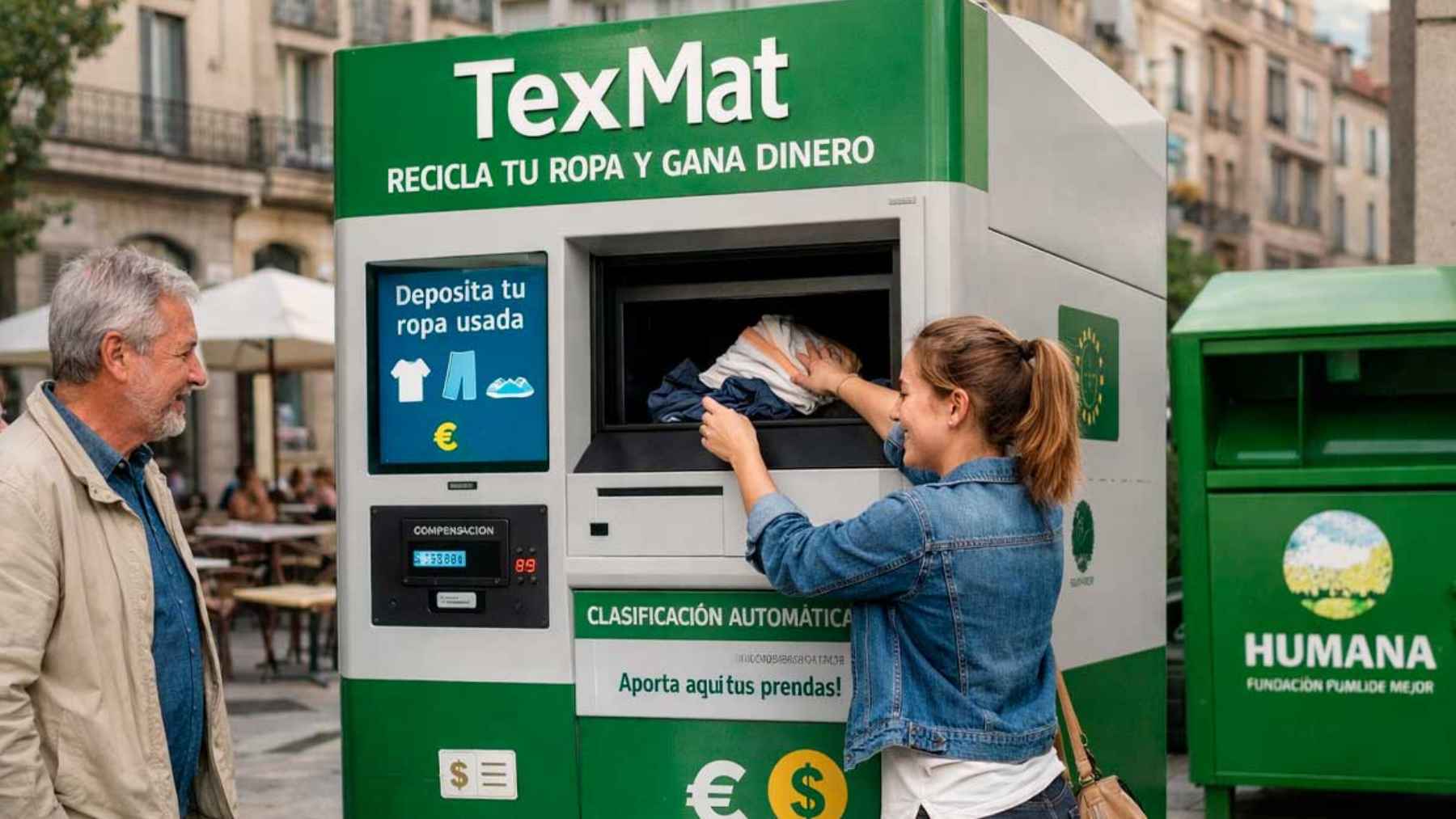
Spain is about to try something that sounds almost too simple. Drop your used clothing into a high-tech container, let the machine judge what it is, and get paid if it can be reused or recycled.
The pilot is part of TexMat, a European Union-backed project testing whether financial rewards and automated sorting can pull more textiles out of the trash and into the circular economy.
But the cash is only the headline. The bigger story is what happens behind the scenes, where Europe is building the rules, data systems, and business incentives that could make clothing waste feel less like a messy afterthought and more like a managed supply chain.
If this works, it could change how brands pay for waste, how recyclers get clean feedstock, and how consumers think about that overstuffed closet.
A deposit return idea for the clothes in your closet
Most people already understand the deposit-return concept from bottles and cans. TexMat is testing a similar logic for garments, using automated “smart containers” that sort clothing on the spot and tie payouts to what the item is actually worth in reuse or recycling.
The EU investment behind TexMat is described as about $7.0 million in Horizon Europe funding in the project’s launch materials. Using the European Central Bank reference rate for April 1, 2026 (1 euro equals $1.1605), that estimate lines up with public figures that range from roughly $7.0 million to about $7.8 million depending on how the project budget is reported.
That range matters because it hints at the project’s real challenge. This is not just about paying people to clean out their wardrobes. It is about paying for the infrastructure that makes sorting accurate, scalable, and cheap enough to run in the real world.
Europe’s textile waste problem is bigger than most people think
Europe’s textile and clothing sector is massive, with the European Commission describing it as generating about $197 billion in turnover in 2023 and employing 1.3 million people across roughly 197,000 companies. That scale is great for jobs and business, but it also means the waste problem is not a niche issue anymore.
On the waste side, the European Environment Agency says EU Member States generated about 6.94 million metric tons of textile waste in 2022, which is roughly 7.65 million U.S. tons. It also notes the capture rate was just under 15%, meaning most household textile waste still was not collected separately.
And the environmental footprint is not abstract. The EEA estimates the textile value chain for what EU households consumed in 2022 drove 159 million metric tons of CO2-equivalent emissions, about 175 million U.S. tons, which it compares to 1,800 kilometers of petrol car travel per person, roughly 1,118 miles.
How the smart containers are supposed to work
TexMat’s pitch is that the container does the hard part. Instead of asking consumers to decide what is “donation quality” versus “recycling only,” the system uses automated assessment to sort items into reuse, recycling, or disposal streams.
The project also leans on digital product passports, which are meant to carry key information about what a garment is made of and how it was produced. CORDIS, the European Commission’s research news service, says TexMat plans to record material information using these passports and notes the EU is phasing them in starting in 2026 and 2027.
There is also a business signaling layer built in. TexMat says it can notify producers when discarded textiles require formal waste management, which fits neatly with the EU push toward extended producer responsibility, where brands and producers fund collection and treatment.
Why Spain is a proving ground
Spain’s pilot is expected to start small, with two containers in 2026, one in an urban area and one in a less populated setting. That detail matters because it frames this as a behavior test as much as a technology test.
Spain is also a high-stakes market for textiles. Reuters has reported that official data show only 12% of used clothing is collected separately in Spain, while 88% ends up in landfill, and that residents discard about 20 kilograms of clothing per year, roughly 44 pounds per person.
Other Spanish industry sources land in a similar zone. The Spanish Federation of Recovery and Recycling cites about 890,244 metric tons of textile waste generated annually, around 981,556 U.S. tons, and about 19 kilograms per person, roughly 42 pounds. Either way, it is a lot of fabric.
The money matters, but so do the business incentives
The payout is the hook that gets people to try something new. Spanish reporting on the pilot emphasizes that the compensation amount has not been made public and will depend on the garment’s condition and quality, which is a polite way of saying your shredded gym shirt is not going to be valued like a barely worn coat.
That quality-based reward is not just a consumer feature. It is also a way to protect the system from being flooded with low-value material that drives up handling costs and leaves recyclers stuck with contaminated or unusable loads.
For businesses, the incentives are even sharper. If automated sorting can lower labor costs and improve “right routing” of textiles, it can strengthen secondhand supply while making recycling streams more predictable, which is the difference between a circular economy on paper and one that actually works at scale.
Sorting and recycling capacity are the real bottlenecks
The uncomfortable truth is that collection is only step one. The European Commission has warned that textile waste management needs clearer rules and better sorting, including requirements that separately collected textiles undergo sorting before possible shipment so waste is not mislabeled and exported as “reusable.”
This is where technology can help, but it cannot do magic. Fiber blends, mixed materials, and low-quality fast-fashion items can be difficult to recycle into anything close to the original product, and every wrong sorting decision adds cost downstream.
TexMat’s project leader Elina Ilén has argued that the solution could help “transform the collection and resale” of valuable used garments while reducing reliance on manual work. That is the promise, and it is also the test.
Digital product passports raise a new question about data
Digital product passports sound technical, but the consumer version is easy to imagine. Think of a QR-style identity card for your jacket that tells systems what it is, what it is made of, and how it should be handled when you are done with it.
For brands and regulators, that same data can support extended producer responsibility and fee systems that change based on sustainability criteria, which the European Commission describes as part of its approach. In practical terms, it means design choices could affect what companies pay later when products become waste.
Still, data only works if people trust it. If consumers feel like the bin is watching more than the clothing, participation could drop, and a pilot with two containers can reveal those social frictions fast.
What to watch as the pilot moves from concept to streets
TexMat is slated to run through March 2029, which gives the consortium time to measure something more meaningful than a launch-day headline.
The real metrics are participation, contamination rates, how much ends up in reuse versus recycling, and whether the system can be scaled without turning into a money-losing logistics exercise.
There is also a policy clock ticking in the background. The EU’s revised Waste Framework Directive that entered into force on October 16, 2025, sets stronger expectations around textile waste management and extended producer responsibility, and projects like TexMat are effectively testing how those rules might play out in everyday life.
In the end, the pilot is asking a simple question with big consequences. Can a smart bin, a small payout, and better data turn a closet cleanout into the start of a real circular textile market?
The official update was published on the European Commission CORDIS.