President Donald Trump has signed an executive order aimed at protecting a very specific slice of American life, the four-hour television window for the annual Army-Navy football game on the second Saturday of December.
The order, titled “Preserving America’s Game,” directs federal officials to work with college football leaders and media partners so no College Football Playoff broadcast overlaps the rivalry.
It sounds simple, almost quaint. But it drops the federal government into a modern tug of war that mixes military tradition, billion-dollar media rights, and the messy reality that an executive order cannot directly command private networks or the NCAA.
So what is this move really trying to do, and what could it change for fans flipping channels on a cold December Saturday?
What the order says
The White House order states it is U.S. policy that no college football game, including the CFP and other postseason games, be broadcast in a way that “directly conflicts” with the Army-Navy game. It frames the rivalry as a morale-building national event tied to the military service academies, not just another matchup in the schedule.
In practical terms, it instructs the Secretary of Commerce and the FCC chairman to coordinate with the CFP Committee, the NCAA, and broadcast rights partners to establish an “exclusive window” for Army-Navy. That is the key phrase, because the order is built around coordination and pressure, not a new sports law passed by Congress.
The most legally sensitive line is the one aimed at broadcasters. The order says the FCC chairman should consider reviewing the “public interest obligations” of broadcast licensees to see whether those obligations would require Army-Navy to remain a protected national service event.
A tradition built for national attention
Army-Navy is not the biggest brand game in college football, but it has something most matchups do not, a national stage all to itself. The rivalry has been played annually for decades and has continued even through major disruptions like wartime and the COVID-19 pandemic, which is part of why it carries symbolic weight far beyond the standings.
The attention is also measurable, not just sentimental. The 2025 Army-Navy game averaged 7.84 million viewers, according to the game’s own media release, and the 2024 edition drew a record 9.4 million viewers on CBS, per Sports Business Journal. Those are the kinds of numbers that make a “standalone window” feel like valuable real estate.
CBS has leaned into that identity by locking in long-term rights. Army and Navy extended their CBS Sports multi-platform deal through 2038, keeping the game on CBS and Paramount+ for years to come.
The business math of a protected Saturday
The timing issue is not about the current CFP calendar as much as what might come next. Under the 12-team format, CFP first-round games have been scheduled for the following weekend, not the Army-Navy weekend, and for the 2026 season the first round is set for December 18 and 19.
That leaves December 12, 2026, clear for Army-Navy at MetLife Stadium in New Jersey.
The fear inside the order is expansion creep. Reuters and the Associated Press both reported the administration’s concern that if the CFP grows beyond 12 teams, potentially even to 24, the sport may need to start playoff games earlier in December, which is exactly where Army-Navy sits.
And the money behind the playoff is enormous. ESPN and the CFP agreed to a new six-year deal worth $7.8 billion that keeps ESPN as the exclusive media rights holder through the 2031-32 season, a reminder that December scheduling is not only a sports decision: it is a major media-rights product decision.
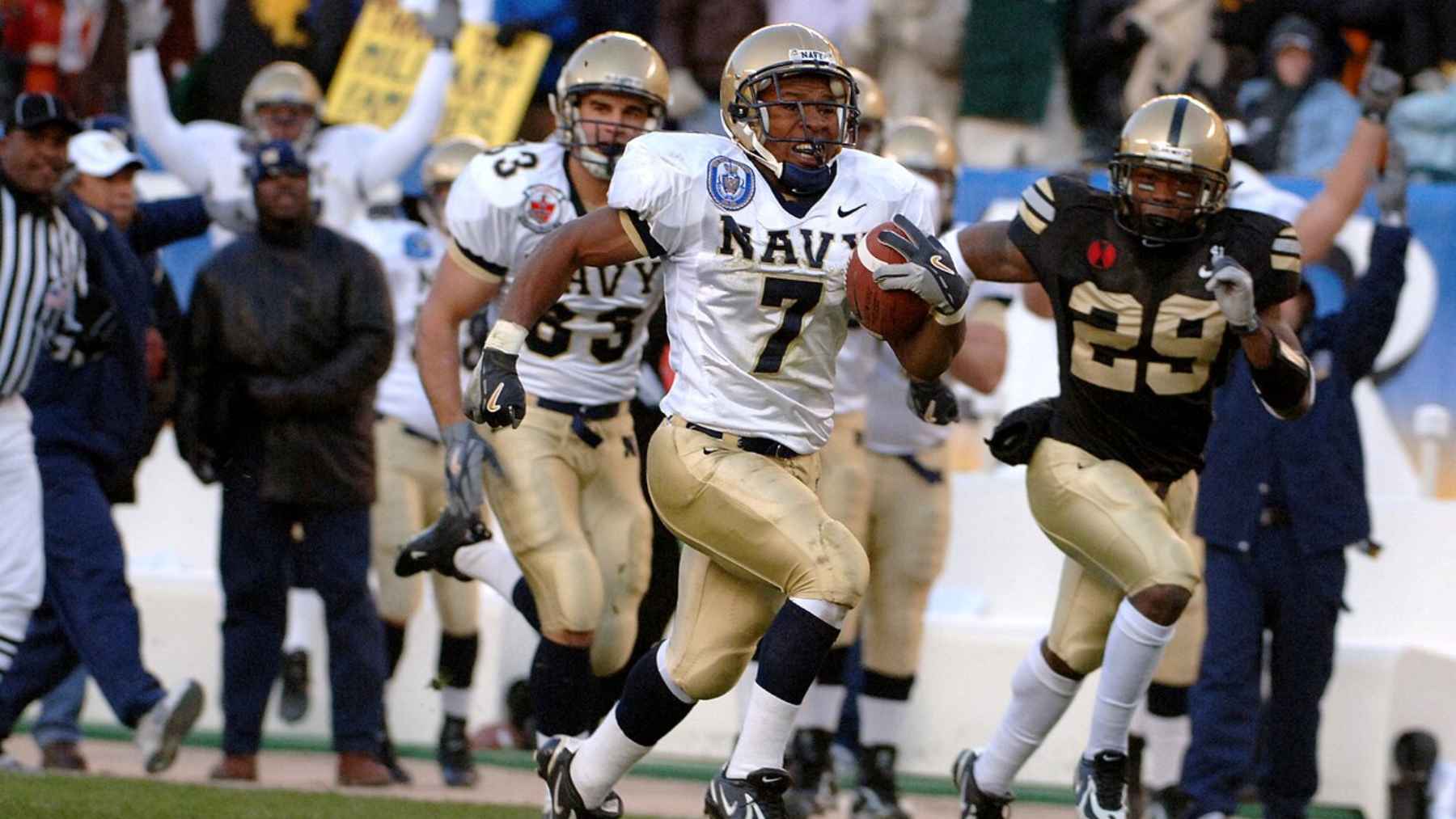
A Navy player breaks away for a touchdown during the Army-Navy game, a long-standing rivalry with national attention beyond college football.
Can the FCC police a sports schedule?
Here is the hard part. Executive orders generally bind federal agencies, not private leagues and networks, and several reports have noted that legal and regulatory questions are unavoidable when the government is seen as steering what broadcasters can air at a given time.
That is why the order’s FCC language matters so much. By pointing to “public interest obligations,” the order gestures at the FCC’s licensing authority over broadcast television, which is a different tool than simply “asking nicely.”
Media and legal coverage has already raised First Amendment concerns and basic enforcement questions, because telling broadcasters what they cannot air at a given time can quickly look like government pressure on speech.
Even the document itself hints at limits, saying it must be implemented consistent with applicable law and that it does not create enforceable rights for private parties. In other words, it reads less like an instantly enforceable ban and more like a warning shot designed to shape negotiations before a real scheduling fight erupts.
What changes and what probably does not
For the average fan, the short-term experience may look exactly the same. Army-Navy is already treated like a national appointment viewing event, and the 2026 calendar does not place CFP games directly on top of it.
Where it could matter is the next time college football’s power brokers seriously push the playoff deeper into December.
The CFP management committee has already announced it will keep the 12-team format through the 2026-27 season, which buys time, but it does not end the expansion debate. It just delays the moment when the calendar gets tighter and the temptation to double-book a Saturday becomes stronger.
The order also fits into a broader pattern of Washington showing more interest in college sports governance, from NIL rules to postseason structure.
Trump hosted a White House roundtable on college sports earlier this month, signaling that the administration sees the business of college athletics as something it can influence, even if the courts ultimately decide how far that influence can go.
The official statement was published by the White House.