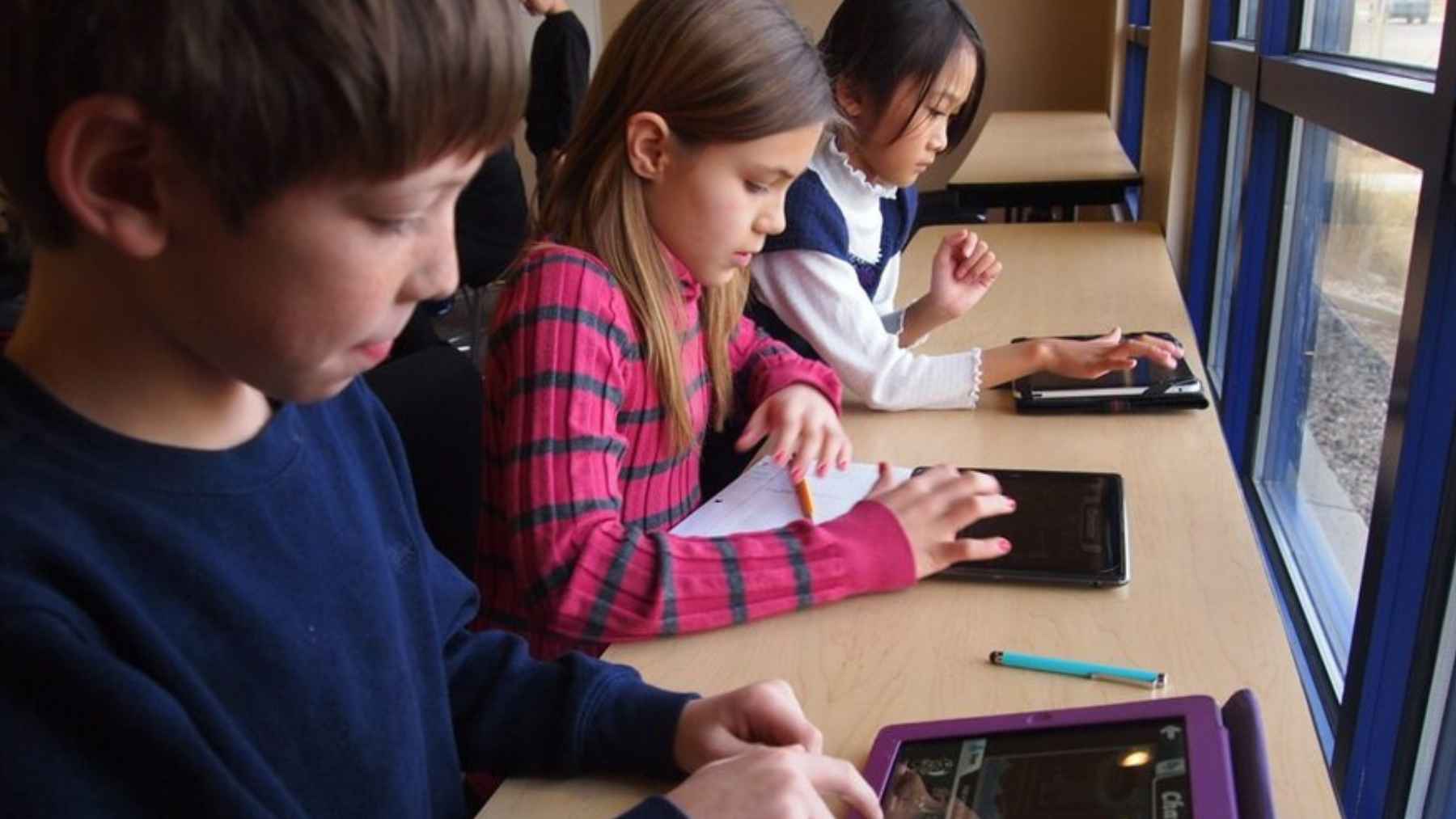
What happens when schools confuse access with learning? That is the question hanging over American classrooms after years of putting a laptop or tablet in nearly every student’s hands.
The warning is getting louder. In written testimony to the U.S. Senate in January 2026, neuroscientist Jared Cooney Horvath said literacy, numeracy, attention, and higher-order reasoning have declined across much of the developed world over the past two decades, even as schools expanded technology and public investment.
Maine, often seen as an early model, launched its statewide laptop effort in the early 2000s with the goal of preparing students for a faster digital world.
That does not mean every classroom device is a mistake. In fact, the data are more nuanced than the panic suggests. OECD analysis tied to PISA 2022 found that moderate use of digital devices for learning at school was linked to better math performance and a stronger sense of belonging.
But once use climbed too high, results worsened. Leisure use during school was more clearly associated with lower scores and more distraction. In practical terms, that means the problem may be less “technology” and more the way schools let it spill into every corner of the day.
The policy problem behind classroom technology
And that is where policy comes in.
Federal data show how deeply device culture is now built into school life. NCES said 88 percent of public schools had a one-to-one computing program for the 2024 to 2025 school year. At the same time, 77 percent of public schools prohibited cell phone use during class, and 53 percent of school leaders said phones hurt academic performance.
That says a lot. Schools are still handing out screens, but they are also trying to claw back student attention, one rule at a time. Anyone who has watched a teenager bounce between tabs, alerts, and short videos can probably guess why.
Why the debate is bigger than hardware
The bigger lesson is not that America should go back to chalkboards and overhead projectors. It is that friction still matters. Deep learning is usually slow, effortful, and a little uncomfortable.
Screens can help with that, to a large extent, when they are used with purpose. But when they turn class into a stream of interruptions, the device stops being a tool and starts acting like background noise.
That is the real policy failure. For years, education leaders sold hardware as if hardware alone could raise achievement. It did not. Now the harder work begins, deciding when technology sharpens the mind and when it simply steals the room.
The written testimony was published on the U.S. Senate Committee on Commerce, Science, and Transportation.