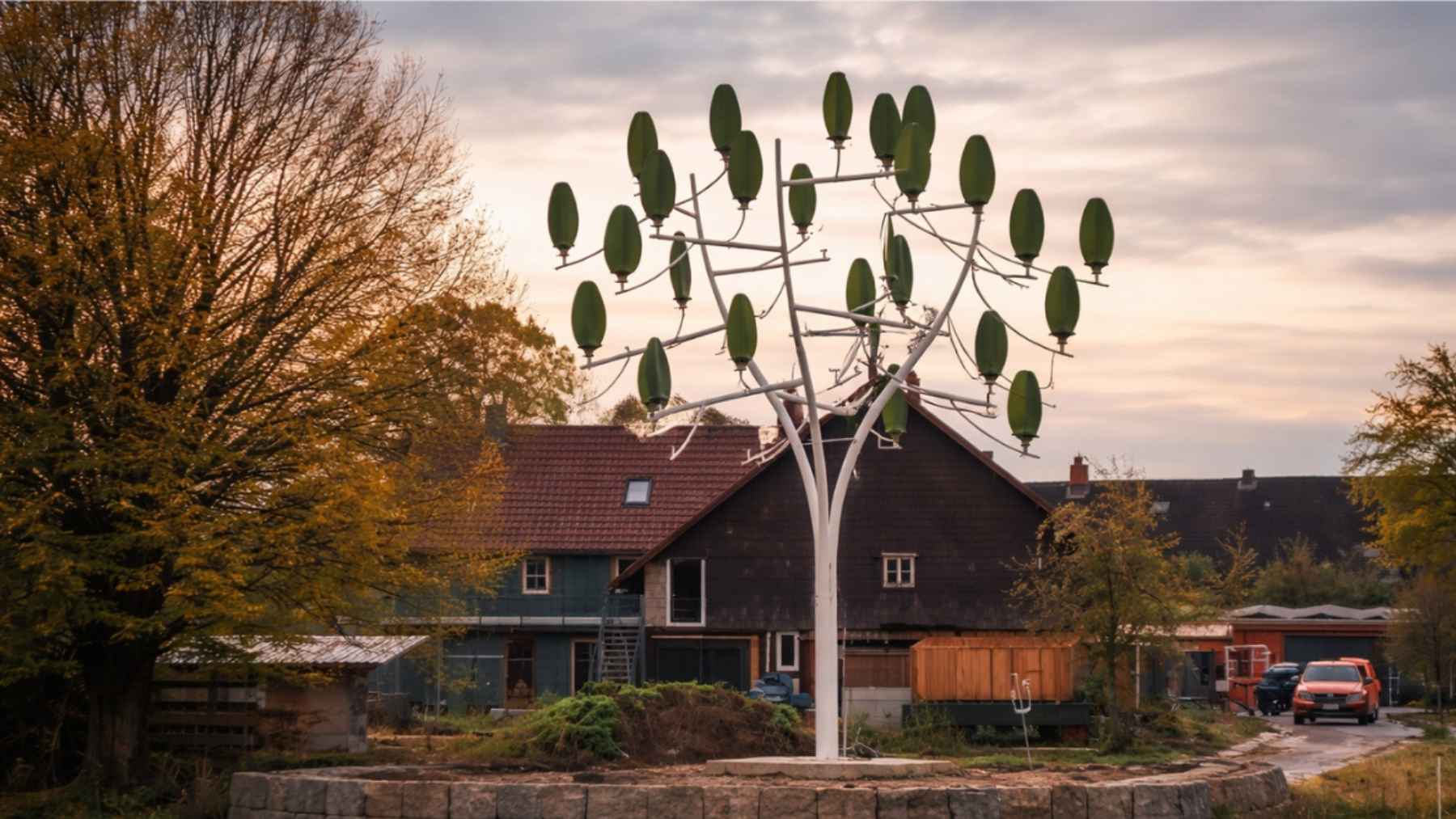
A metal “tree” with 36 green microturbines is now spinning in a private garden in Thüdinghausen, Lower Saxony, and its owner says it can help power his home, office, and electric car while driving his power costs to zero.
It is a striking image, and it lands in a familiar place for a lot of households right now: the monthly electric bill that keeps refusing to behave. But the bigger story is not the futuristic yard art. It is whether small wind can ever deliver enough real-world energy to justify a price tag that looks more like a vehicle purchase than a home upgrade.
A “tree” built for low wind
The system is marketed as the WindTree, a nearly 32-foot steel structure designed to look like an urban tree while producing electricity through leaf-shaped microturbines.
Those “leaves” are called Aeroleafs, and each is rated up to 300 watts in the manufacturer’s materials. They are independent modules, so the idea is that a failure on one “leaf” does not bring down the full system.
The pitch is also about practical living. The manufacturer says the microturbines start turning at about 5.6 miles per hour and are meant to be quiet enough for residential settings where noise complaints can kill projects fast.
One homeowner, one very expensive experiment
The homeowner, Sebastian Harms, is not starting from scratch. He already has two rooftop solar systems rated up to 10,000 watts each, and he sees the wind tree as a complement when solar output drops at night and during winter.
That kind of hybrid logic is easy to understand. Solar is strongest when the sun is up, but wind can show up in different patterns, and that is the whole bet behind pairing generation types with battery storage or other backup options.
The catch is the price. Harms told local media he invested about €70,000 in the install, which is roughly $81,000, including foundation and electrical work, and the timeline he has set is ambitious. He wants full self-sufficiency by 2029.
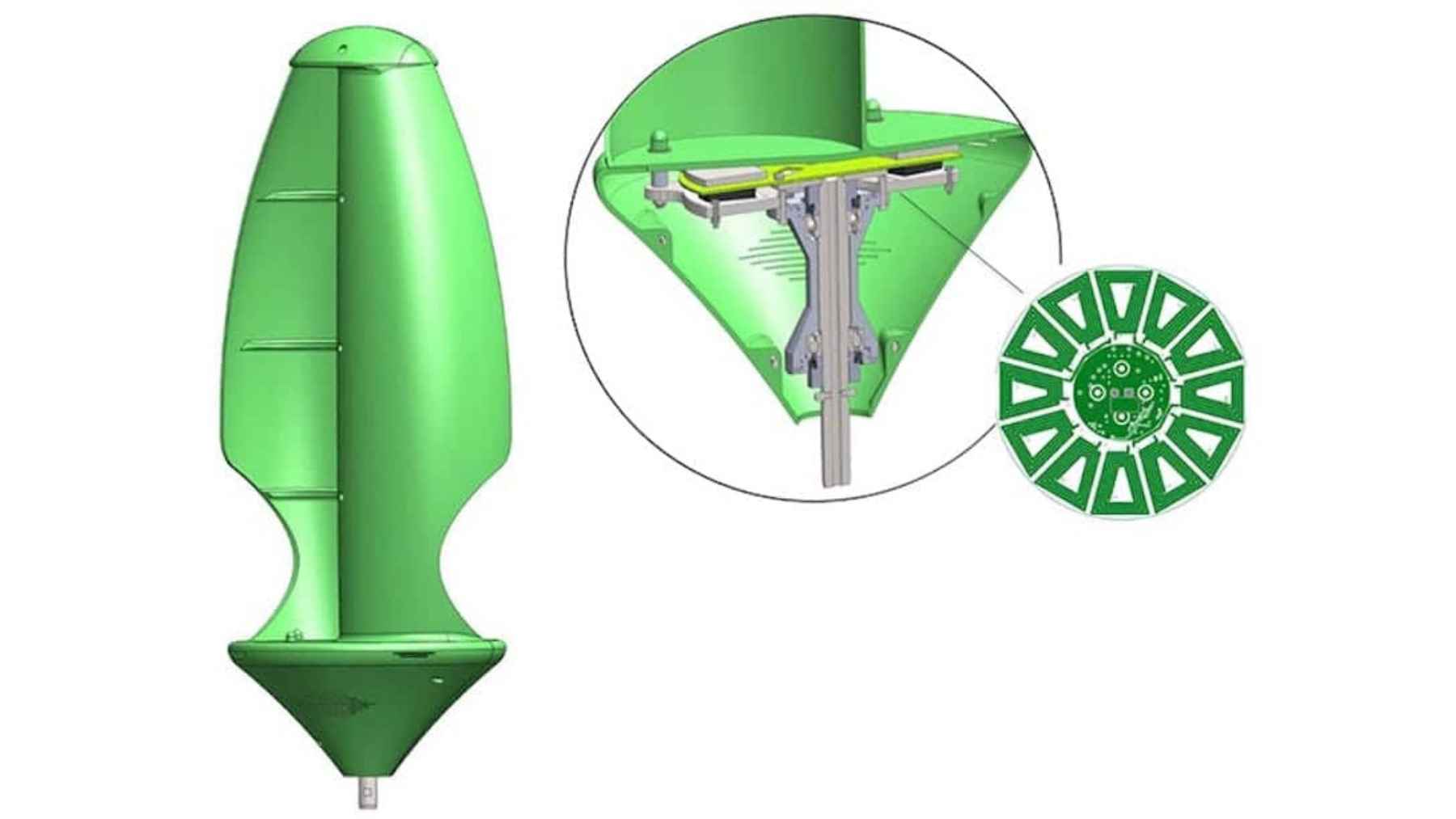
Independent modularity: An inside look at the Aeroleaf microturbine shows the internal generator that allows each “leaf” on the WindTree to operate independently.
Output numbers can fool people
The headline figure is 10.8 kilowatts of theoretical peak output, which sounds huge if you are thinking in terms of appliances and chargers. But capacity is not the same as production, and this is where many home-energy dreams run into reality.
What matters is energy over time, measured in kilowatt-hours. In Germany, regulators and analysts often use about 3,500 kilowatt-hours per year as a reference level for a typical household, and a home with an office and an EV can go well beyond that.
Wind also punishes bad sites. The U.S. Department of Energy notes that wind power depends heavily on wind speed, and in simple terms, small changes in average wind can mean big swings in what a turbine actually delivers.
The economics are the real hurdle
If the wind is strong and consistent, a micro-wind system can add meaningful energy, especially when it fills in gaps solar cannot cover. But if the site is sheltered, turbulent, or simply not windy enough for long stretches, the payback can stretch into uncomfortable territory.
That is why Harms says he plans to analyze production data over time, especially through winter, when the temptation is to believe wind will “save” the season. People know that feeling from everyday life. The days get shorter, the heat comes on, and the household power draw climbs right when solar production falls.
This is also why the “DIY energy” trend is spreading into multiple directions, from backyard wind to off-grid water setups that run day and night. If you want a sense of how far people are taking it, consider a mini power plant build that claims year-round generation without grid dependence.
Where micro-wind fits, and where it does not
For most homeowners, the practical role for small wind is not replacing the grid overnight. It is shaving the peaks, improving resilience, and pairing with solar and storage in a way that reduces purchases from the utility when prices spike.
Micro-wind also sits on a spectrum. On one end, you have fixed installations like this backyard tree. On the other, you have the rise of small, portable wind devices that promise charging power in the right conditions, such as a portable wind turbine meant for camping and emergency use.
And then there is the alternative that quietly beats them both in the right geography. Where water flow and elevation cooperate, off-grid electricity can be more consistent than either sun or wind, though it comes with its own permitting and safety complications.
What homeowners should ask before buying
The first question is boring, but it matters most. What is the actual wind resource at the turbine height on your property, and do you have real measurements rather than optimistic assumptions?
The next question is about what you are really trying to achieve. Is this about lowering costs, increasing independence, or simply proving a concept that feels worth it even if the spreadsheet never looks perfect?
Finally, there is the real-world test that separates marketing from results: production through the dull, cold months when demand rises and weather is unpredictable. If the numbers hold up through winter, this metal tree could become less of a novelty and more of a blueprint.
The official data sheet was published on New World Wind.