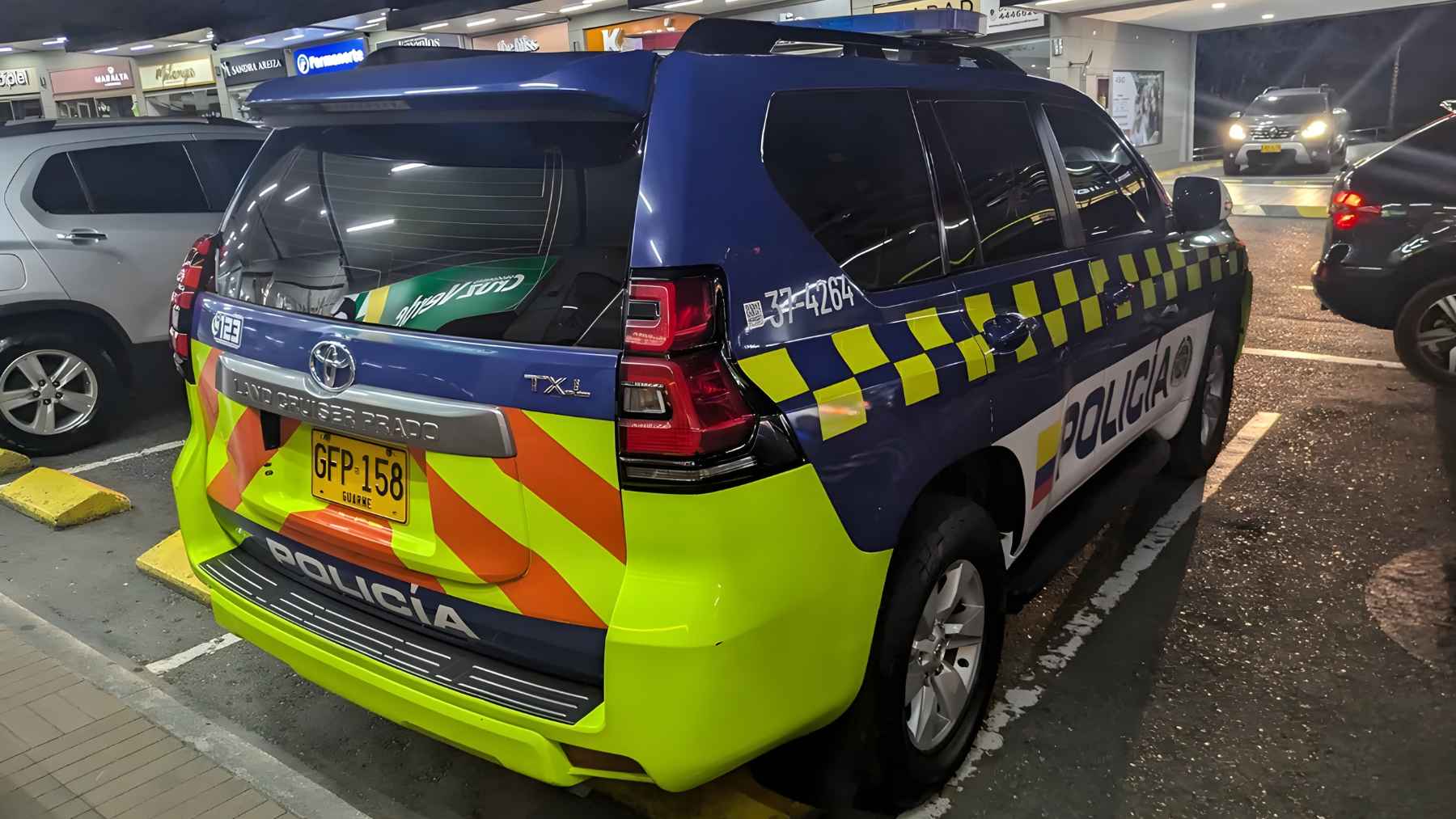
Colombia’s National Police has added four Toyota Land Cruiser Prado SUVs to its fleet, but these are built for a very particular job.
The diesel TX vehicles were recently armored by Colombian defense firm Armor International and are meant for liaison and transport missions involving senior personnel, with initial deployment planned through the institution’s national directorate in Bogotá.
It is a small buy, yet it says a lot about how protection is changing in 2026. What matters now is not only whether armor can defeat rifle rounds, but whether the vehicle can keep leaders moving when threats range from firearms to drones and when traffic can turn any route into a slow, exposed crawl.
A small fleet with a big job
Infodefensa reports that the SUVs received NIJ Level III protection through a mix of special steel ballistic panels, high-strength composite materials, and reinforced multilayer glass installed across doors, sides, the roof, and other critical areas. The police plan to use them for high-ranking personnel transport, which is usually when security risks and public visibility collide.
Bogotá is not Colombia’s most lethal city, but it is still a major capital with real security pressures. An EUAA compilation of national police statistics puts Bogotá’s 2024 homicide rate at about 15.2 per 100,000 residents, while Colombia’s national rate was 25.4 per 100,000 that year. That gap helps explain why targeted protection can matter even when overall crime is not at its peak.
What “NIJ III” really means
NIJ is the U.S. National Institute of Justice, and its ballistic labels have become a common reference point well beyond the United States. In NIJ Standard 0123.00, the older “Level III” label maps to “RF1,” a rifle threat category, and NIJ says the newer naming system is meant to reduce confusion for law enforcement users.
The RF1 test threats include 7.62×51 mm NATO M80 ball and 7.62×39 mm mild steel core ammunition at specified reference velocities. Put into U.S. units, those cartridge dimensions are roughly 0.30 by 2.01 inches and 0.30 by 1.54 inches, respectively, and they match the calibers cited in the police description of the vehicles’ protection level.
Here is the part most people miss. NIJ also stresses that Standard 0123.00 lists protection levels and test threats, but it does not, by itself, lay out the performance requirements or test methods for a specific piece of equipment. So when you see “NIJ III” on a vehicle, the practical follow up is simple: which lab testing, which protocol, and which documentation.
Armor that still lets you move
The armoring described for these Prados is designed to keep rounds from penetrating into the cabin by absorbing and dispersing impact energy through multiple ballistic layers. Infodefensa says the protection package uses both steel and composites, paired with reinforced multilayer glass in key areas, which is the typical recipe for balancing durability and weight.
Mobility is treated as part of the protection, not a nice extra. The report also points to chassis reinforcements, overlapping panels around door joints and frames, and run flat tires that can keep the vehicle moving even after impacts or a loss of pressure.
If you have ever been stuck in stop-and-go traffic, you already know why “keep moving” can be the difference between leaving safely and sitting exposed.
The threat backdrop is evolving
Colombia’s violence trends do not move in a straight line. The EUAA report notes a slight decline in the national murder rate in 2024 to 13,393 murders, even as the country’s homicide rate remained high by regional standards. In other words, “better than last year” can still mean “high risk,” depending on where you are and who you are.
Meanwhile, explosives and remote attacks are shaping day-to-day security planning. The ICRC reported that between January and May 2025, it recorded 524 people wounded or killed by explosive devices, a 145% increase compared with the same period in 2024, and tied the surge in part to the intensive use of weaponized drones and improvised launchers.
That drone detail is not abstract. The New Humanitarian reports that the government registered 115 drone attacks in 2024, and notes that drones can be used to scout targets such as police facilities before an attack.
At the same time, ACLED found violence targeting civilians fell by 20% in 2024 to nearly 1,500 events, which is a reminder that fewer lethal incidents does not always mean fewer threats in daily life.

The business angle behind the glass and steel
Armor International’s role matters because it points to local capacity, not just imported hardware. The company markets vehicle and specialized armoring and says it exports to the Americas, Europe, Asia, and Africa, which suggests Colombia’s security supply chain is not only domestic but outward facing.
That matters for government buyers, too. Armored vehicles require ongoing inspection and repairs, especially for components like ballistic glass and run-flat systems, so having a nearby industrial base can reduce downtime and simplify sustainment.
Over time, the quieter story may be less about the initial purchase and more about whether maintenance keeps the protection level consistent.
What to watch next
A four-vehicle rollout will not transform policing in Bogotá. But it does raise fair questions about how agencies specify ballistic standards, how they verify testing, and how they train drivers to use armored mobility safely under pressure.
There is also a language shift coming. NIJ’s current system explicitly separates handgun threats from rifle threats and ties “Level III” to RF1, so procurement teams that still use the older labels may need to spell out the exact threat set they mean.