Solar panels are great at one thing, and sometimes that is the problem. They keep making electricity even when a building does not need much, while solar thermal systems keep making heat on days when everyone is already sweating.
Harvard engineers have now shown a different approach in a new study. Their prototype uses water’s phase change to route sunlight into either electricity or indoor heat, without sensors, pumps, or control electronics. What if a solar-panel window or skylight could do that quietly, all by itself?
Why solar output often misses the moment
Buildings are a huge part of the energy story, and not just because they have roofs. The International Energy Agency says building operations account for about 30% of global final energy consumption and 26% of global energy-related emissions, much of it tied to heating, cooling, and electricity use.
In the United States, the seasonal swing is obvious when the bill arrives. The U.S. Energy Information Administration estimates that 52% of household energy use in 2020 went to space heating and air conditioning, two demands that rarely peak at the same time.
Cooling is also becoming the louder drumbeat. The IEA has warned that global energy demand from air conditioners is expected to triple by 2050, which is why summer electricity peaks are such a stubborn planning problem.
A panel that decides without sensors
The device is described in a paper posted online on March 24, 2026, in the Proceedings of the National Academy of Sciences by Raphael Kay, Rafiq Omair, and Joanna Aizenberg at Harvard. The core idea is simple even if the optics take a minute to picture.
At the center is a Fresnel lens, a flat, ridged lens that can concentrate sunlight without a bulky curved shape. Above that lens sits a sealed cavity holding a fixed amount of water, and below it sits a small photovoltaic cell, with the indoor space beneath acting as a place where light can become heat.
Here is the trick. When the cavity is warm and the water stays as vapor, the optical conditions let the lens focus light onto the solar cell for electricity.
When it cools and the water condenses into a thin film, the focusing effect weakens and more light bypasses the cell and is absorbed indoors as heat, so the output flips on its own.
Lab results that stand out
In one demonstration, the team set the enclosed air so the dew point was near 59°F (15°C). Given average seasonal temperatures in Boston, researchers said electricity production could dominate from May through October, while heat could dominate from November through April.
They also noted that adjusting the enclosed humidity could shift that crossover point to better match local climate needs.
In lab tests that cycled outdoor conditions from about 50°F to 95°F (10°C to 35°C), the system behaved as designed. As the outside temperature rose, indoor temperature in the setup fell from about 77°F to about 71.6°F (25°C to 22°C), while light intensity on the photovoltaic cell increased by roughly 50%.
The heating numbers are the headline grabbers. In heating mode, the system converted about 90% of incident sunlight into indoor heat, and Kay estimated that could be roughly five times the solar heating yield of using a photovoltaic panel paired with electric resistance heating.
The sun angle problem
A solar concentrator lives and dies by geometry, and the team is upfront about that. Because the unit is mounted at a fixed tilt and orientation, it concentrates light efficiently only during certain hours and seasons, when the sun hits at the right angle.
When the sun is off angle and the light does not focus sharply on the solar cell, the device tends to default toward solar thermal behavior. That can be useful in winter, but it is not always what you want on a bright spring afternoon when heat is the last thing you need.
Researchers say they are developing strategies to widen the number of hours when both modes are available. That work will likely decide whether the concept stays a clever lab demo or becomes something architects can actually specify.
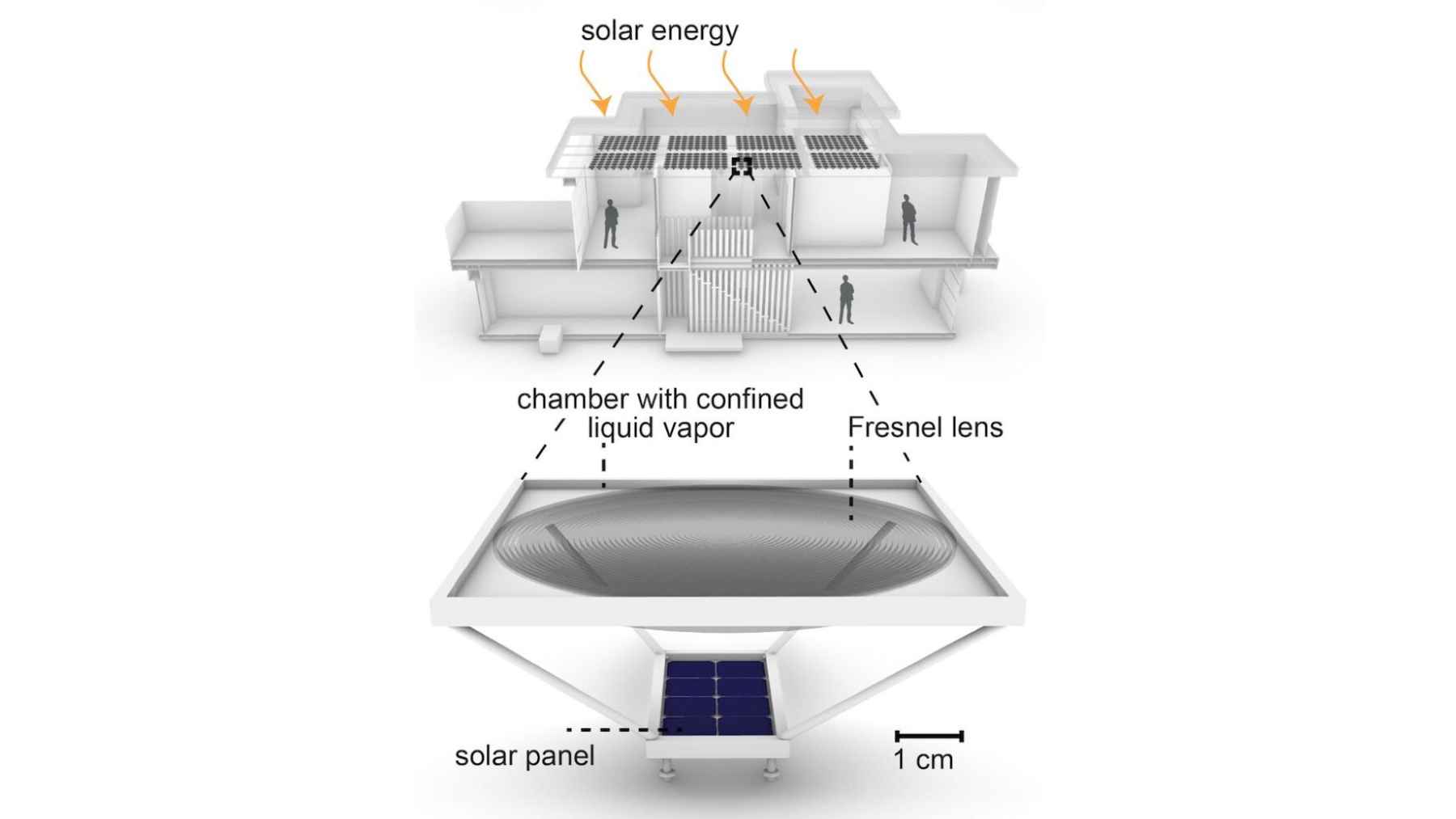
Beyond electricity: This architectural diagram shows how Harvard’s prototype integrates into a building to harvest both light and heat.
Where it could fit in real buildings
The most interesting part may be where it lives. The Harvard team has pointed to integration in skylights or facades, turning the building envelope into a kind of quiet energy manager that does not need a software update. Aizenberg described the commercial appeal as “a component that can be laminated into skylights or facades.”
In practical terms, that could help with two everyday annoyances at once. A system that biases toward electricity during hot spells could support air-conditioning loads when the sticky summer heat hits, while shifting toward indoor heating when cold snaps show up and boilers start working overtime.
There is also a resilience angle that goes beyond comfort. Passive hardware that reduces reliance on external controls can be attractive for facilities that hate downtime, including hospitals, data centers, and potentially some military or emergency operations sites, though real deployment would depend on durability, cost, and integration details.
What has to be proven next
This is still early-stage engineering, and the real world is rougher than a lab bench. Sealed cavities have to stay sealed, materials have to survive years of UV exposure, and any building-integrated product has to fit codes, maintenance routines, and safety requirements.
Commercially, the path looks plausible because the authors disclose they are inventors on a recently filed U.S. provisional patent application. If the design scales and the sun angle limits can be eased, the biggest payoff may be flexibility: one panel that can complement rooftop photovoltaics and building heating without asking occupants to babysit it.
Not magic. Just physics. The study was published in PNAS while related solar performance work is also evolving in areas like solar engineering, grid reliability and battery storage, U.S. utility-scale generating capacity, and everyday resilience ideas such as off-grid energy production.