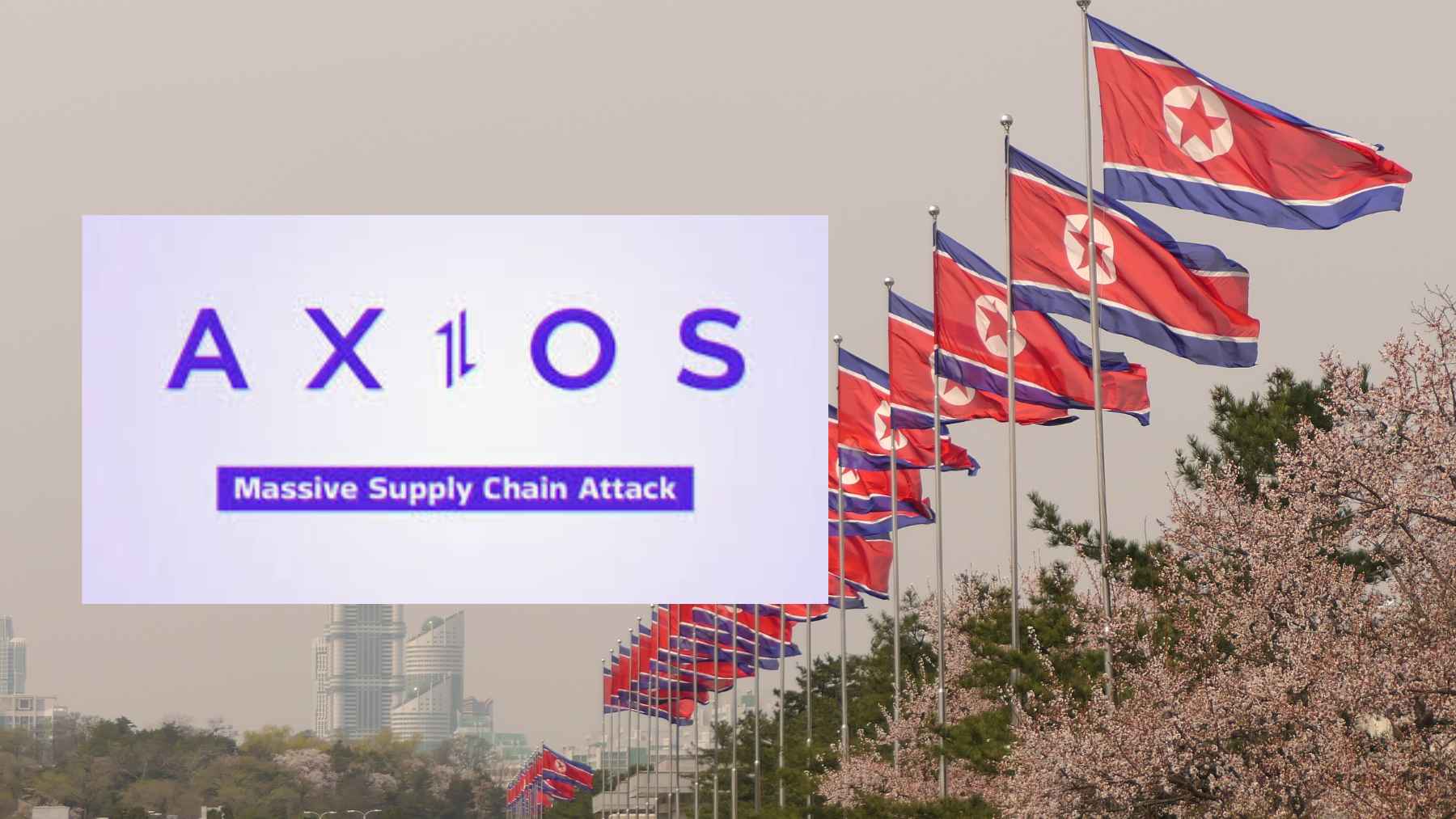
A suspected North Korea-tied hacking group briefly poisoned the widely used JavaScript library “axios” in a supply chain attack that could ripple across developer laptops and corporate build systems for weeks.
Google and multiple cybersecurity firms say the attackers slipped credential-stealing malware into malicious releases that were available only for a short window before being pulled down.
It sounds niche until you remember how modern software gets built. Axios is the kind of “invisible plumbing” that helps apps talk to online services, and it shows up inside countless products even when a company never chose it directly.
That is why a few hours of access to a maintainer account can become a business problem, and for some firms, a national security one.
What happened
Attackers compromised publishing access for the official axios package on npm and pushed two malicious versions, “axios@1.14.1” and “axios@0.30.4,” according to incident responders. Those releases were available in the early hours of March 31, 2026 (UTC) and were removed within roughly three hours, but any machine that installed them during that window could have been hit automatically.
This is the uncomfortable part of a supply chain attack. As one researcher told Reuters, “You don’t have to click anything or make a mistake” because the trusted tool does the damage on install. In practical terms, that means a routine dependency refresh can turn into an incident response call.
Huntress said it observed at least 135 endpoints contacting attacker infrastructure during the exposure window across operating systems. That is not a full victim count, but it is a real-world signal that the malicious releases landed fast and traveled through normal workflows.
Why Axios is a big target
Axios is a popular JavaScript HTTP client used to make web requests from browsers and servers, and it is not affiliated with Axios Media. Think websites, mobile apps, internal dashboards, and all the little services calling APIs behind the scenes. In other words, it is everywhere because it is useful.
How big is “everywhere” exactly? Estimates vary, but they are all huge. Wiz told Axios the library is downloaded roughly 100 million times per week and shows up in about 80% of cloud and code environments, while Sonatype described axios as seeing more than 300 million weekly downloads in the npm ecosystem.
That scale is why attackers keep coming back to open-source choke points. A single compromised dependency can reach a developer workstation, a CI runner, and a production service before anyone notices, often while someone is just grabbing coffee and letting a build pipeline run.
Huntress specifically warned that developer machines and CI environments tend to hold the exact secrets an attacker wants.
Attribution and the North Korea angle
Google attributed the activity to a group it tracks as “UNC1069,” which it has linked to targeting cryptocurrency and financial organizations. Reuters also reported that North Korea uses stolen cryptocurrency to fund weapons programs and to help evade sanctions, which is why a software library breach can quickly become a Military and Defense story as well as a Tech one.
Google’s threat analysts framed this as part of a familiar pattern, describing North Korean hackers as experienced with supply chain attacks aimed largely at crypto theft.
That does not mean every infected machine belongs to a crypto firm, but it does shape what defenders should assume about follow-on behavior, like credential abuse and lateral movement.
Researchers also emphasized how broadly the malware could run. Reuters cited analysis that the attackers built malware capable of infecting Windows, macOS, and Linux systems, increasing the odds it could land in mixed corporate environments rather than a single niche.
The trick inside the malicious releases
One reason this incident is making defenders uneasy is that the poisoned axios versions did not need to visibly rewrite axios itself. Sonatype and Huntress both described a hidden dependency approach, where the compromised releases pulled in a newly published package named “plain-crypto-js” that executed during installation and acted as a loader for a remote-access trojan.
That matters because it changes what “spotting the bad code” looks like. Huntress documented anti-forensics behavior where the dropper cleaned up after itself, including deleting evidence tied to install scripts and swapping in a cleaner-looking stub, which can make later inspections misleading.
If you are only checking what is currently in your dependency folder, you may be checking the wrong thing.
The end result is straightforward even if the chain is not. A remote access trojan gives an attacker the ability to run commands, collect system information, and potentially pivot toward the credentials that software builders keep close at hand. Reuters noted the malicious software could expose data and access credentials that enable further operations.
What security teams should do right now
First, find out whether your environment ever pulled the affected versions. Huntress andSnyk both advised organizations to audit dependency manifests and lockfiles for “axios@1.14.1” and “axios@0.30.4,” and to treat any system that installed them as potentially compromised.
Rotate secrets and credentials that might have been exposed, especially tokens used in CI, cloud access keys, and developer workstation credentials.
Second, remember that transitive dependencies count. You may not have typed “install axios” yourself, but a package you do use might have, and Huntress noted the first observed infections aligned with automated installs resolving a fresh version immediately.
That is why defenders often look at build logs, artifact timestamps, and package manager caches from the exposure window, not just current source trees.
Finally, treat this as a board-level software supply chain lesson, not just a Patch Tuesday headache. Sonatype’s team summed up the dynamic well when it said, “Attackers have figured out they don’t need to compromise the code people trust” if they can compromise the trust around it.
For companies, that translates into basics like stronger publishing controls, shorter-lived tokens, tighter dependency pinning, and monitoring that assumes a trusted package can betray you.
The bigger lesson for business and defense
If this breach feels like it came out of nowhere, that is part of the problem. Modern software supply chains are optimized for speed, and speed is great until it becomes a delivery mechanism for someone else’s payload. The same automation that keeps products shipping can also turn a three-hour compromise into an enterprise-wide exposure review.
There is also a strategic layer that businesses sometimes file under “someone else’s issue” until it hits their own build systems. When a state-linked actor is suspected, the line between cybercrime and geopolitical funding gets blurry, and stolen credentials can become the bridge from a developer box to a higher-value environment.
That is why supply chain defense is now part of operational resilience, not just IT hygiene. Short window, long tail. That is the story teams are living with this week.
The advisory was published on Huntress.