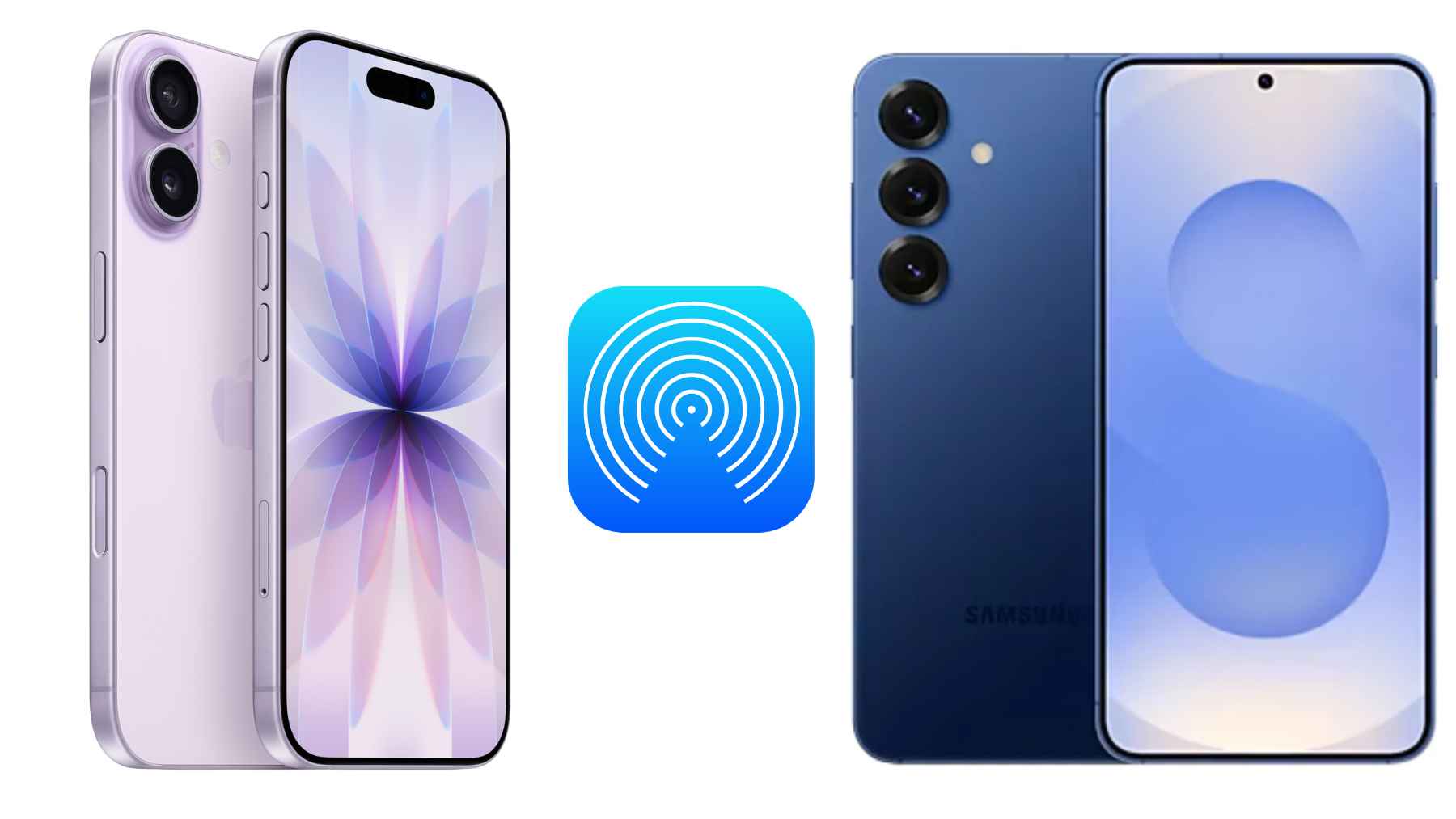
If you have ever been standing next to a friend who says, “Just AirDrop it,” and you are holding an Android phone, you know the awkward pause that follows. On Samsung’s new Galaxy S26 lineup, that pause is starting to disappear, because AirDrop file sharing is now working between Galaxy and iPhone.
This is not just a convenience upgrade. It is a signal that the biggest mobile platforms are being pushed, by consumer habits and regulation, toward something closer to real interoperability, whether Apple likes it or not.
A new button that changes the routine
Samsung says the Galaxy S26, S26+, and S26 Ultra now support AirDrop through Quick Share, with rollout beginning March 23 starting in Korea and expanding to multiple regions including Europe and North America. In other words, it is not a lab demo – it is a shipping feature.
On the Galaxy side, users will see a setting labeled “Share with Apple devices,” and Samsung notes the feature is turned on by default. The practical result is simple: you can send photos, videos, and documents directly to iPhones, iPads, and Macs without third-party apps or the usual “email it to yourself” workaround.
That last part matters more than it sounds. In a workplace where half the team carries iPhones and the other half carries Galaxy phones, this is the difference between a two-tap transfer and five minutes of fumbling right before a meeting.
Google built the bridge first
Samsung is not the origin story here. Google introduced Quick Share compatibility with AirDrop in November 2025, starting with the Pixel 10 family, and framed it as a basic expectation that “sharing should just work” regardless of device.
Google also positioned this as part of a broader campaign to reduce cross-platform friction, alongside efforts around RCS messaging and unwanted tracker alerts. AirDrop has been one of the most visible “sticky” Apple-only features, so cracking the file-sharing barrier is a major symbolic win for Android.
In Bloomberg’s reporting around the Galaxy S26 rollout, Google’s Android ecosystem president Sameer Samat put it bluntly. He argued that in 2026, with advanced AI everywhere, people should obviously be able to share a photo with someone else in the same room.
The business math behind a simple photo
This story is really about market gravity. Android and iOS together account for essentially the entire smartphone landscape, and StatCounter’s March 2026 figures put Android at about 67.46% worldwide versus iOS at about 32.27%.
In the United States, it flips. StatCounter shows iOS at about 63.09% in March 2026, compared with Android at about 36.71%.
So why would Samsung and Google care so much about a feature that looks small on paper? Because friction is a lock-in strategy. If AirDrop stops being Apple’s private hallway between iPhone, iPad, and Mac, then switching phones becomes less scary, especially for students, families, and companies that live in mixed-device reality.
Regulation is in the background, even when nobody says it out loud
Google and Samsung are not claiming Apple helped build this. In fact, WIRED reported that Google said it “has not worked with Apple” on the cross-compatibility and implemented the feature itself, while also saying it would welcome working with Apple to improve how it behaves under stricter AirDrop settings.
Still, the timing is hard to ignore. In the EU, the Digital Markets Act includes interoperability obligations, and the European Commission has emphasized interoperability for features controlled by iOS and iPadOS under Article 6(7).
Apple has also set up a formal process for developers in the EU to request interoperability with iOS and iPadOS features, including timelines for initial eligibility assessments in many cases. That does not mean AirDrop has been “opened,” but it does show Apple is operating under a new kind of scrutiny in one of its most important markets.
At the end of the day, this is what regulators often want – lower switching costs. And this is what platform owners often resist, because switching costs protect margins.
Security questions are real, and the “Everyone” mode is a clue
Whenever two ecosystems start talking directly, security becomes the immediate follow-up question. Google has said it built Quick Share’s AirDrop interoperability with security as a core requirement and pointed to testing by independent security experts.
There is also a reason early reporting keeps mentioning AirDrop’s “Everyone for 10 Minutes” setting. WIRED noted that this mode is a requirement for the cross-platform sharing to work in at least some cases, and Apple’s own support documentation explains that “Everyone for 10 Minutes” automatically reverts after 10 minutes.
That design choice is telling. The convenience is real, but it is being delivered through a controlled window that reduces long-term exposure, which is exactly the kind of compromise you would expect when privacy, safety, and ease of use are all fighting for space on the same screen.
Expect a messy rollout, then a bigger shift
Samsung’s own announcement says AirDrop support will initially be available on the Galaxy S26 series, with expansion to additional devices to be announced later. If you are waiting for older Galaxy models to get it, that is the direction of travel, but it may not be instant everywhere.
And the rollout already looks uneven in the real world. Some tech outlets report the setting appearing on older Galaxy devices but not fully functioning yet, suggesting staged updates, server-side switches, or software version dependencies.
The bigger question is what happens if this becomes normal. When file sharing stops being a brand-exclusive perk, phone choice shifts a little more toward hardware, price, and services, and a little less toward “who can I easily send stuff to.”
That is a subtle change. It is also how platform power erodes, one everyday habit at a time.
The official statement was published on Samsung U.S. Newsroom.