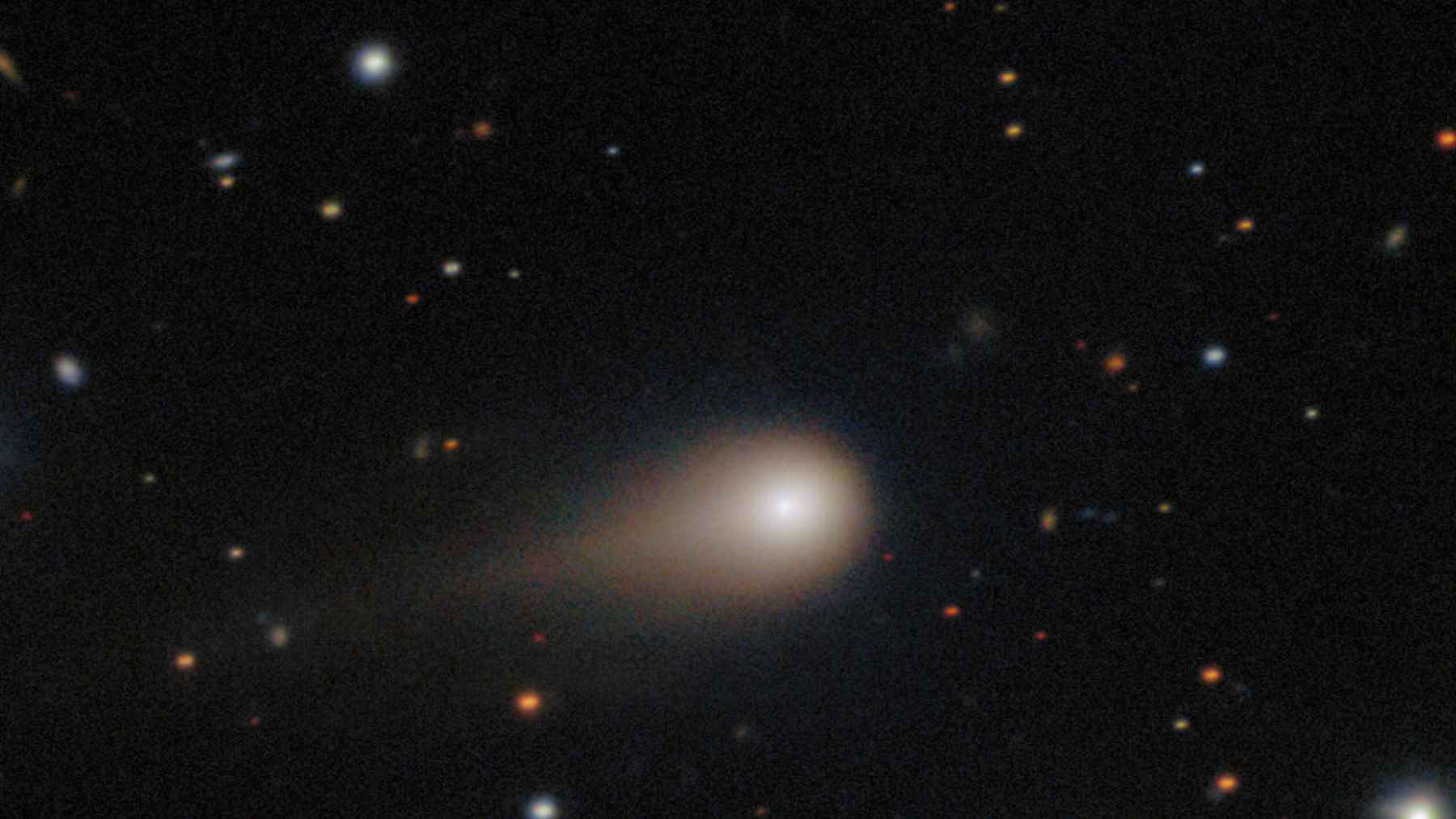
For now, interstellar travel still lives in science fiction and in the long to-do lists of space agencies. Yet a fast moving visitor cutting across our solar system is forcing scientists to think in a very different way.
What if advanced civilizations do not always build shiny starships from scratch, but occasionally treat certain comets as ready-made vehicles and simply ride along?
That idea is now being taken seriously in discussions about interstellar comet 3I/ATLAS. It is only the third confirmed object from another star system ever seen passing through ours and it is moving much faster than the comets that usually swing past the Sun.
Instead of designing a huge craft and paying every ounce of mass in fuel, a technological civilization could let gravity and chemistry do most of the work and “hijack” an icy body that is already on an escape path between the stars.
A fast visitor that may already carry its own fuel
3I/ATLAS, also cataloged as C/2025 N1, was first spotted on July 1, 2025 by the Asteroid Terrestrial impact Last Alert System survey in Chile. Its orbit is sharply hyperbolic, which means it is not bound to the Sun and will never loop back the way ordinary comets do.
NASA estimates that it will pass just inside the orbit of Mars before arcing back into interstellar space, traveling on the order of 60 kilometers per second relative to the Sun.
That speed is not just impressive on paper. At that pace, an object like 3I/ATLAS can cross the disk of the Milky Way in less than a billion years, brushing past ring after ring of stars that orbit the galactic center. In other words, it naturally follows a route that touches many possible home systems for life.
After its October 29, 2025 perihelion, a hydrogen-sensitive camera on the joint ESA and NASA Solar and Heliospheric Observatory (SOHO) watched the growing cloud of hydrogen around the comet.
A recent analysis of those data, titled “Water Production of Interstellar Comet 3I/ATLAS from SOHO/SWAN Observations after Perihelion,” found that the object released the equivalent of many millions of tons of water over about a month. For a spacecraft engineer, that is more than a pretty halo. It is a giant natural tank of potential rocket propellant.
Turning ice into propulsion
The basic trick is simple in concept. Take water, run electricity through it, and split the molecules into hydrogen and oxygen. Those gases can then be burned together as a powerful chemical rocket fuel.
Harvard astrophysicist Avi Loeb has argued that for a civilization born on a heavy world like Earth, “interstellar hitchhiking” on objects like 3I/ATLAS might, to a large extent, be easier than designing a dedicated starship.
Instead of building a thick pressure hull, a radiation shield, and a huge propellant tank, you tuck your hardware inside the icy body, drill channels, and add engines that tap the onboard water.
In practical terms, that means installing power sources, electrolysis systems, tanks, and thrusters inside the comet. Once in place, the craft could gradually adjust its trajectory. It might tilt the spin axis, shift slightly toward the orbital plane of nearby planets, or trim its path to pass closer to promising star systems many millions of years in the future.
What would give an engineered comet away?
From far away, even a sophisticated vehicle disguised as a comet would probably look natural. The coma would still be made of ordinary gas and dust, and the orbit would still follow the laws of gravity. That is why some researchers talk about “Trojan horse” scenarios, where the only clues hide in fine details.
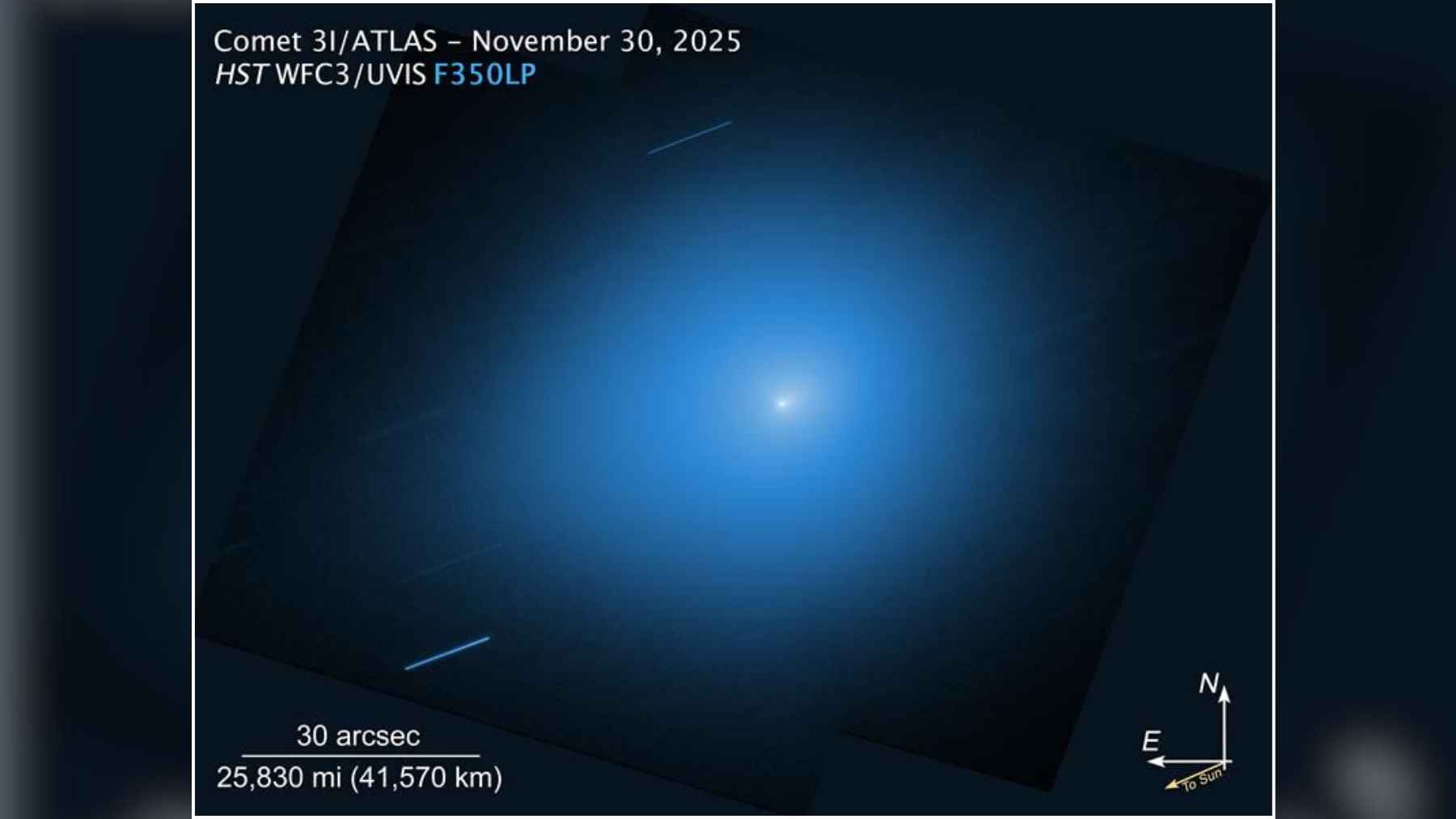
In the case of 3I/ATLAS, Hubble images already show a complex pattern of jets shooting out from its surface.
The NASA ESA Hubble Space Telescope reobserved the comet in late November 2025, revealing a bright central condensation with delicate streaks of material. Loeb and others have noted that some jet configurations appear unusually symmetric, which is the kind of thing engineers like and nature does not always prefer.
So far, though, every anomaly has at least one natural explanation. Radio astronomers with the Breakthrough Listen program used the Green Bank Telescope to scan the object for artificial narrowband signals and reported none, as summarized in their research note “Breakthrough Listen Observations of 3I/ATLAS with the Green Bank Telescope at 1 12 GHz.”
To a large extent, 3I/ATLAS still behaves like a very strange but natural comet.
Why 3I/ATLAS has scientists thinking about our own future
Even if 3I/ATLAS turns out to be entirely natural, it is already changing how scientists think about interstellar travel.
One team led by orbital dynamicist Adam Hibberd has analyzed a mission architecture called a Solar Oberth maneuver in a paper titled “Catching 3I/ATLAS Using a Solar Oberth.” The idea is to launch a probe in the mid-2030s, swing past Jupiter to fall inward, then fire its engines very close to the Sun, where each bit of fuel buys more speed.
That kind of trajectory could let a spacecraft catch 3I/ATLAS several decades after launch, even though the comet will already be on its way out of the solar system. It would not be a quick trip for the crew.
That is why most concepts imagine uncrewed vehicles run by sophisticated artificial intelligence, more like an extremely patient robot explorer than a classic crewed starship.
If you have read about predictions that AI could transform work and enable new kinds of life in space, such as those discussed at Italian Tech Week and elsewhere, ideas like that may sound a little closer to home.
At the same time, human spaceflight is steadily moving outward. Commercial rockets now carry NASA Mars probes on deep space missions, and suborbital operators are already selling a ticket to space to a small group of wealthy passengers.
Compared with a frozen interstellar boulder, those trips barely graze the edge of space, but they show how quickly new transportation habits can form once the hardware exists.
Back on the science side, other recent research, such as work on lunar dust that rewrites the idea of a carbon-poor Moon, reminds us that small samples can upend big assumptions about how planets and moons form.
An interstellar comet like 3I/ATLAS carries that same potential on a galactic scale. It is a chunk of another planetary system passing through our neighborhood for only a short time.
At the end of the day, that is why astronomers are treating 3I/ATLAS as more than a curiosity.
Whether it is a natural time capsule, a test case for future missions, or in the very unlikely case a disguised vehicle, it points toward a future in which our own probes might someday ride similar objects out of the solar system and into the wider Milky Way.
The study on water production in 3I/ATLAS was published in The Astrophysical Journal.