For decades, Hallucigenia has been the poster child for strange life in the ancient seas. Now a new fossil from the famous Burgess Shale suggests that this spiky little worm was not just a visual oddball. It was probably a tiny scavenger gathering around dead jelly-like animals on the seafloor.
The work, led by paleontologist Javier Ortega-Hernández, reexamines a fossil slab that has been sitting in collections since the late 1970s.
The new study, posted as a preprint under the title “Hallucigenia’s diet illuminates the feeding ecology of Cambrian lobopodians,” describes at least seven small Hallucigenia clustered around the remains of a gelatinous creature identified as a comb jelly in the genus Xanioascus.
A feeding frenzy frozen in stone
Hallucigenia lived roughly 505 million years ago in the Cambrian period, when most major animal groups were first appearing in the oceans.
It was only a few centimeters long, with soft stubby legs underneath and tall defensive spines along its back, and is now recognized as a lobopodian relative of modern velvet worms and arthropods.
In the new fossil, the body of a three-and-a-half-centimeter comb jelly lies flattened in the rock, its soft tissues smeared the way you might expect a jelly-rich dessert to collapse on a plate. Scattered across that smear are Hallucigenia spines that belong to several individuals.
Ortega Hernández and his colleagues interpret this as a brief moment on the seafloor when a dead ctenophore sank, then drew in a little swarm of these worms that fed by sucking in bits of the carcass instead of tearing it apart.
Why suction feeding? Hallucigenia lacks sturdy claws or cutting jaws that would be needed to rip tough prey. Earlier work on its anatomy already hinted that its mouth and throat were better suited to drawing in soft food. A collapsed, jelly-like body is exactly the kind of meal that such a feeder could handle.

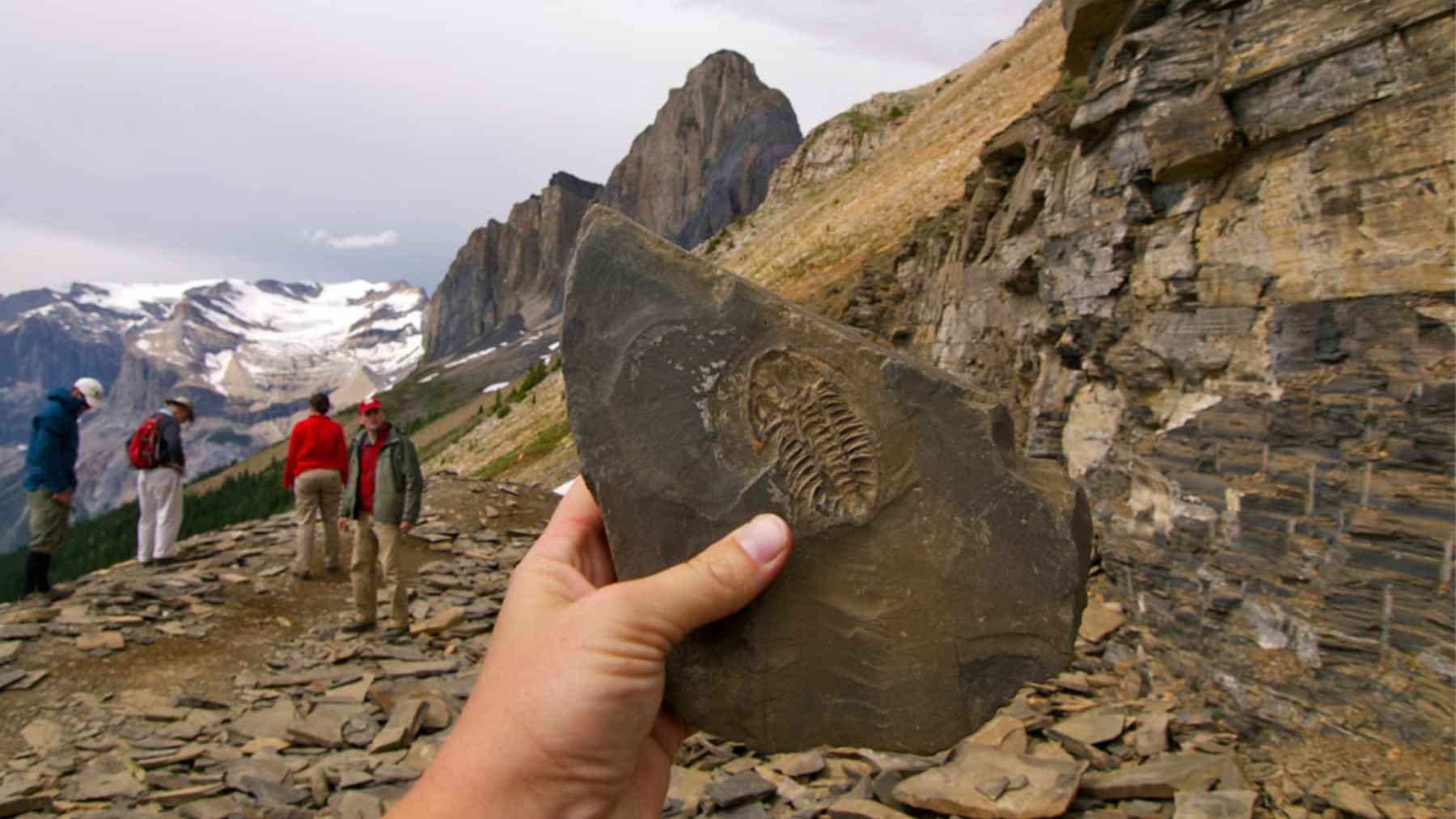
Fossil specimen of Hallucigenia sparsa preserved in rock from the Burgess Shale, one of the most famous Cambrian fossils.
Not everyone is fully convinced
Other paleontologists are intrigued but cautious. The Burgess Shale is famous for mudslides that mixed animals together as they were buried. That means unrelated creatures can end up side by side in the rock.
Experts such as Jean-Bernard Caron have warned that some associations might be geological accidents rather than true behavior, and the new slab could be another example of that.
Paleontologist Allison Daley points out that, if the interpretation holds, this fossil is basically an instant photograph of Cambrian life. A dead jelly falls, small worms gather to feed, and a cloud of sediment locks everything in place. It is the kind of frozen scene researchers dream of finding, because most of the time fossils record bodies, not what those bodies were doing.
Why this tiny meal matters
At first glance, arguing about what a five-centimeter worm ate half a billion years ago might sound like pure trivia. In reality, it speaks to how early seafloor ecosystems worked.
If Hallucigenia and its relatives were active scavengers on soft carcasses, that suggests more complex food webs, with roles that start to resemble those in modern oceans where everything from crabs to deep sea fish clean up fallen animals.
The study also helps demystify an animal that has been treated almost like a hallucination since its original, upside down reconstruction in the 1970s.
Putting Hallucigenia into a more ordinary ecological role, as one small player in a bustling community, makes the Cambrian seas feel a little more familiar. You can almost picture these worms crowding a jelly-rich patch of seafloor the way gulls crowd a dropped snack on a sidewalk.
There is still debate, and the work awaits formal peer review, but to a large extent it shows how much information can hide in museum drawers for decades. A single slab, reexamined with fresh questions, can turn a famous fossil from a mere oddity into a real animal with a place at the table.
The study was published on bioRxiv.