Oil markets have a way of reminding everyone who is still vulnerable. When traffic through the Strait of Hormuz gets restricted,fuel prices can swing fast, and the ripple shows up in everything from shipping costs to the monthly energy bill.
About 20% of the world’s seaborne oil trade moves through that narrow passage, which is why even a distant disruption can rattle businesses far away.
Against that backdrop, the U.K. has switched on something very different in Cornwall. GEL Energy says it is now delivering the country’s first geothermal electricity around the clock from its United Downs site, with Octopus Energy buying at least 3 megawatts of constant power, enough for roughly 10,000 homes.
In the same project, GEL says it has begun commercial-scale production of lithium carbonate from the geothermal fluid, aiming to turn a power plant into a strategic minerals play at the same time.
Energy security gets real
Energy security is not just a policy phrase when tankers get delayed and supply routes become bargaining chips. Reuters reported that Iran communicated it would allow passage for “non-hostile” vessels coordinated with Iranian authorities, a reminder of how quickly normal commercial shipping can become conditional.
For import-dependent economies, that kind of uncertainty is a loud signal to diversify, even if the short-term headlines fade.
That is where geothermal gets interesting, especially for electricity grids that need steady power at all hours. The International Energy Agency says global geothermal plants average a utilization rate above 75%, compared with under 30% for wind and under 15% for solar PV.
In practical terms, that means geothermal can keep producing when the weather changes or when demand spikes on a hot night and air conditioners stay on.
Still, geothermal remains a small slice of global power. IRENA puts total installed geothermal electricity capacity at 15.4 gigawatts worldwide by the end of 2024, with only about 0.4 gigawatts added that year. The promise is reliability, but the challenge has always been scaling it affordably and fast enough to matter.
A power plant beneath Cornwall
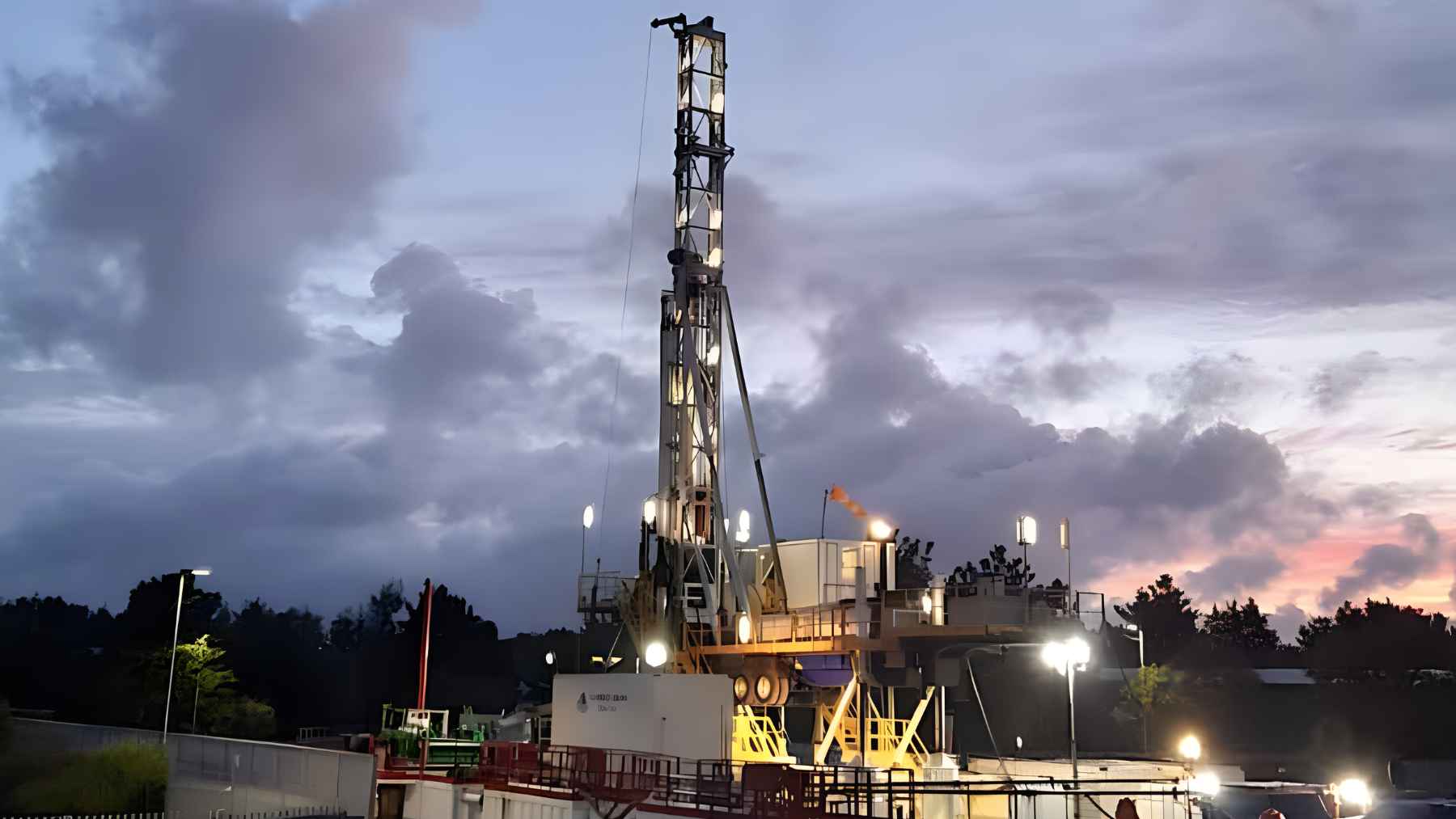
United Downs is not shallow drilling or a simple retrofit. GEL says the geothermal fluid comes from the deepest well ever drilled on U.K. soil, more than 5 kilometers down (about 3.1 miles). That depth matters because you need serious heat to make electricity, not just warm water for heating.
According to the company, the water coming up exceeds 190°C (374°F), which it describes as the hottest recorded in the U.K. The system generates power 24/7 regardless of wind speeds or cloud cover, and then reinjects the fluid underground in a closed loop after it has been used at the surface.
If you like simple comparisons, think of it as running a constantly refilled kettle, except the heat source is the Earth itself.
The first-stage output is not massive, but it is meaningful as a proof point. Octopus Energy has a long-term deal to purchase at least 3 megawatts of constant power, which GEL says is enough for around 10,000 homes. For the U.K. grid, 3 megawatts is a small block, but as a “firm” renewable source it plays a different role than intermittent generation.
Lithium in the water
The twist is that the hot water is not just hot. GEL says the geothermal fluid contains more than 340 parts per million of lithium carbonate equivalent, and the company claims this ranks among the highest lithium concentrations globally. Instead of treating that as waste chemistry, the project is designed to pull value out of it.
GEL says it has started commercial-scale production of “zero-carbon” lithium carbonate, beginning with capacity of 100 metric tons per year (about 220,000 pounds annually). The company’s longer-term target is more than 18,000 metric tons per year (about 39.7 million pounds annually) over the next decade, which it says would be enough for roughly 250,000 EV batteries a year.
It also argues that domestic lithium supports the U.K. automotive sector and supply chain rules tied to battery sourcing, though that will ultimately depend on how the material is certified and integrated into real manufacturing contracts.
The bigger market context helps explain why companies are chasing lithium wherever they can find it. The IEA says lithium demand rose by nearly 30% in 2024, driven largely by energy technologies like EVs and battery storage.
The USGS estimates worldwide lithium production in 2025 rose to about 290,000 metric tons (roughly 320,000 short tons), with global consumption around 263,000 metric tons (about 290,000 short tons).
A new kind of energy project
This is what makes United Downs feel like more than a local power story. The IEA’s Global EV Outlook notes that battery demand in the energy sector hit 1 terawatt-hour in 2024, with EV batteries alone rising to over 950 gigawatt-hours.
That is a staggering industrial pull, and it helps explain why “where do the minerals come from” is now a boardroom question, not just a mining conference topic.
Europe has been blunt about the dependency problem. A European Commission factsheet says the EU produces less than 0.1% of global lithium mine production and expects lithium demand to reach 58,000 metric tons per year by 2030 (about 64,000 short tons).
The U.K. is no longer in the EU, but its battery supply chain still operates in the same regional reality, competing for feedstock in a tight and politicized market.
Stacking electricity revenue with minerals revenue is also a business strategy, not just a climate talking point. GEL explicitly argues that collocating power generation and lithium extraction “maximizes investment in the wells,” because the expensive part is drilling deep and proving the resource.
If that approach works at scale, it could change how investors look at geothermal, shifting it from “nice but niche” to “bankable infrastructure with multiple products.”
The hard parts still matter
None of this removes the classic geothermal hurdles. GEL says it has two other deep geothermal sites under development in Cornwall that it expects will add a further 10 megawatts of base-load geothermal power by 2030, which hints at the pace the company believes is realistic.
It also cites a British Geological Survey calculation that more than 200 gigawatts of thermal heat could be available from onshore geothermal sources, but turning theoretical heat into reliable grid power is the part that tends to separate bold projections from real-world rollouts.
Then there is the issue people actually worry about when drilling goes deep, namely ground movement. GEL says geothermal testing and development in Cornwall can cause minor induced seismicity, and it points to a maximum magnitude of 1.7 (local magnitude) during injection testing at United Downs.
The company also says it uses seismic monitoring and conservative operating limits, and that once the plant is in normal operation it is “extremely unlikely” any seismicity would be felt.
The economics are another gate. The IEA argues geothermal can scale if costs fall and policies help reduce early drilling risk, and it notes geothermal projects overlap heavily with oil and gas drilling skills and supply chains.
That overlap is a double-edged sword because it can speed learning, but it also means geothermal has to compete for rigs, crews, and capital with industries that still pay very well.
What comes next
If United Downs holds up technically and commercially, the next question is replication. Cornwall’s geology is unusually favorable, and GEL’s near-term pipeline is still concentrated there, so “copy and paste” across the U.K. is not guaranteed.
But as energy security concerns collide with battery supply chain pressure, the logic behind projects that deliver firm power and critical minerals from the same wells is getting harder to ignore.
Zoom out, and the timing is hard to miss. IRENA’s data shows geothermal is growing slowly compared with solar and wind, yet the IEA argues next-generation geothermal could become a major source of dispatchable low-emissions electricity if costs drop and deployment ramps up.
In other words, the resource is there, and the demand for always-on power is rising, but the industry still has to prove it can build quickly without blowing budgets.
At the end of the day, United Downs is a small power plant with a big strategic message. It is a reminder that “energy transition” is increasingly about resilience, supply chains, and what you can produce at home when the world gets messy.
The press release was published on GEL Energy.