Florida heat has a way of turning everyday comfort into a math problem. The sun is blasting at noon, your solar panels are happiest then, and yet the strongest demand for cooling often shows up later, right when generation fades and the electric bill starts feeling personal.
That timing mismatch is exactly what a Florida hobbyist tried to solve with a homebuilt system that freezes water during the day and uses the ice later as stored cooling.
Reports say the prototype can deliver up to about 700 watts of cooling (roughly 2,400 BTU per hour) without relying on the grid in the moment. It is a small experiment, but it points at a bigger idea that utilities and regulators are taking seriously. Store cold, not just electricity.
A fridge that runs on sunshine
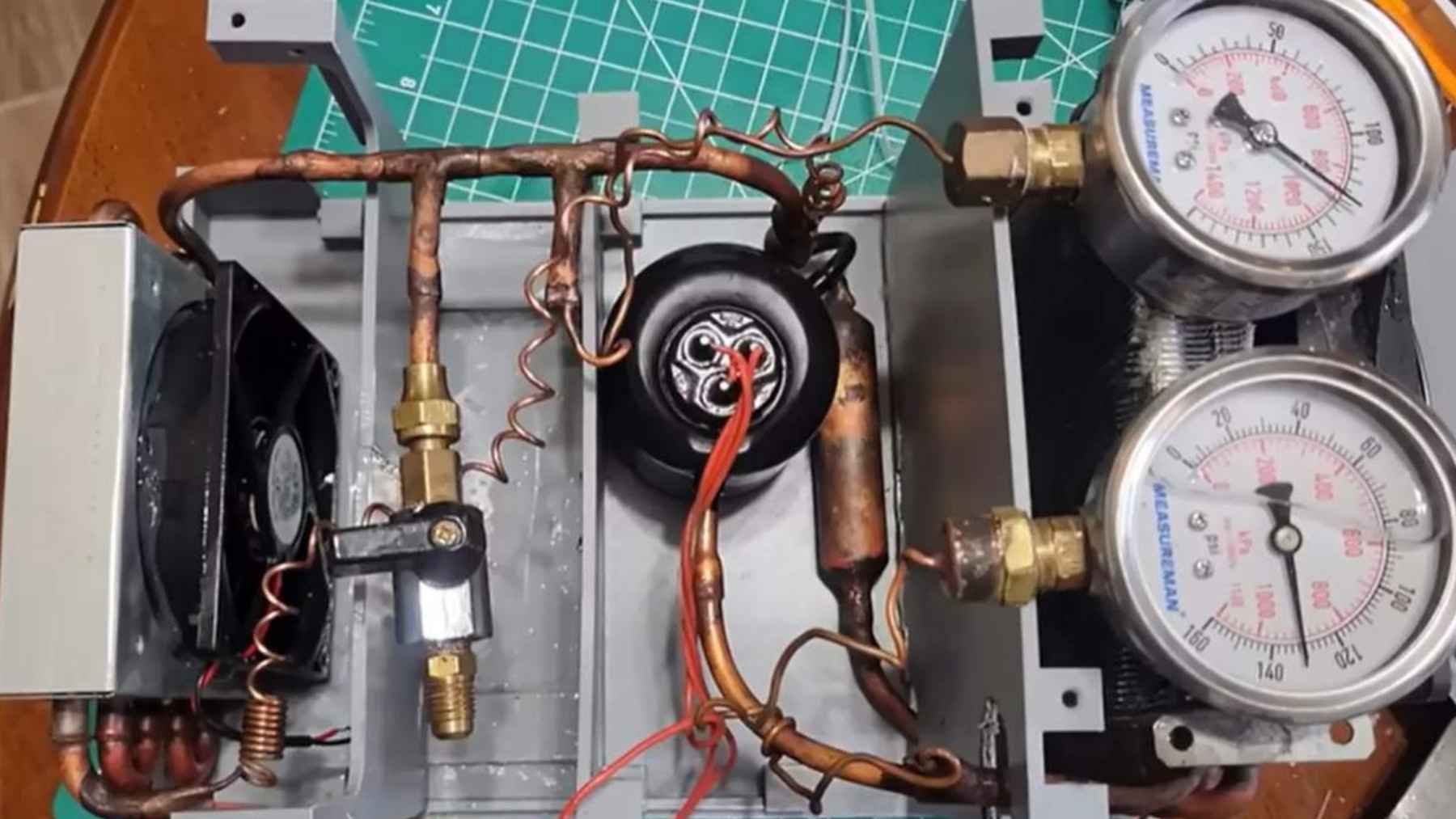
The concept is straightforward in a way that feels almost old-school. Solar panels charge a small battery, an inverter powers a compact compressor, and the compressor chills an insulated container until a few gallons of water become a block of ice.
Later, a separate loop pulls that cold back out using a pump and a coil embedded in the ice. A fan blows air across a small radiator, sending the chill into a tight space like a vehicle cabin, a small room, or a well-insulated shed. No magic tricks, just basic refrigeration paired with a thermal “bank account.”
In one widely shared description, the build used three 100-watt solar panels, a 35-amp hour battery, about 2 gallons of water for the ice reservoir, and roughly 20 feet of copper tubing in the secondary loop. That level of detail matters because it shows the core claim is not “free cooling,” it is “cooling shifted to a different time.”
Why store cold instead of electricity?
Here is the simple question that makes this interesting. If the end goal is cooling, why store electricity first and then convert it into cooling later, especially when the sun is already available during the hours you would prefer to do the energy-intensive work?
Water’s phase change does a lot of heavy lifting. Freezing water locks up energy as latent heat, which is why ice can act like a “thermal battery” in the first place. In practical terms, the reported storage figure of 2.5 megajoules converts to about 0.7 kilowatt-hours of cooling energy, or around 2,400 BTU stored in that ice block.
This is also not a brand-new category. ASHRAE has documented how modern thermal energy storage systems evolved with a clear purpose, which is to reduce peak demand, and ice tanks have been part of that story for decades in larger facilities.
The real value is peak shaving
The strongest argument for “ice batteries” is not that they beat today’s air conditioners on raw performance. It is that they move load away from the hours when grids are most stressed.
The International Energy Agency has been blunt about how fast cooling demand is rising. It notes that air conditioners and fans represent about 10% of global electricity consumption, and space cooling demand has been climbing for decades.
When heat hits, the grid feels it immediately. In an IEA commentary about early summer heat waves in 2025, France saw an evening electricity peak about 25% above the off-season average, and New York saw a peak about 90% higher. That kind of spike is why utilities care about flexibility as much as they care about generation.
The numbers look small but the logic scales
At first glance, “about 2,400 BTU stored as ice” sounds modest – because it is. At a cooling output of around 2,400 BTU per hour, that stored cold is roughly an hour of full-output cooling before the ice is mostly spent, and real-world losses can shorten that.
But scaling changes the conversation quickly. One key reference point used in coverage of the build is that about 35 cubic feet of ice (roughly 1 cubic meter) stores around 93 kilowatt-hours of cooling energy, which is in the ballpark of a large home battery’s electrical storage, just in a different form. The catch is obvious, though. That is a lot of ice, and it has to live somewhere.
This is where the idea starts to look less like a gadget and more like a systems design choice. Commercial buildings have long used chilled water tanks and ice storage to shift load, and the “new” part today is better controls, better integration with heat pumps, and a stronger business case when solar and time-based rates are part of everyday life.
Limits that DIY videos do not solve
There are several reasons this stays a prototype until engineering firms get involved. Weight is the most obvious. Ice is heavy – plus you are carrying pumps, coils, a compressor, and a battery, so “portable” starts to mean “portable with effort.”
Humidity is another practical issue that many people only notice after they try to cool a damp space. A chunk of early cooling power can go into wringing moisture out of the air, which is why a room can feel clammy before it feels cool. The Florida build reportedly ran into the same physics that every air conditioner deals with.
Then there is safety. In the version described by multiple outlets, the system used R600 (n-butane) as the refrigerant, which is flammable and not something you want leaking inside an improvised enclosure.
That is also why regulations matter, because governments are tightening standards around refrigerants and leakage, including the European Union’s F-gas Regulation (EU) 2024/573, which began applying in March 2024.
What to watch next
The most important signal is that official institutions are pushing in this direction, even if the hardware will not look like a DIY bucket of ice. The U.S. Department of Energy has highlighted work on integrating ice and other phase-change thermal storage into HVAC systems so they can charge during low-demand periods and discharge during high-demand periods.
It even puts numbers on the business case, estimating added system costs on the order of $800 to $2,500 and suggesting a payback as low as two to four years in the right rate structures.
This matters because the grid is increasingly juggling multiple pressures at once. The IEA’s World Energy Outlook 2025 executive summary points out that battery storage is growing fast, with additions rising above 75 gigawatts in 2024, but also stresses that cooling demand and peak impacts are climbing in parallel.
Thermal storage is not a replacement for batteries, but it can be a cheaper, more direct tool when the only thing you need to store is cooling.
So the Florida prototype should be read for what it is, which is a proof of concept that makes a policy and market trend feel tangible. A little ice, a little insulation, and a reminder that sometimes the simplest “battery” is the one you can make with water and timing.
The official executive summary was published on the IEA.