If you walked through Philadelphia International Airport on March 24, 2026, you could have been forgiven for thinking you had stepped into a food festival.
In the connector between Terminals B and C, volunteers lined up 1,291 cheesesteaks in a continuous row that stretched about 1,200 feet, just under a quarter mile, to claim a Guinness World Records title for the “Longest Line of Cheesesteaks.”
Then came the part that turned a quirky stunt into a sharper story about operations, budgets, and security.
After Guinness certified the attempt, the sandwiches were handed out to travelers and airport workers, including Transportation Security Administration officers working without pay during the government shutdown, according to multiple reports. What happens to airport security when the people doing the work are not getting paid?
A record built for more than bragging rights
Guinness adjudicator Michael Empric was on site to confirm the line met the rules, including the requirement that each sandwich touch the next so the row is truly continuous. He told CBS that what stood out was how “specific to the Philadelphia community” the attempt was, and that donating so many cheesesteaks to TSA had “community spirit” written all over it.
Organizers said the 1,291-sandwich line cleared Guinness’ benchmark of 500 sandwiches by a wide margin. That detail matters because it shows this was not a casual photo op – it was a carefully planned production that had to clear a documented standard.
There was also a practical constraint in the background. Empric noted that Guinness rules require food used in record attempts to be eaten or donated, which is why the cheesesteaks did not end up in the trash.
The hidden supply chain in a terminal walkway
From a business angle, the event reads like a compact lesson in airport logistics. PHL’s own newsroom and a concessions press release describe months of coordination across PHL Food & Shops, MarketPlace PHL, and the City of Philadelphia Department of Aviation to pull it off.
The ingredient list hints at the complexity. The line used about 990 pounds of shaved ribeye, roughly 225 pounds of cheese sauce, and more than 1,200 foot-long rolls, while local suppliers provided key components such as Amoroso’s rolls, Cooper Sharp cheese sauce, and beef from Philly’s Best Steak.
And it all happened inside an active airport. More than 100 employees and volunteers assembled the sandwiches in about an hour, turning a normal passenger corridor into a temporary production line where timing, food handling, and crowd control had to be right.
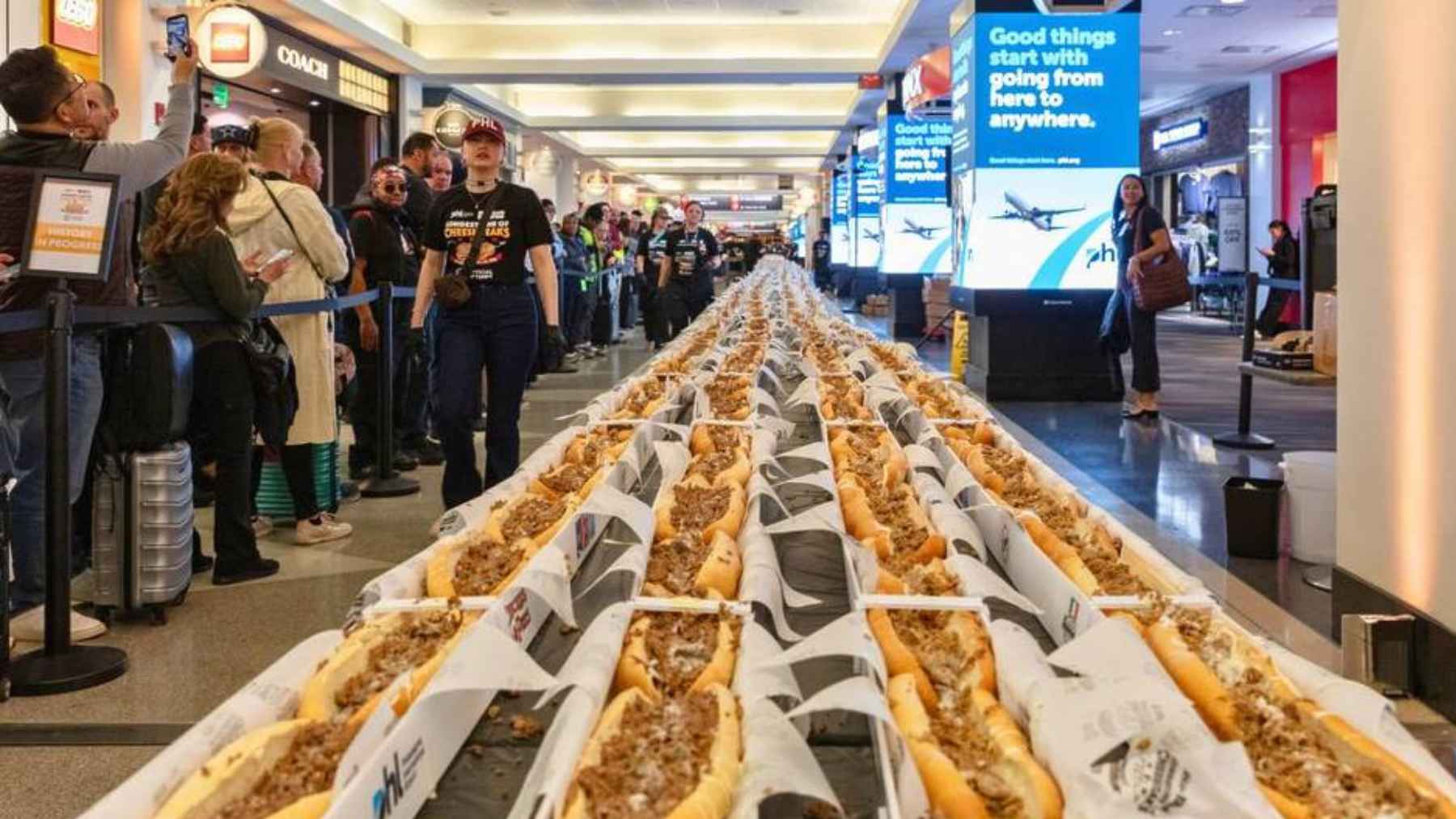
A continuous line of cheesesteaks stretches through a Philadelphia International Airport terminal during a Guinness World Record attempt.
Why TSA pay problems hit travelers fast
At first glance, donating sandwiches to TSA might look like a nice gesture aimed at good headlines. But it also points at a structural issue that can be felt by anyone who has watched the security line creep forward while your phone buzzes with boarding updates.
Both the Associated Press and Guinness noted that TSA officers were working without pay during the shutdown. When that happens, the risk is not just personal financial stress, it is also staffing strain that can translate into longer waits and more pressure on the people screening passengers.
Airports can add kiosks and update signage, but security screening is still labor-intensive. In practical terms, that means the checkpoint depends on a workforce that shows up, stays focused, and has enough support to keep the line moving.
A marketing push timed to a big travel year
PHL officials were not shy about the branding upside. Dana Krawchuk, the airport’s marketing and guest experience manager, told CBS that the airport has more cheesesteaks “under one roof” than any other single location in the city, and that “the airport is really the entry point” for visitors.
The airport also framed the record as a kickoff to what it expects to be a banner travel year for Philadelphia. In its newsroom statement, PHL pointed to major events scheduled for 2026, including the MLB All Star Game, FIFA World Cup 26, NCAA Men’s March Madness, and the PGA Championship, alongside the U.S. Semiquincentennial.
This is where the story becomes more than local pride. Airports compete for routes, travelers, and concession dollars, and viral moments can help shape perception, especially when the broader travel narrative is dominated by delays, staffing headaches, and political fights.
What this stunt reveals about critical infrastructure
There is an almost ironic neatness to the setting. The “Longest Line of Cheesesteaks” was built in the same building where the most important line often forms, the one that leads to security screening.
That contrast is the real editorial takeaway. In a high-volume transportation hub, public security functions and private business operations are intertwined, and the seams show quickly when federal pay and staffing are disrupted.
So yes, it was a celebration of a city’s signature sandwich. But it was also an on-the-ground reminder that “homeland security” is not an abstract phrase – it is the people scanning bags and checking IDs, even when their own paychecks are uncertain.
The lesson for other airports and travelers
For other airports, the playbook is clear. If you want a feel-good moment that actually lands, tie it to local identity, involve local suppliers, and build in a plan to avoid waste by donating what you make.
Still, a food line cannot fix a funding line. If pay interruptions become a recurring feature, morale and retention will likely take a hit, and travelers will feel it in the most immediate way possible, the wait.
In the meantime, Philadelphia’s record shows what a well-coordinated public-private partnership can do in a tight space and on a tight clock.
The official statement was published on Guinness World Records.