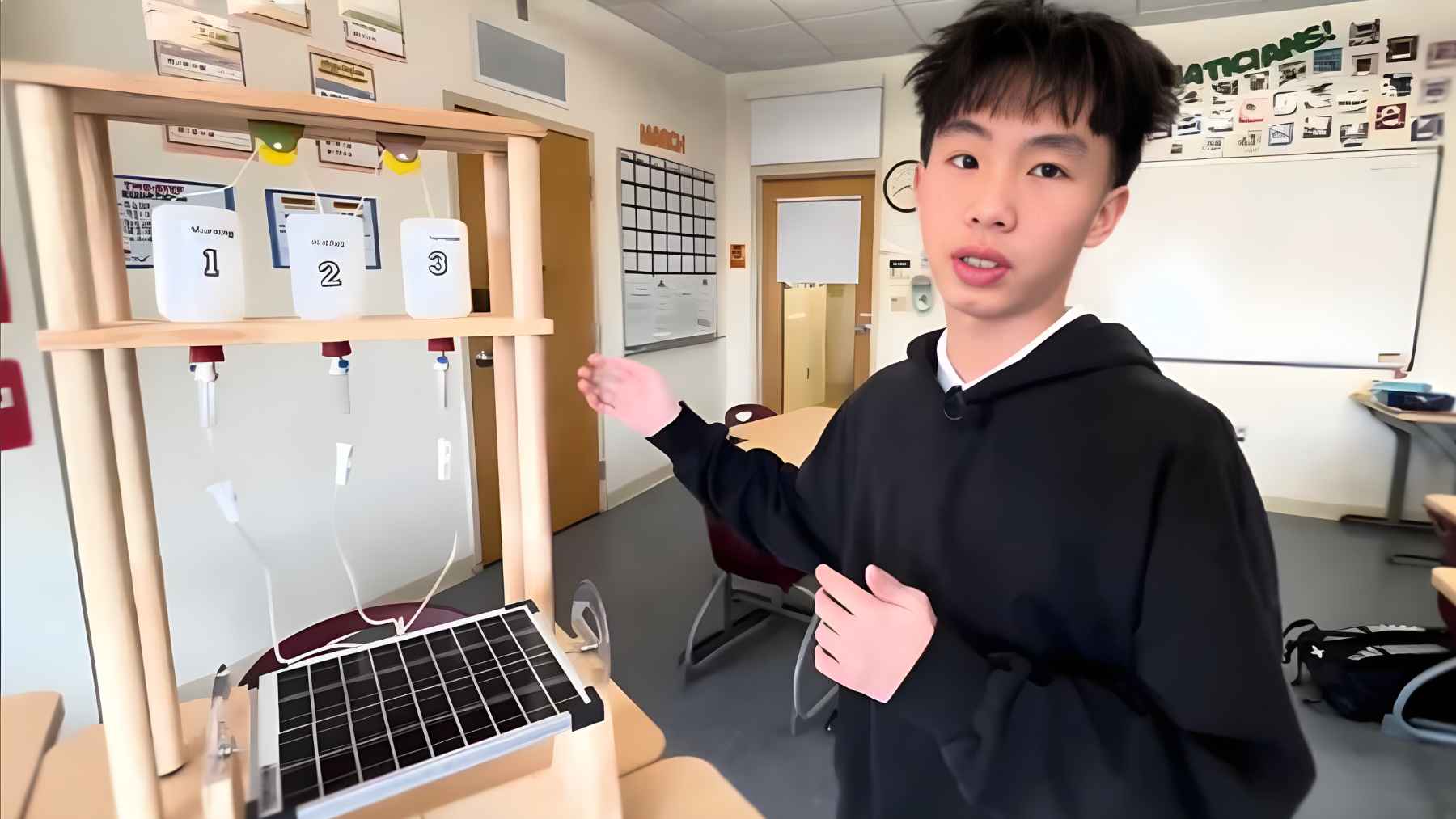
A seventh grader in Worcester, Massachusetts, has turned a family nuisance into a working piece of clean energy hardware. Jason Chang, 13, built what he calls an “eco-efficient solar tracking system” for less than $25, using recycled materials and a simple physics trick that avoids motors, sensors, and even electricity.
That low-tech approach is exactly why the project is getting attention. Chang’s prototype posted about 20% higher voltage than a standard fixed panel in outdoor comparisons, and it helped earn him a spot as one of 55 “National STEM Champions” who will head to Washington, D.C. to present their work.
A tracker that runs on gravity
Chang’s invention is, at its core, a solar panel mount that tilts through the day to keep facing the sun. Instead of using powered actuators, it shifts weight using water moving between containers on a seesaw-like structure, guided by what he described as a carefully-timed fluid control frame.
The origin story is almost too relatable. Chang told CBS Boston that he got tired of being asked to go outside and reposition the family’s solar holiday decorations, and wondered if he could “fix this problem.”
He has been refining the build for more than a year and documenting the process in detail, including what did not work the first time. The most difficult piece, he said, was getting the fluid control frame precise enough that the panel moves correctly as the day progresses.
Why that 20% gain turns heads
Most solar panels are installed at a fixed angle, which means they do not always catch sunlight at the best orientation. Tracking systems solve that by keeping panels aimed closer to the sun’s path, and in many locations that translates into a meaningful bump in production.
The U.S. Energy Information Administration has pointed to National Renewable Energy Laboratory PVWatts estimates showing that, for a 10-kilowatt system in Los Angeles, a single-axis tracker can produce about 21% more electricity than a fixed-tilt system, while a dual-axis tracker can produce about 31% more.
One important nuance, though, is measurement. Chang’s test result was described as about 20% more voltage, and voltage alone is not the same as energy produced over a day (watt-hours), since energy depends on both voltage and current over time. Still, the direction of the result matches what the broader solar industry already knows about tracking when it is implemented well.
The business context is bigger than a classroom project
In utility-scale solar, trackers are not some exotic add-on anymore. Reuters reported that single-axis tracking dominated new U.S. utility-scale PV builds in 2022, citing Lawrence Berkeley National Laboratory data showing that 94% of new utility-scale PV capacity added that year used single-axis tracking.
So why should anyone care about a homemade, water-driven tracker when industrial trackers already exist? Because the mainstream products that dominate large solar farms are engineered for grid-scale sites with maintenance crews, spare parts, and predictable operating conditions, not necessarily for places where a broken motor or sensor can sideline an entire system for months.
That’s where Chang’s approach has an interesting potential niche. A tracker that needs no electronics to track, and is built from simple components, aims at a different customer profile: the off-grid user who cares less about optimization software and more about keeping the lights on.
Off-grid power is where simplicity can be a feature
Chang told CBS Boston he hopes the design can help “people around the world” generate more electricity, arguing that the low cost means it could be made in many places. CBS Boston also noted the concept could be useful in off-grid communities, developing regions, or disaster zones where electricity is limited or unavailable.
In practical terms, that means the use cases are not just about lowering an electric bill. They are also about keeping phones charged after a storm, powering a radio when the grid is down, or running a small medical refrigerator when supply chains are strained.
The catch is that low-tech does not automatically mean rugged. Chang has already identified one real-world limitation: water can freeze in cold temperatures, and he is working on a year-round version that can operate in winter conditions.
Military and defense planners think about the same problem
Energy resilience is not only a civilian concern. The U.S. Department of Defense has described itself as “the largest consumer of energy in the federal government,” and officials have tied cleaner and more resilient power to operational needs.
Fuel logistics is part of that story. The Government Accountability Office reported that DoD is the U.S. government’s largest purchaser and consumer of bulk fuel, with expenditures totaling $10.3 billion in fiscal year 2022.
That is why military analysts keep coming back to microgrids and local generation, including renewables, as a way to reduce dependence on vulnerable supply lines and to keep critical systems operating when the broader grid fails, a point underscored in an HDIAC overview of deployable power and survivability.
Washington is the next step, and the real test comes after
Chang’s recognition is not just local praise. A March 25, 2026 announcement said 55 students were named 2026 National STEM Champions and will be recognized at the National STEM Festival in Washington, D.C., scheduled for June 24 through June 27, including a public “Build Day” expo on June 27.
The same announcement said each Champion and a guardian receive an expense-paid trip, and it described the program as highly selective, citing an acceptance rate of less than 5%.
For Chang personally, the throughline is clear. He told CBS Boston he wants to become an entrepreneur and “create products” that make life easier – the kind of ambition that often fades after the applause dies down, unless it is paired with testing, iteration, and the boring work of engineering for the real world.
At the end of the day, this story is less about a magic gadget and more about mindset.
The press release was published on PR Newswire.