What if the next big data center is not built off a highway exit, but tucked inside a wind turbine out at sea? That is the bet behind Aikido Technologies, a U.S. offshore developer that says it is building a floating wind platform that can host “AI-grade” data halls alongside the power system.
Aikido says its first proof-of-concept unit is planned for deployment off Norway in the North Sea later in 2026, with a larger commercial project targeted for the United Kingdom in 2028. The idea sounds futuristic, but the motivation is immediate, as AI demand is running into limits on land, power, cooling, and public patience.
Why compute is chasing power
Data centers already account for a meaningful slice of the world’s electricity use, and AI is making the curve steeper. The European Commission cites International Energy Agency figures that put global data center consumption around 415 terawatt-hours in 2024, or about 1.5% of total electricity, with projections that it could more than double to roughly 945 terawatt-hours by 2030.
That growth is not just an abstract graph. In practical terms, it shows up in local grid queues and the pushback that follows when residents worry about water, land, and what a big new power draw might mean for the electric bill.
Europe is also trying to build more clean power at sea, fast. At a January 2026 North Sea summit, leaders pledged closer cooperation to scale offshore energy, and industry groups committed to invest about $11.2 billion (about €9.5 billion) in supply chains by 2030, based on the euro-dollar reference rate on January 26, 2026.
A wind turbine that doubles as a data center
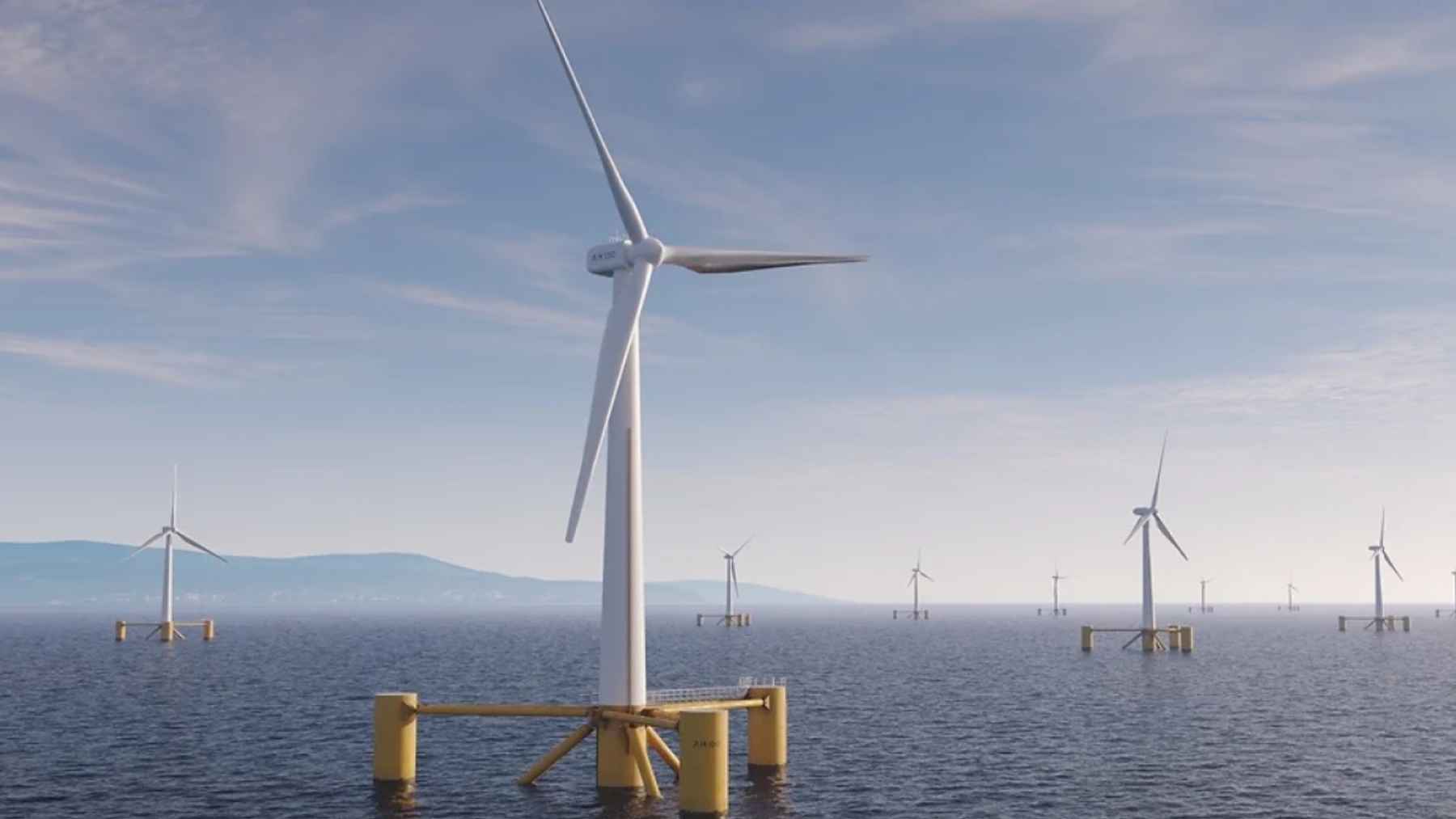
Aikido’s concept, called AO60DC, is built around a semisubmersible floating platform with three ballast columns.
IEEE Spectrum reported that each leg ends in a ballast section about 66 feet deep, and Aikido says the platform pairs a 15-to-18 megawatt wind turbine with 10 to 12 megawatts of computing load plus integrated battery storage.
For now, the company is starting small. Aikido says it is developing a roughly 100-kilowatt demonstration unit off Norway, and its technical materials describe a retrofit in summer 2026 that adds a small wind turbine and a proof-of-concept data center to a deployed platform.
If that 100 kilowatt load ran around the clock, it would use about as much electricity as roughly 80 average U.S. homes.
Cooling is the make-or-break detail, and Aikido is betting the ocean can do most of the work. The company says it will use water in the ballast system to carry heat away from liquid-cooled servers, then transfer that heat through the steel hull into cold seawater, targeting a power usage effectiveness below 1.08 and a thermal impact limited to a few yards around the structure.
Aikido CEO Sam Kanner told IEEE Spectrum, “We have this power from the wind. We have free cooling.”
The hard part is uptime
Wind power fluctuates, while computing customers pay for reliability. Aikido says it plans to use batteries and a grid connection, with the grid used mainly during summer months, so the platform can power the compute load for most operating hours rather than acting as an isolated offshore “island.”
This is why the storage conversation keeps coming up. Reuters has reported that AI-driven electricity demand is helping push investment into longer-duration energy storage, since short bursts of battery backup do not solve multi-hour gaps in supply.
Then there is the network problem. Aikido says its units can be deployed within about 200 miles of major load centers and still stay under 10 milliseconds of round-trip latency, but that depends on robust fiber routes and redundancy, not just proximity on a map.
Germany’s onshore trial shows what breaks first
The idea of “compute inside a turbine” is not new, and Germany has already tested a land-based version. Rittal and WestfalenWIND IT built a three-level data center inside a turbine tower near Paderborn, with infrastructure stacked inside the lower section of the tower at a total height of about 66 feet.
Power supply was the big selling point. Rittal says the windCORES site drew electricity directly from the turbine generator for at least 90% of the year, relying on the public grid the rest of the time and working with two different grid operators to keep quality stable.
Connectivity turned out to be just as critical as kilowatts. The case study says the site used redundant links to the DE-CIX internet hub in Frankfurt, with WestfalenWIND IT emphasizing, “Our infrastructure benefits from very low latency and a high-performance bandwidth.”
It also describes doors too narrow for fully assembled rooms, forcing the team to rethink how equipment was moved and stacked.
Offshore adds salt, motion, and security questions
Moving the data hall offshore raises the difficulty level. Salt-laden air can corrode equipment, floating platforms move, storms limit access, and a repair trip becomes a marine operation, not a quick drive with a spare part.
Aikido argues it can lean on existing offshore wind and oil and gas logistics, saying the units can be installed and serviced with vessels already active in those industries, with multiday staffing possible to meet typical uptime expectations.
The company also says the integrated halls are engineered for a high level of physical security, but those claims will be judged in real maintenance windows. There is also a bigger defense and resilience backdrop that is hard to ignore.
The European Commission announced a “Cable Security Toolbox” in February 2026 and set aside about $409 million (about €347 million) for strategic submarine cable projects, using the euro-dollar reference rate on February 5, 2026, and NATO has separately launched “Baltic Sentry” to strengthen protection of critical undersea infrastructure.
What to watch before this scales
The near-term question is simple. Can the Norway proof-of-concept stay cool, stay connected, and stay serviceable through a real North Sea season, while meeting environmental rules about heat discharge and potential impacts on marine life?
If the answers are yes, the next test is whether customers will sign up for offshore compute at meaningful scale, and whether regulators treat these platforms as energy assets, digital infrastructure, or both.
The press release was published on GlobeNewswire.