Global electric vehicle registrations fell 11% in February 2026 to about 1.1 million, according to data from Benchmark Mineral Intelligence (BMI). The drop was driven by sharp declines in China (down 32% year-over-year to under 500,000) and North America (down 35% to under 90,000), even as Europe and other markets kept growing.
So is the EV story suddenly over? Not really. What the February numbers show is something more familiar, and in some ways more important, for the long run.
EVs are moving from an incentive-fueled sprint into a normal consumer market where buyers compare monthly payments, charging convenience, and even the electric bill before they commit.
A global slowdown that hides a regional split
The headline is down, but the map is messy. Europe saw EV registrations rise 21% in February, while sales in the rest of the world jumped 78% to more than 180,000 vehicles, helped by expansion from Chinese automakers into parts of Asia and Australia.
Zoom out a little and the split gets clearer. BMI’s year-to-date snapshot for January and February puts global EV sales at about 2.2 million units (down 8%), with China down 26% and North America down 36% while Europe is up 21% and the rest of the world is up 84%. That’s not one market, it’s several markets moving at different speeds.
China looks like the whole story because it nearly is
China’s February drop mattered so much because it is still the gravitational center of EV demand. The International Energy Agency has estimated that China accounted for close to 60% of global new electric car registrations in 2023, which means any pullback there shows up quickly in worldwide totals.
BMI and Reuters linked the China slowdown to policy shifts and buyer sensitivity. Funding for auto trade ins was pulled back, and a tax exemption for EV purchases expired at the end of 2025, lifting the effective price right when consumers were already watching costs closely.
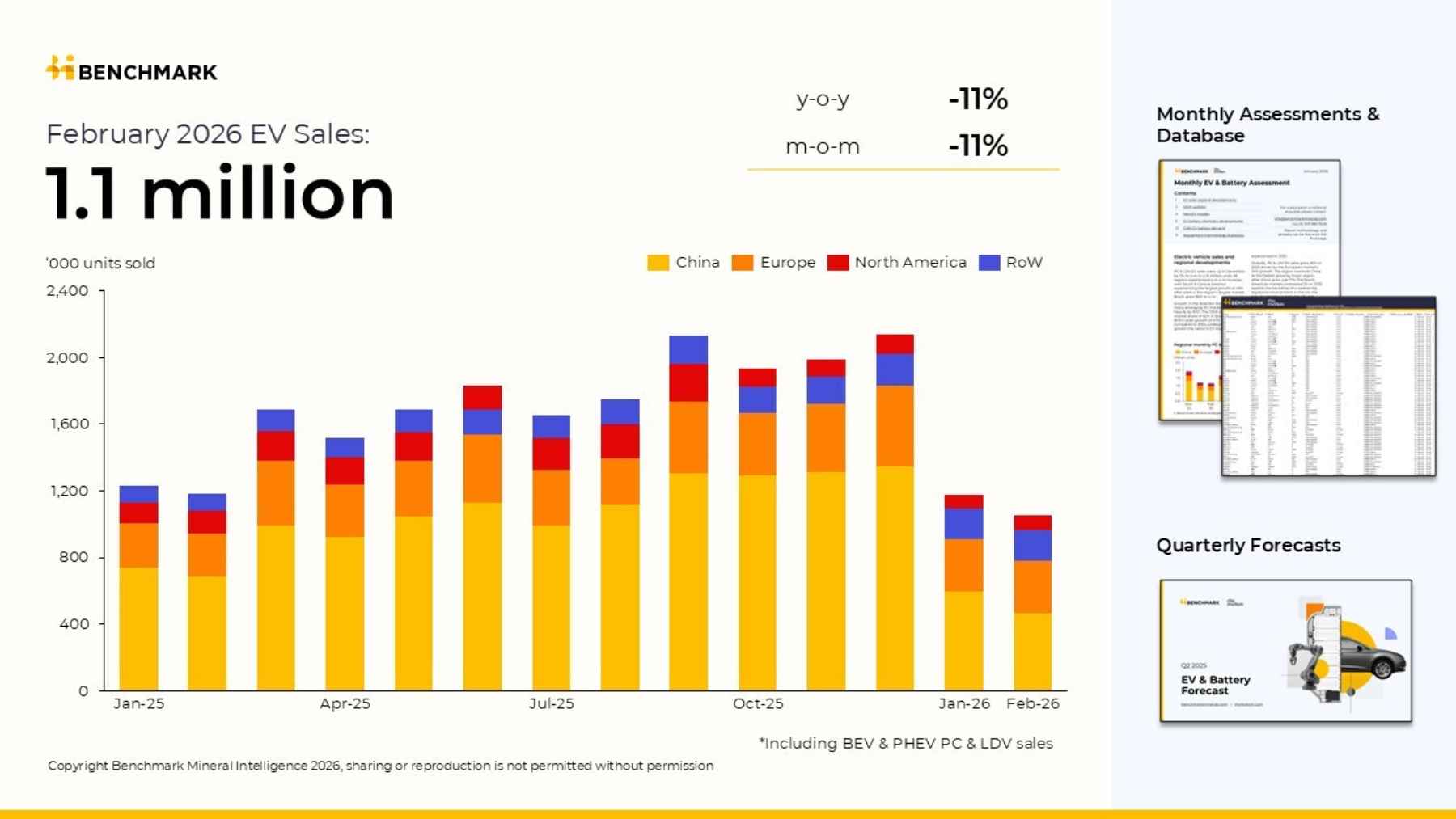
A Benchmark Mineral Intelligence chart highlights the February 2026 drop in global EV sales, led by steep declines in China.
North America is feeling policy uncertainty in real time
North America’s decline is now part of a longer slide, not a one-off. Reuters reported a fifth consecutive monthly drop after a U.S. EV tax credit scheme ended last September, alongside moves by President Donald Trump’s administration to roll back parts of federal emissions policy.
That uncertainty has a dollar figure, and it’s not small. The same Reuters report said Trump’s policies and cooling demand have pushed automakers with heavy U.S. exposure to book more than $70 billion in writedowns, a sign that boardrooms are recalculating timelines and product bets.
Europe keeps growing, but nobody should get complacent
Europe’s 21% increase in February suggests demand is still there when rules and model lineups are stable enough for buyers to plan around.
At the same time, Reuters noted that Europe has also eased back on some emissions targets, which adds another layer of uncertainty for automakers deciding how fast to shift factories and supply chains.
Here’s the practical takeaway. When policy signals wobble, the market tends to favor cheaper options that feel less risky, including plug-in hybrids and other transitional models, because shoppers can still fall back on gasoline when charging is inconvenient.
It’s a reminder that the EV transition is not just engineering, it’s consumer confidence.
What buyers and investors should watch next
First, watch pricing, not just technology announcements. BMI’s data manager Charles Lester said consumers are “very price sensitive,” and that sensitivity gets sharper when subsidies fade and interest rates make car loans feel heavier month to month.
Second, watch where Chinese brands land next. Strong growth outside China in early 2026 lines up with BMI’s view that exports are accelerating even as domestic policy support shifts, which could reshape competition in Southeast Asia, Australia, and parts of Europe.
Third, pay attention to what governments do, not what they say. The February dip is a case study in how quickly demand can react when incentives, tax rules, or emissions standards change, especially in markets where EV adoption is not yet a default choice.
The official statement was published on Benchmark Mineral Intelligence.