What if one coastal device could help with two modern headaches at once? A Chinese-led team has reported a solar-powered “seesaw” extractor that pulls lithium from seawater while also producing desalinated water.
In lab tests, the SPSE raised local lithium concentration 15.5 times, achieved a lithium-to-sodium separation factor above 370,000, and delivered 69% higher lithium uptake over 120 hours than a fully immersed design.
That matters because seawater holds enormous lithium reserves, but the metal is present at only about 0.2 milligrams per liter, while sodium tops 12,000 milligrams per liter.
The business angle is easy to see. The IEA says lithium demand rose nearly 30% in 2024, and global lithium-ion battery deployment in 2025 was six times as high as in 2020, with electric vehicles accounting for more than 70% of total deployment.
In practical terms, that means more pressure on supply chains, more pressure on mines, and often more pressure on water too.
Why this design stands out
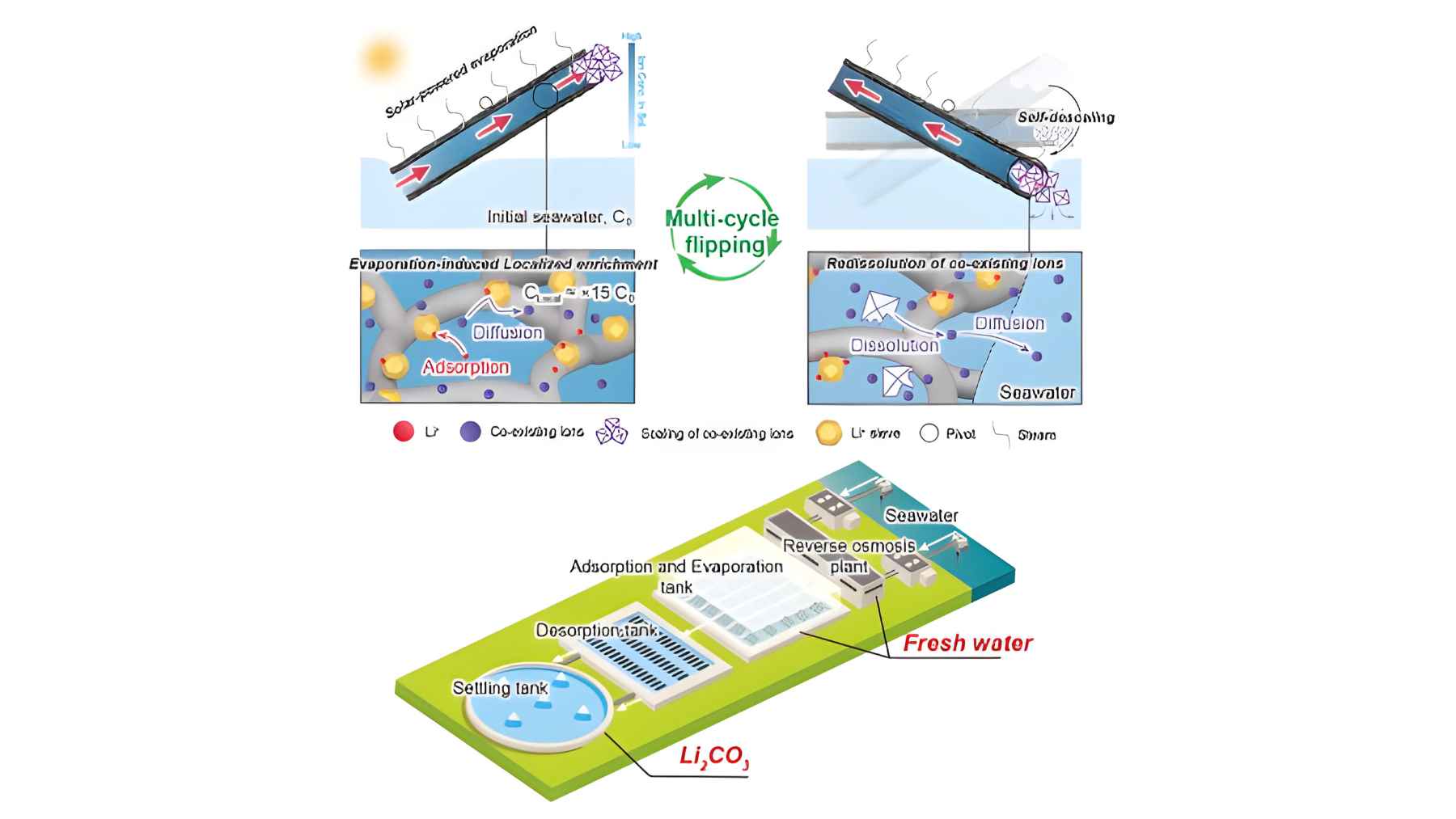
The novelty is not just the chemistry. It is the motion. The extractor starts at a 30-degree tilt and uses sunlight to drive evaporation through a lithium-adsorbing middle layer. As salts build up on the upper edge, the extra weight tips the device like a seesaw, dips the crust back into the water, and clears the surface so the cycle can continue.
If you have ever seen mineral scale build up on a faucet, the challenge is easy to picture. That self-cleaning step is what helps it avoid the clogging problem that has tripped up many other seawater lithium concepts.
There is another reason the study stands out. With further optimization, the team says the process can also yield water that meets drinking-water quality standards. For dry coastal regions, that is not a small detail. It points to a future system that could support battery supply and local water security at the same time.
The catch is scale
Still, nobody should confuse this with commercial production tomorrow. The researchers reported a 21.6% performance drop after 30 cycles, tied to instability in the manganese-based lithium sieve, and they say real seawater chemistry plus pH conditions remain open challenges.
Rice University researcher Shihong Lincalled the concept “very clever” but not “paradigm-shifting” yet because the material still has to be regenerated with acid. So yes, this could matter. But only if the lab trick becomes a durable industrial system.
The study was published in Device.