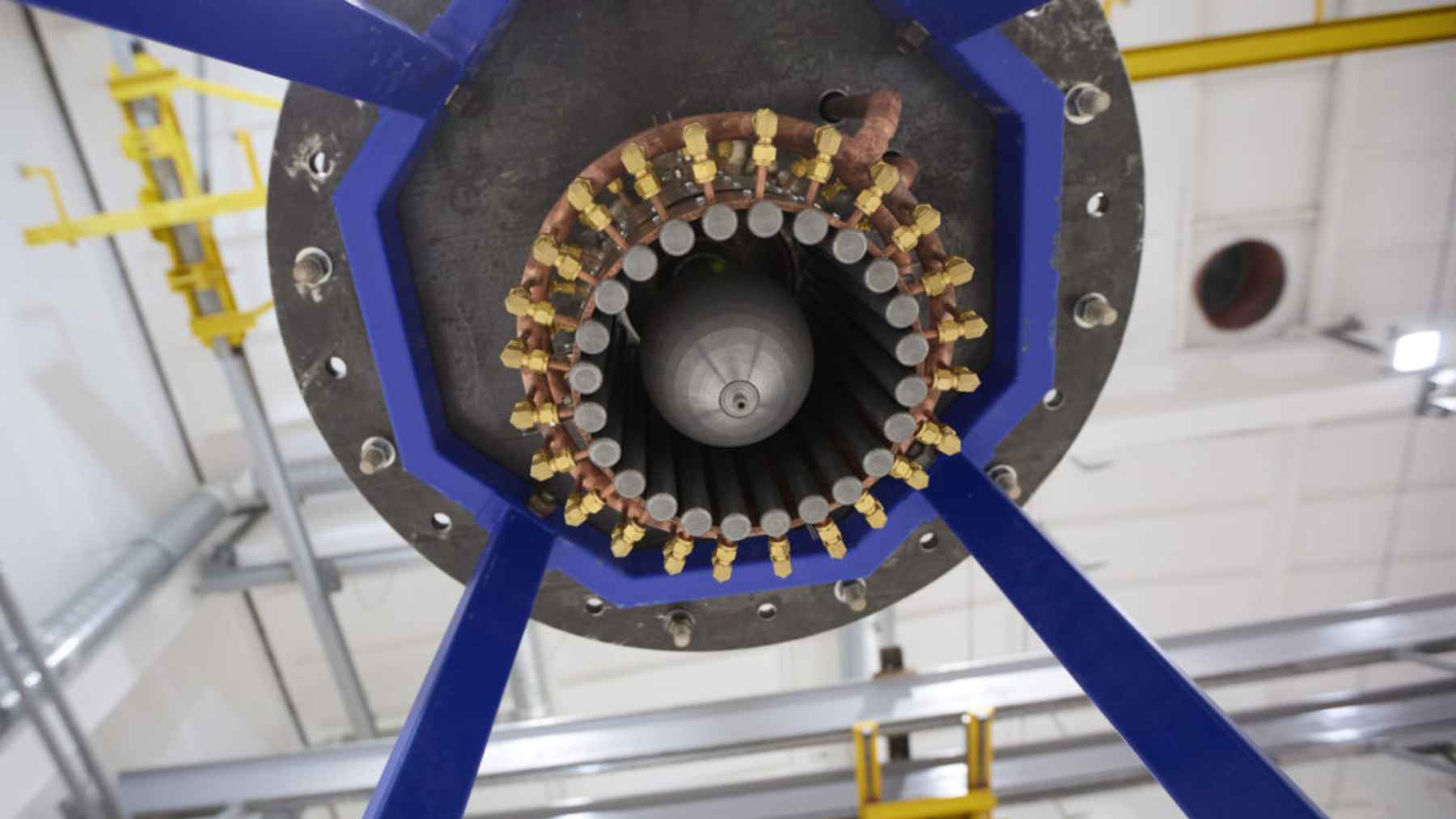
Could a Mars trip really shrink from most of a year to about 60 days? That is the bold claim coming out of Russia’s Troitsk Institute, where Rosatom scientists say they have already built a laboratory prototype of a plasma electric rocket engine for deep-space missions.
The bigger takeaway, though, is more grounded. This is still a lab-stage project, and Rosatom’s own updates say a flight prototype is targeted for 2030, not a launch-ready system today.
How it works
Instead of depending on chemical combustion alone, the concept uses electric and magnetic fields to accelerate ionized hydrogen and generate thrust. By Rosatom’s own figures, the current prototype is rated at 300 kilowatts, aims for a specific impulse of 100 kilometers per second (about 62 miles per second), and is said to operate at better than 80% efficiency.
Scientists at the institute also say they are building a 150-cubic-meter (about 5,300 cubic feet) vacuum chamber for endurance testing, because plasma can wear down engine components over time and reliability will matter just as much as raw speed.
In practical terms, a faster trip to Mars is not just about bragging rights. It could mean less food, less water, and less spare equipment packed at launch, which matters for any crewed mission. It could also reduce the time astronauts spend exposed to deep-space radiation.
NASA says a trip to Mars generally takes 7 to 10 months, and its Mars mission timeline puts a typical cruise phase at about 200 days. NASA also says radiation remains a central concern for human missions to the Red Planet. That is why claims like this get attention so quickly.
What still has to happen
Here is the catch. NASA notes that electric propulsion usually wins on efficiency, not brute force, and often runs for hundreds or thousands of hours with relatively low thrust.
Rosatom says its design could push past that tradeoff, but it also acknowledges that such a spacecraft would need a powerful onboard energy source, likely nuclear, and a long testing road before vibration trials and a flight article become real. Big promise. Early stage. That is the story readers should keep in mind.
The official statement was published in Strana Rosatom.